Always a product on the shelf: Engineering resilience in CPG supply chains

At Hannover Messe 2026, Volker Albrecht, CEO of Siemens Digital Logistics, addressed a challenge that defines today’s consumer packaged goods (CPG) industry: keeping the promise that every product is always available. It sounds simple. In reality, it has become one of the most complex operational challenges companies face.
In a world shaped by geopolitical uncertainty, climate disruption and rapidly shifting consumer demand, product availability is no longer just an operational metric – it is a strategic differentiator. As Albrecht emphasized, the cost of failure is significant. Billions are lost each year due to out-of-stocks, while supply chain disruptions continue to erode profitability over time. The issue is not episodic; it is systemic.
From disruption to control
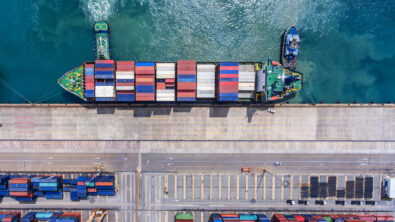
The modern supply chain is no longer a linear process – it is a dynamic, interconnected network. Every node, from raw material sourcing to final delivery, introduces dependencies and potential risks. A single disruption can cascade across continents, ultimately resulting in an empty shelf thousands of kilometers away.
To illustrate this complexity, Albrecht pointed to the global journey of soybeans. From farms in Brazil – the partner country of Hannover Messe in 2026 – to processing facilities and retail shelves worldwide, the path involves multiple transport modes, geographies and stakeholders. Each step introduces variability. Managing this complexity is not simply about logistics – it is about gaining control over an increasingly fragmented system.
This is where connected supply chains become essential. By integrating logistics, production planning and real-time data visibility, companies can shift from reactive problem-solving to proactive orchestration.

Turning visibility into performance
Albrecht highlighted several real-world examples demonstrating how end-to-end transparency translates into measurable business impact.
In the case of PepsiCo, increasing demand for Gatorade created pressure across a complex network of factories, mixing centers and distribution routes. Rather than addressing bottlenecks in isolation, Siemens enabled a holistic view of the entire production network. By leveraging digital twin technology and advanced planning capabilities with Supply Chain Suite from Siemens Digital Logistics, PepsiCo increased production capacity by over 20% while reducing capital expenditure by up to 15%. Planning cycles that once took months were compressed into days.
A similar approach was applied with the Radeberger Gruppe in Germany. By building a digital twin of the supply network based on the Supply Chain Suite, Siemens helped optimize both production and logistics across 11 factories. The result was a double-digit increase in available capacity, alongside improved delivery efficiency and optimized return flows for reusable bottles – demonstrating how transparency enables smarter decision-making across the entire value chain.
For BSH Hausgeräte, the focus was on scalability. Across dozens of factories, a reusable digital model of the logistics network enabled faster scenario analysis, reducing simulation time by more than 50%. This allowed the company to respond more quickly to changing conditions while continuously improving operational efficiency.
Connecting logistics end-to-end
Beyond production, logistics plays a critical role in ensuring product availability. Thanakorn Vegetable Oil Products in Thailand faced challenges with fragmented, manual logistics processes across inbound and outbound operations. By implementing a connected, data-driven approach based on the logistics platform AX4, Siemens helped increase operational efficiency by 15%, reduce freight costs by 25% and improve visibility by 61%.
These results highlight a key principle: visibility alone is not enough. It must be actionable. When logistics, production and planning are connected, companies can make faster, more informed decisions – and execute them with confidence.
From tools to integrated intelligence
A central message of Albrecht’s presentation was that solving today’s supply chain challenges does not require another standalone tool. Instead, it requires the integration of four critical capabilities: network intelligence, real-time execution, production-demand balancing and scenario intelligence.
When these capabilities are combined within a unified environment, powered by artificial intelligence (AI) and digital twin technology, supply chains become adaptive systems. A change in production capacity can automatically propagate across the network. Decisions can be tested virtually before being implemented physically. Complexity is no longer a barrier – it becomes a source of competitive advantage.
Delivering on the shelf promise
Ultimately, the goal is clear: to transform the promise of product availability into a predictable, engineered outcome. Companies that achieve this move beyond firefighting. They gain resilience, agility and the ability to outperform in volatile markets.

As Albrecht concluded, the future of CPG supply chains lies in connected intelligence – an integrated approach that spans the factory floor and the logistics network. In this model, the question is no longer whether disruptions will occur, but how effectively companies can anticipate and respond to them.
Because in today’s environment, having the right product on the shelf is not just an expectation. It is a competitive necessity.