Designcenter | What’s New June 2026 | Ship Structures
We are continuing our journey through the What’s New in Designcenter™ software blog series with highlights from the June 2026 release, this time focusing on Ship Structures.
Modern shipbuilding programs demand more than powerful modeling tools. Engineering teams must manage increasing design complexity while maintaining continuity between design, manufacturing planning, and production output. Designcenter Ship Structure provides a highly productive and collaborative environment for ship structural design, supporting end-to-end workflows across multiple design stages while enabling reuse of design data for downstream production deliverables.
The Designcenter June 2026 release introduces enhancements that improve usability, strengthen model-based production workflows, streamline manufacturing planning, and deliver significant performance gains across commonly used ship design processes.
Penetration management
Penetration management is a critical workflow for coordinating structural and outfitting systems throughout the ship design process. As vessel designs evolve, maintaining consistency between penetration requests and their corresponding structural cutouts can become increasingly challenging.
Designcenter introduces several enhancements that improve the overall penetration management workflow. Cutout depth now adjusts automatically when the thickness of the penetrated plate changes, ensuring that modifications to structural parts remain synchronized with penetration geometry after a penetration request refresh.
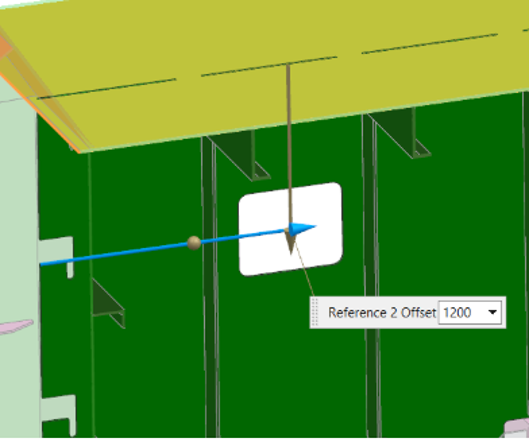
The penetration object solid body is also retained after cutout implementation as a separate component within the penetration assembly, preserving valuable design information throughout the workflow. In addition, cutouts can now be created on revised penetration requests, removing a previous limitation and improving flexibility when managing design changes.
These improvements help ship designers manage downstream changes more efficiently while maintaining greater consistency between structural and penetrated systems.
Improved usability for lightweight ship features
Ship objects like plates and profiles in Detail design are modelled as lightweight features. This means wave links generated while authoring them are replaced with lightweight inter-part references. This helps improve performance of authoring and editing workflows, thereby improving working with large and complex ship models. However, designers still need quick access to feature relationship information for these inter-part references.
With Designcenter, parent object information is now available for lightweight ship features such as plate and profile cutouts that are created using these inter-part references. This information can be accessed directly through the Information command without requiring the lightweight feature to be edited.
By making dependency information more accessible, designers can investigate feature relationships faster and spend less time opening and editing objects simply to understand their parent associations.
Profile preparation: Moving toward model-based production output
Many shipbuilders continue to rely on traditional 2D profile sketches to communicate manufacturing information for bent profiles. As organizations pursue digital transformation initiatives, there is increasing interest in replacing paper-based outputs with model-based alternatives that improve clarity and reuse design data more effectively.
Designcenter introduces Profile Preparation, an initial step toward a model-based approach for generating production information for bent profiles. A new command creates a flattened 3D representation of selected profiles, allowing manufacturers to generate production-ready information directly from your 3D model. The resulting profile preparation body is stored within a dedicated reference set, while customer defaults provide control over spacing between the flattened and bent representations.
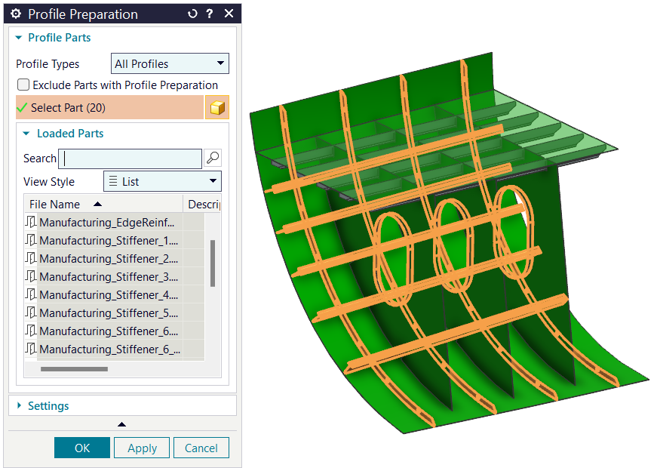
Once generated, designers can add 3D PMI dimensions to the flattened profile representation and use Technical Data Package capabilities to create 3D PDF outputs. This provides an alternative to traditional 2D profile sketch documentation while improving visualization across your engineering, manufacturing, and inspection teams.
As shipbuilding organizations continue their transition toward model-based engineering and manufacturing practices, Profile Preparation provides an important foundation for reducing dependency on paper-based deliverables and improving communication throughout the production process.
Manufacturing Build Strategy: Faster manufacturing planning
Preparing manufacturing structures is a critical step between design and production. Defining, organizing, and maintaining manufacturing build hierarchies often requires significant effort, particularly on large vessel programs.
Designcenter introduces a new manufacturing build strategy workflow that provides a faster and more flexible alternative to the traditional Restructure Assembly approach. Multiple build strategies can now be defined and stored for the same set of manufacturing parts, allowing teams to evaluate different assembly approaches, based on yard requirements, while maintaining a single active strategy. The dedicated navigator simplifies editing through drag-and-drop, cut-and-paste, and other familiar hierarchy management operations.
Configurable columns provide visibility into assembly name, weight, orientation, and center of gravity information. Manufacturing assembly names can also be automatically calculated as hierarchy nodes are then re-organized. Additional improvements include the ability to show or hide welds within the hierarchy, filter ship object types during selection operations, and synchronize completed manufacturing structures with the Assembly Navigator when required. Welds can optionally be distributed as part of that synchronization process.
According to internal testing presented in the release materials, the new Manufacturing Navigator delivers approximately 30% faster generation of manufacturing build hierarchies compared with the existing Restructure Assembly workflow for large assemblies.
By simplifying hierarchy creation and providing more efficient editing tools, these enhancements help manufacturing planners move from design data to production-ready structures more quickly and with less manual effort.
Performance improvements across common ship design workflows
In addition to new functionality, there are substantial performance improvements across several frequently used ship structure workflows. These enhancements focus on reducing processing time while maintaining the accuracy and consistency required for ship design.
The creation of multiple ship features has been optimized through a geometry construction approach that reuses common geometric information across multiple locations. This improvement benefits the creation of many endcuts on stiffeners and edge reinforcements, brackets, and collar plates. Internal testing showed performance gains of up to 1.6 times faster for multiple endcut creation, 1.6 times faster for bracket creation, and up to 1.3 times faster for collar plate creation
Update handling has also become more intelligent. Designcenter now avoids unnecessary updates to structural objects when only non-geometric property values are modified. Support previously existed for material and material grade updates, and Designcenter 2606 extends this capability to context and tightness attribute changes.
This optimization applies across plates, stiffeners, and edge reinforcements in both Basic and Detail Design workflows, helping reduce unnecessary regeneration activity during design revisions. The performance gain achieved with this improved update handling approach is of the order of 10 to 20X. Fewer number of parts are marked as modified because of this smarter update handling, reducing the overall time needed to “save” as well, once the design change is executed.
Manufacturing weld workflows have received significant improvements too. Welds can now be managed as features in addition to components, and cloning operations have been streamlined through simplified workflows that infer the weld scope directly from manufacturing part structures. Weld distribution, publication as Teamcenter® software product structure connection objects, and the existing ship manufacturing batch processes have also been enhanced.
Continue your journey with Designcenter
The Designcenter June 2026 release continues to strengthen the connection between ship design, manufacturing planning, and production information generation. These capabilities help reduce manual effort, improve information reuse, and support a more connected shipbuilding process from initial structural design through manufacturing preparation.
The result is a more efficient environment for creating, managing, and delivering the complex structural information required by today’s shipbuilding programs.
Ready to explore these capabilities? Contact your Siemens representative to learn how Designcenter June 2026 can help accelerate your ship structure design and manufacturing workflows.
Take me to the Designcenter blog 📚