Making industrial robots more adaptable: a collaborative digital twin use case for Europe
How Siemens Cre8Ventures aims to bring European start-ups, Siemens EDA and the Digital Twin Marketplace together to test sovereign Physical AI capabilities against a real industrial need.
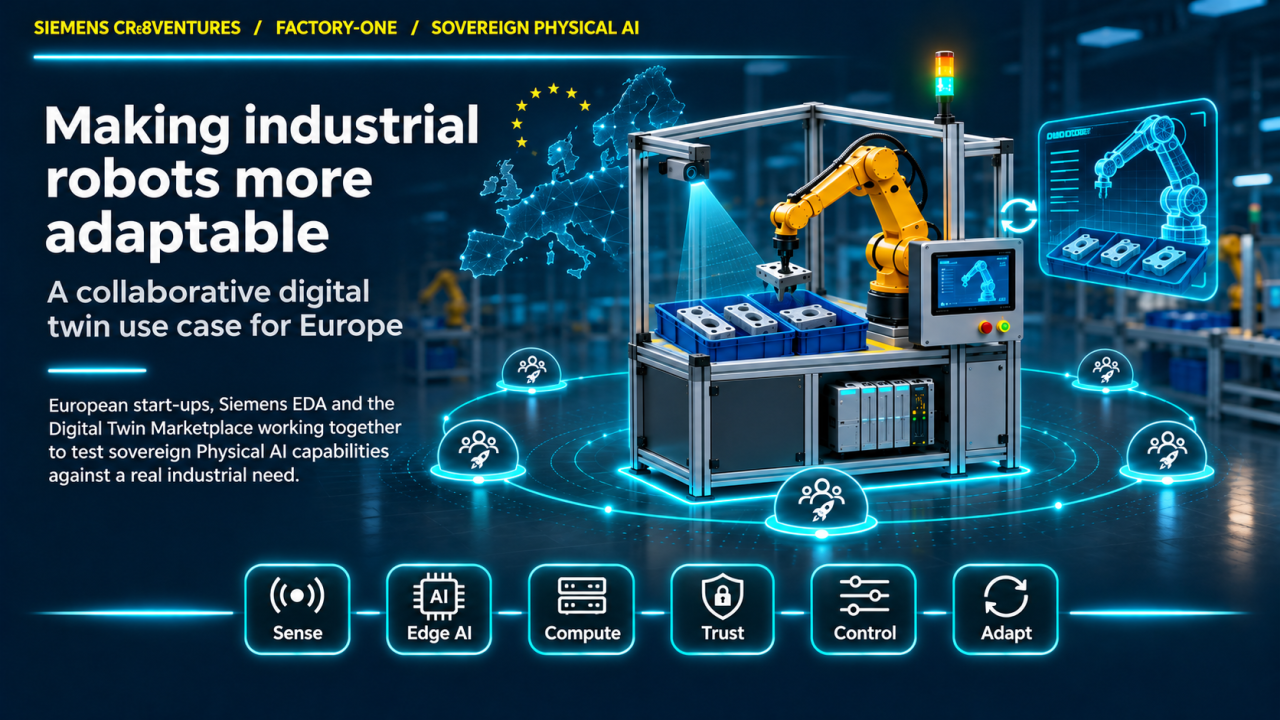
Industrial robots can be highly productive when parts, tools and tasks stay within a known range. The challenge comes when a production cell must cope with changing products and part mixes, new variants, different handling requirements or updated processes. In aerospace kitting and assembly, for example, a cell may need to keep working as components and work instructions change.
A robot that cannot adapt quickly can leave manufacturers relying on manual workarounds, engineering effort and production downtime. The opportunity is to make the cell more responsive while preserving the safety, predictability and quality expected in an industrial environment.
That is the business problem behind a new Factory-One collaborative venturing use case: how can we help an industrial robot adapt to changing tasks and parts, and demonstrate that it will work before committing to a production deployment?
What we want to do
Siemens Cre8Ventures is shaping a collaborative digital twin use case around a flexible robot workcell. The proposed use case brings together a robot, its sensors, edge compute and AI, control software, and the physical process it has to perform.
The work would start with a specific customer challenge—for example, adapting a robot in an aerospace kitting cell to handle a changing part mix. The team would then define the task and the evidence needed to show that a proposed capability can meet it.
European start-ups could contribute specialist technologies such as machine vision, sensing, deterministic edge AI, compute, security and trust, power management, or robotics modelling. Siemens capabilities would support the design and validation work, including Siemens EDA tools for relevant semiconductor and embedded designs. The Digital Twin Marketplace would help identify and connect the complementary companies needed to explore the wider system.
The objective is not to assemble a technology showcase. It is to test whether a selected combination of capabilities can help solve a customer’s operational problem.
How the collaborative route could work
The use case is intended to create a faster, evidence-led path from an interesting technology to a customer-relevant outcome:
- Define the production challenge. Agree the robot task, operating conditions, constraints and a small set of measurable success criteria with a manufacturer or lighthouse customer.
- Select the relevant capabilities. Identify which start-ups and Siemens technologies are needed for that use case, keeping the scope focused on the problem.
- Test a component or subsystem. Use Siemens EDA tools where relevant to explore, design or validate semiconductor and embedded elements. A proof of technology could help establish whether a component is ready to progress and what still needs to be proven.
- Connect the subsystem to a digital twin. Bring the selected elements into a model of the robot workcell and its operating context. Depending on the agreed scope, Siemens system simulation and digital twin capabilities can help examine interactions across hardware, software and the physical process.
- Progress toward a lighthouse pilot. If the evidence supports it, move from subsystem testing to a proof of concept and then a customer-led proof of value in a representative workcell.
This is a proposed progression, not a claim that a production pilot or performance result has already been achieved. The scope, partners, tools and success measures would be agreed with participating companies and the customer.
What makes the approach different
Start with the industrial need. The work begins with an operational challenge such as keeping a kitting cell productive as the part mix changes. Technology choices follow from that need.
Combine specialist companies around one use case. A robot’s adaptability may depend on several interacting capabilities. The Digital Twin Marketplace offers a route to bring the right companies together around a defined subsystem or system challenge, while allowing each company to retain a distinct contribution.
Use Siemens EDA early in the evidence path. Where semiconductor or embedded technology is part of the solution, Siemens EDA can support exploration and validation before the team commits to a larger integration effort. The purpose is to establish evidence and expose design questions earlier.
Validate interactions, not just components. A sensor, AI accelerator or compute device may work on its own and still fail to meet the timing, power, thermal or control requirements of the full application. A collaborative digital twin can help the team examine those interactions before a physical deployment.
Build toward a sovereign capability. European start-ups can contribute critical technologies, expertise and design choices to a capability developed for a European industrial need. Sovereignty here is a direction to strengthen control, assurance and participation across the technology stack—not a promise that every component or dependency will be European.
Together, these elements offer a practical route from start-up technology to system-level evidence: a customer-defined problem, Siemens EDA-enabled technology exploration, marketplace collaboration and digital twin validation, with a lighthouse pilot as the intended next milestone.
What happens next
The next step is to convene interested manufacturers and European technology companies around a focused discovery discussion. That discussion would:
- select a specific robot task and workcell challenge;
- confirm the customer, operating context and baseline;
- identify the relevant start-ups and Siemens capabilities;
- agree what can be tested through EDA-led proof of technology and what requires system-level validation; and
- define the evidence required to justify a proof of concept and, if appropriate, a lighthouse pilot.
The first use case should remain narrow enough to test, while being connected to a larger ambition: industrial robots that can adapt more readily as products, processes and environments change.
An invitation to European companies
We are inviting European manufacturers, robotics and automation companies, semiconductor and embedded start-ups, sensor and edge-AI innovators, and other relevant technology providers to help shape the use case.
If you have a real workcell challenge, a technology that could make robots more adaptable, or an interest in validating a new capability in an industrial context, we would like to hear from you. Bring the problem you need to solve, the capability you can contribute, or the customer environment where a focused test could make a difference.
Together, we can explore how Siemens Cre8Ventures, the Digital Twin Marketplace and Siemens EDA can help turn European innovation into a tested, customer-relevant Physical AI capability—and create a faster path from technology potential to industrial value.
Siemens Cre8Ventures is exploring this collaborative use case with prospective partners. Participation, scope and outcomes will depend on customer discovery and technical validation.