From Technology to Mission: Siemens Cre8Ventures Enters Its Next Phase
Bringing robotics, digital twins and Europe’s emerging semiconductor, quantum and photonics ecosystem together around real-world industrial missions
Europe has no shortage of breakthrough technology.
Across our ecosystem, start-ups, scale-ups, universities and established companies are developing new semiconductor architectures, AI technologies, sensors, photonics, quantum capabilities and advanced software.
The harder challenge is turning those technologies into capabilities that solve important problems in the physical world.
That is the challenge we want the next phase of Siemens Cre8Ventures to address.
Cre8Ventures is evolving from helping companies explore and prove individual technologies towards a broader Mission-Led Platform.
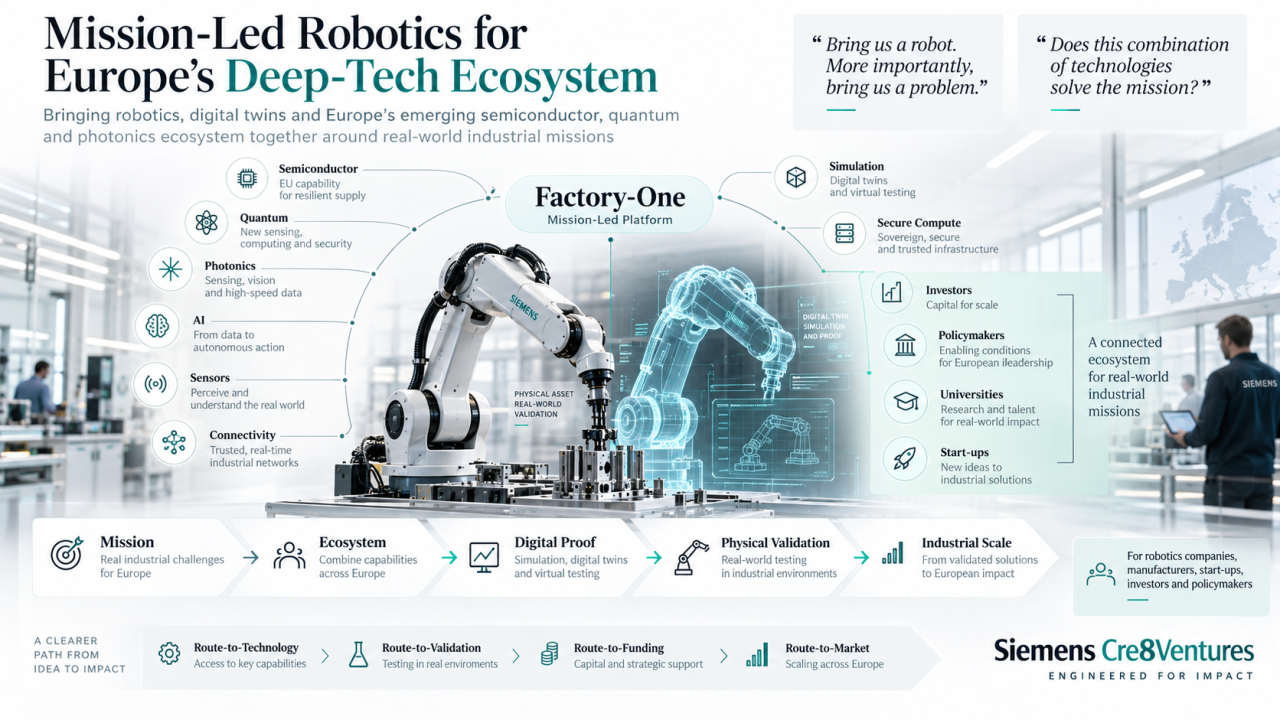
The aim is to bring customers, technology companies, investors, researchers and policymakers together around real industrial challenges — using digital twins to accelerate the journey from promising technology to proven capability.
And robotics provides an exciting place to start.
What if the mission came first?
Much of innovation starts with a technology and then searches for an application.
We want to explore the opposite approach.
Start with something valuable that a robot needs to be able to do.
Perhaps a manufacturer wants robots that can adapt much more quickly when a production line changes.
Perhaps an autonomous system needs to operate reliably where GPS or communications are unavailable.
Perhaps robots need better perception, lower-power edge intelligence, more efficient motion planning or the ability to work safely alongside people in less structured environments.
The mission becomes the organising principle.
Cre8Ventures can then bring together capabilities from across an open ecosystem to explore how that mission could be achieved.
That could include new semiconductor compute architectures, photonic sensors, AI, quantum optimisation, connectivity, robotics software, security and specialist IP.
The objective isn’t to showcase those technologies individually.
It is to discover what becomes possible when we combine them around a valuable real-world problem.
New Use Cases for Multi Physics Digital twins can change how we get there – Collaborative Venturing.
Building new physical systems is expensive.
Finding out late that a technology does not perform as expected is even more expensive.
This is where we believe Siemens can make a significant contribution.
Through our EDA, simulation, digital twin, lifecycle and industrial capabilities, technologies can increasingly be explored at multiple levels before committing to expensive physical integration.
A new semiconductor architecture might initially exist as a model.
A new sensing technology may still be under development.
A quantum optimisation capability could initially be evaluated against a classical approach.
And the robot itself can be represented digitally alongside its operating environment.
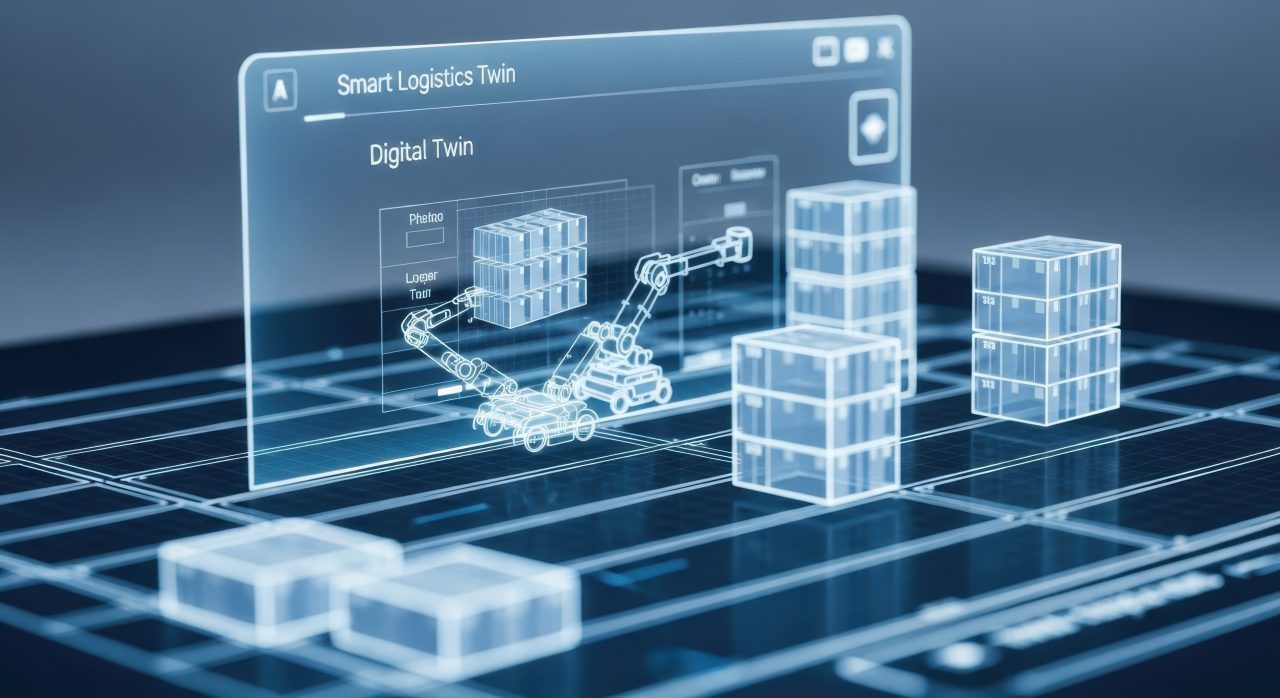
Bringing these models together creates the possibility of a multi-physics digital proving ground.
Instead of simply asking:
Does this technology work?
We can ask a much more valuable question:
Does this combination of technologies create a capability that solves the mission?
Pre-silicon. Post-silicon. Before the factory. Inside the factory.
Cre8Ventures was established with strong roots in the semiconductor ecosystem.
In this next phase, we want to explore how those capabilities can become part of much larger systems.
That means creating a path where technologies can potentially participate before silicon exists, after silicon exists and ultimately inside a physical system.
The same principle can extend to photonics, quantum technologies, sensors, AI and other emerging capabilities.
A promising technology should not necessarily have to wait until it is completely industrialised before we can begin understanding its system-level value.
Digital twins give us the opportunity to learn earlier.
And earlier learning can mean faster decisions, fewer expensive dead ends and a shorter path between invention and industrial impact.
Why robotics?
Robots provide an unusually powerful proving ground because they bring together many of the technologies Europe wants to strengthen.
Compute. AI. Sensors. Photonics. Connectivity. Control. Simulation. Cybersecurity. Power electronics.
And increasingly, optimisation technologies that could potentially include quantum and quantum-inspired approaches.
But the real opportunity isn’t creating technology for technology’s sake.
It is creating more adaptable robots.
Robots that can respond to changing manufacturing requirements.
Robots that can understand less structured environments.
Robots that can work more effectively alongside people.
Robots that consume less energy.
And autonomous systems that can continue operating safely in increasingly challenging environments.
Introducing Factory-One
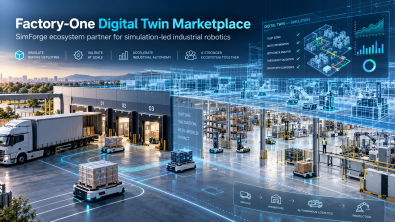
This is the thinking behind Factory-One, our first robotics-focused Mission-Led campaign.
The idea is straightforward:
Bring us a robot — but more importantly, bring us a problem.
Something your customers want that is difficult, expensive or perhaps impossible with today’s technology.
Cre8Ventures can then explore whether Siemens and our wider ecosystem can assemble the capabilities needed to address it.
The robotics company does not need to know whether the answer is a different processor, a new sensor, photonics, AI, quantum optimisation or some combination of them.
That is precisely what the mission-led process is intended to discover.
Where appropriate, Siemens manufacturing environments and industrial customers could then provide a route towards understanding whether the resulting capability creates genuine industrial value.
An open marketplace for deep technology
The other side of the platform is equally important.
We want to hear from organisations developing technologies that could become part of these future systems.
This could include European start-ups, scale-ups, corporates, research organisations and universities working in:
- Sovereign semiconductor IP and specialist compute
- Sensing and photonics
- Quantum and quantum-inspired optimisation
- Edge AI and physical AI
- Robotics and control
- Secure connectivity and communications
- Simulation and modelling
- Energy-efficient compute
- Other differentiated technologies capable of changing system-level performance
Cre8Ventures’ role isn’t to predict which technology wins.
It is to create opportunities for technologies to prove their value inside missions that matter.
Bringing investors into the journey
There is another important participant in this ecosystem: capital.
Deep technology often faces a difficult gap between a compelling technical demonstration and evidence of commercial demand.
We believe mission-led development can help narrow that gap.
For venture capital and corporate investors, the platform creates an opportunity to see technologies being evaluated not simply as isolated companies or technical claims, but as components of potential customer solutions.
That creates a potentially powerful connection between:
Route-to-Technology → Route-to-Validation → Route-to-Funding → Route-to-Market
For policymakers, there is a complementary opportunity: helping translate investment in sovereign technology into measurable industrial capabilities and, ultimately, economic impact.
From Europe’s technology ecosystem to Europe’s industrial capability
This is the bigger ambition behind the second phase of Siemens Cre8Ventures.
Not another accelerator.
Not another technology showcase.
And not a closed Siemens ecosystem.
We want to build an open, partner-led environment where missions create the demand and the ecosystem competes and collaborates to provide the capabilities needed to solve them.
Digital twins become the proving ground.
The marketplace provides the technologies.
Industrial partners provide the problems and routes to deployment.
Investors help successful technologies scale.
And Siemens helps connect those worlds.
The objective is simple:
Shorten the path from breakthrough technology to proven industrial value.
Bring us a mission. Or bring us a capability.
We are now looking for organisations interested in helping us shape the next Factory-One missions.
If you are a robotics company: bring us a capability your customers need but today’s technology struggles to deliver.
If you are a manufacturer or industrial company: bring us a problem worth solving.
If you are a start-up, scale-up, semiconductor, quantum or photonics company: bring us a differentiated capability that deserves to be tested inside a real system.
If you are an investor: bring us technologies that need industrial validation and a route to market.
If you are a policymaker, research organisation or university: help us identify the missions where European sovereign capability could make the greatest difference.
Mission → Ecosystem → Digital Proof → Physical Validation → Industrial Scale
That is the next phase of Siemens Cre8Ventures.
Engineered for Impact.