A proposed collaboration between Siemens Cre8Ventures & SimForge
Exploring simulation for industrial autonomy through the Factory-One Digital Twin Marketplace
Siemens Cre8Ventures is exploring a proposed collaboration with SimForge, a digital twin and simulation technology company, as part of the Factory-One Robotics Mission Digital Twin Marketplace ecosystem.
The proposed collaboration would examine how realistic digital environments can help manufacturers, robotics developers and industrial operators develop and validate autonomous mobile robot (AMR) applications before introducing them into complex, real-world operations.
The ambition is to help industrial customers move from promising robotics technologies to commercially viable deployments, with earlier evidence of what works, where a system fails and what needs to improve.
Autonomous robots must work in the real world
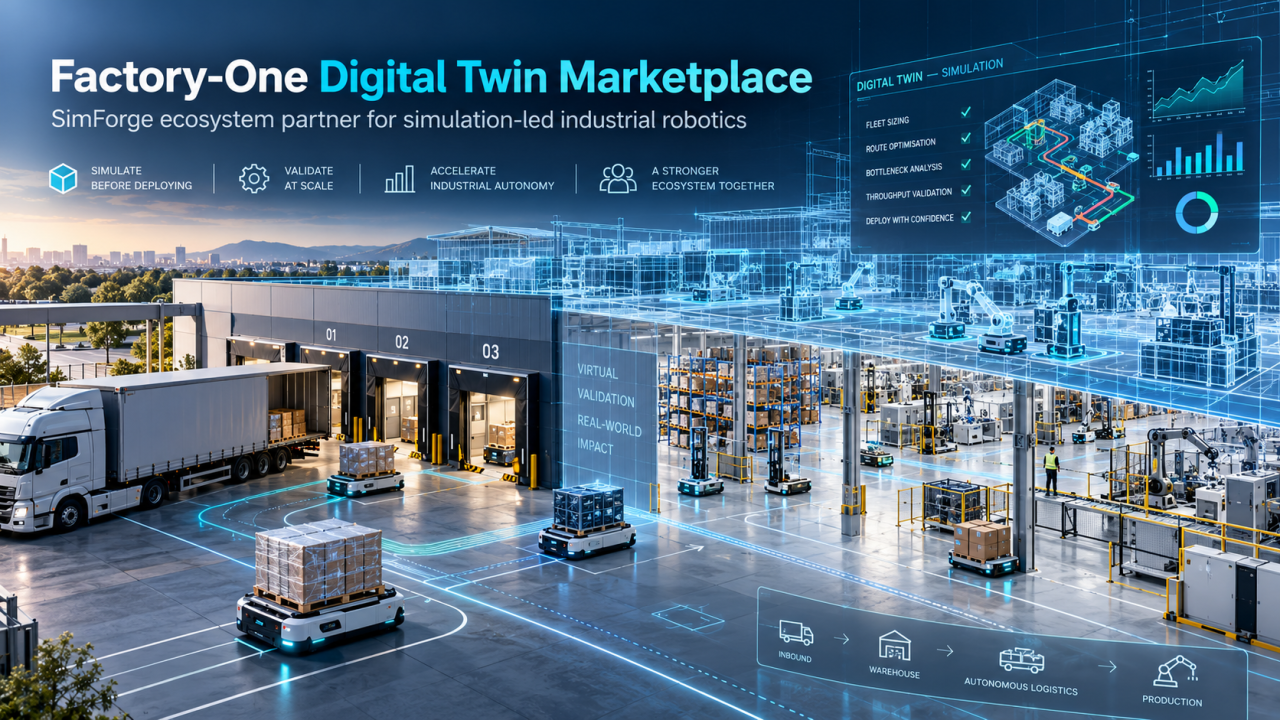
Manufacturing facilities are dynamic environments. Delivery vehicles arrive and depart. Materials move between loading bays, warehouses and production lines. Pedestrians, forklifts and autonomous robots share increasingly complex operating spaces.
Successful deployment requires more than showing that a robot can navigate from one location to another.
Manufacturers need confidence that autonomous systems can operate safely, reliably and efficiently alongside existing infrastructure, equipment and people.
The opportunity to simulate before deploying
One illustrative opportunity is an AMR moving materials between delivery lorries, loading bays and manufacturing operations.
A suitable simulation could help a customer explore the intended operating conditions before committing to a physical trial.
- Route validation. Test navigation through access roads, loading areas and shared operating spaces.
- Operational complexity. Explore interactions with people, vehicles and equipment, including occlusions and blocked routes.
- Scenario testing. Vary timing, obstacles and visibility to examine difficult or infrequent events.
- Deployment planning. Compare candidate operating policies, identify constraints and investigate delays before implementation.
These are opportunities for joint exploration, subject to customer requirements, technical validation and the agreed commercial scope.
A connected development and validation cycle
SimForge brings together maps, digital twins, editable scenarios, sensor rendering and a runtime in which the world responds to an autonomy policy.
Together, these capabilities support a repeatable workflow: turn an operating problem into testable scenarios, improve the policy, and bring its failures back into the next development cycle.
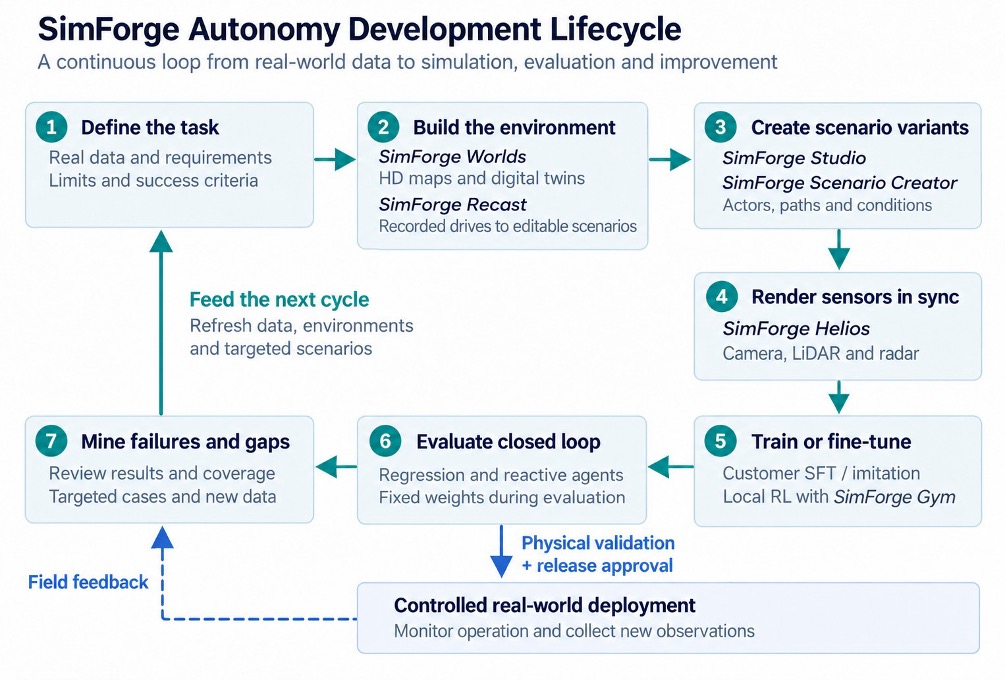
Figure 1. A development workflow supported by SimForge products. Customer training, failure analysis and release decisions surround the simulation cycle. SFT means supervised fine-tuning; RL means reinforcement learning.
SimForge Worlds provides HD maps and corresponding 3D digital twins of real places, with custom Worlds available on request.
SimForge Recast converts recorded drives into editable scenarios.
In SimForge Studio and Scenario Creator, developers can arrange actors and trajectories, attach sensors and run scenarios.
These tools make it possible to revisit a difficult encounter and change the conditions around it. [1–3]
SimForge Helios Engine renders cameras, LiDAR and radar from the same scene on a shared clock.
The outputs can feed a customer’s supervised or imitation-learning pipeline; SimForge Gym provides a Gymnasium-compatible interface for local reinforcement learning.
Helios renders locally or on SimForge Cloud, now in open beta. [4–6]
A public scenario dataset, SIMLOG-25k, offers an additional starting point for driving-policy development and testing.
Its scenarios contain motion and ground-truth data rather than pre-rendered video; sensor data can be rendered in Helios.
Site-specific industrial cases would still need to be developed and validated. [7]
Turning simulation into useful validation evidence
Closed-loop evaluation tests a policy while the simulated world reacts to its decisions.
A late stop or an unexpected manoeuvre changes what happens next.
Evaluation keeps the policy fixed so that developers can compare versions against the same scenarios; reinforcement learning instead updates the policy using experience and rewards. [5]
For an industrial mission, the customer and development team would first agree the operating limits and acceptance criteria.
Depending on the task, these could include mission completion, collisions, clearance from pedestrians, route adherence and delay.
Failed cases would become targeted scenarios and regression tests, with training and held-out evaluation data kept separate.
Operate Through and the Siemens ecosystem
The first proposed route for collaboration is through the Siemens Cre8Ventures Operate-Through Digital Twin Marketplace.
This provides a pathway for emerging technology companies such as SimForge to introduce differentiated capabilities to relevant Siemens businesses, industrial customers and ecosystem partners.
For SimForge, the initial focus would be on identifying practical customer problems where its simulation capabilities could complement existing Siemens industrial digitalisation and robotics activities.
The goal would be measurable customer value rather than an isolated technology demonstration.
Operate Alongside and customer-led missions
Where a customer identifies a broader challenge requiring multiple technologies, Siemens Cre8Ventures could explore an Operate-Alongside approach.
Through Factory-One, complementary ecosystem partners could be brought together around a specific, customer-led mission.
For example, a future autonomous logistics mission might combine:
- SimForge. Digital environments, scenario generation and sensor simulation for autonomy development and evaluation.
- Arm. Compute architectures supporting intelligent edge devices and robotics.
- Terra Quantum. Potential optimisation capabilities for routing, scheduling and operational decisions.
- Siemens. Industrial engineering, digital twin and automation capabilities, together with routes to industrial customers.
These are illustrative roles, not confirmed project commitments.
Integration, funding and commercial arrangements would depend on the customer’s mission and agreement among the participating organisations.
Factory-One and the path to industrial deployment
Factory-One is a Siemens Cre8Ventures robotics mission designed to connect emerging technologies with real industrial challenges.
It starts with the needs of manufacturers, robotics companies and industrial operators, then assembles the capabilities required to address them.
For a potential SimForge mission, that approach would mean identifying a commercially meaningful problem, agreeing measurable requirements, and defining a customer-funded proof of concept.
The team could then assess technical feasibility through simulation and physical validation before deciding whether to progress towards deployment and scale.
Commercial use of SimForge’s runtime, maps and dataset requires an appropriate commercial licence.
Custom-site work, integration and acceptance criteria would need to be scoped for the mission. [6]
An invitation to industrial partners
Siemens Cre8Ventures and SimForge welcome discussions with manufacturers, robotics developers, logistics operators and industrial technology companies interested in exploring simulation-led autonomy applications.
The immediate objective is to identify a suitable industrial challenge where realistic digital environments can be evaluated against real operational requirements.
Bring a defined task, the operating constraints and the outcome that would make a difference to the business.
Together, we can explore the capabilities needed to solve it.
About Siemens Cre8Ventures
Siemens Cre8Ventures is a collaborative venturing initiative that brings together emerging technology companies, established industrial organisations, investors and ecosystem partners to accelerate the development and commercialisation of advanced technologies.
Its mission-led approach connects innovation with industrial requirements through Operate-Through marketplace opportunities and Operate-Alongside customer-led programmes.
About SimForge
SimForge builds data infrastructure for physical AI: digital twins and HD maps of real places, scenarios derived from recorded drives, synchronized sensor rendering and tools for closed-loop development and evaluation.
Its current product family includes SimForge Worlds, Helios Engine, Recast, Studio and Scenario Creator, and SimForge Gym.