The cost of too much: How simulation helps reduce overproduction and inventory waste in CPG
Producing too much can feel like protection. It helps avoid stockouts, supports service levels and gives teams a buffer when demand shifts. In consumer packaged goods (CPG) manufacturing, though, extra product quickly becomes extra cost. For products with limited shelf life, that cost grows every day inventory sits. Excess production ties up working capital, consumes storage space, adds handling and raises the risk of discounting, disposal or expired product.
Teams rarely plan for this waste on purpose. It builds up because production decisions are often made without full visibility into their downstream impact. Factory simulation planning gives CPG manufacturers that visibility. This article explains how CPG manufacturers can use factory simulation planning to test batch sizes, production schedules, and pull-based production models virtually before committing materials, labor, or line capacity to reduce overproduction and inventory waste.
Two wastes that are especially costly in CPG
Lean teams often use TIMWOODS to describe the eight types of manufacturing waste:
- Transportation
- Inventory
- Motion
- Waiting
- Overproduction
- Over-processing
- Defects
- Skills underutilization
Two of them, overproduction and inventory, are especially costly in CPG because shelf life changes the economics.
Overproduction occurs when a plant makes more product than needed, earlier than needed or in a sequence that creates downstream pressure. In CPG, it often results from batch-size decisions, demand uncertainty or well-intended efforts to avoid stockouts. Inventory waste follows, as excess raw materials, work in progress (WIP) and finished goods require storage, handling and aging time. In most industries, that inventory ties up capital. In CPG, it also loses freshness, requires discounting, consumes warehouse capacity or becomes unusable.
The numbers are significant:
- Food waste in the U.S. is estimated at 30% to 40% of the food supply (USDA).
- Annual inventory carrying costs commonly run 20% to 30% of inventory value, covering capital, storage insurance, taxes, shrinkage and obsolescence (APQC).
For CPG leaders, overproduction directly erodes margin, consumes capacity and creates waste.
Overproduction hides inside reasonable decisions
Plants overproduce because the system is complex, not because teams are careless. Demand signals shift, trade promotions spike and retailer orders move. Ingredient availability varies. Cleaning and allergen sequences constrain run order, while maintenance windows, labor and equipment availability change throughout the week. Limited cold storage can turn a seemingly efficient run into an inventory problem.
Retailer commitments add pressure of their own. A missed order can mean on-time in-full (OTIF) penalties or lost shelf placement, so buffer stock often exists to protect against exactly that risk.
Complexity also starts upstream. When new flavors, formulas, pack sizes or packaging formats enter the portfolio, production complexity increases before demand is fully proven. A recipe or packaging change that looks manageable in development can alter batch sizes, changeovers, storage needs and shelf-life exposure once it reaches the line. Upstream product decisions and downstream production waste are more connected than they first appear.
These trade-offs are hard to see from a spreadsheet:
- A larger batch reduces changeovers but increases finished goods inventory.
- A production sequence improves line utilization but creates storage congestion.
- A forecast justifies volume but misses a late order change.
- A pack-size change looks simple but creates new constraints for materials, changeovers and storage.
Each decision is reasonable on its own. Made together without full system visibility, they produce waste and unpredictable performance. The shared challenge for product, engineering and operations leaders is making faster production decisions without adding cost, complexity or risk.
Use what-if analysis to see production impact before committing resources
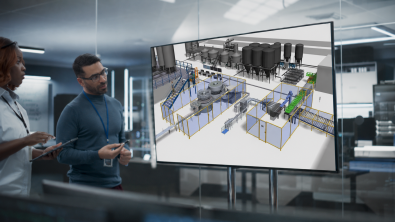
Factory simulation planning gives teams a virtual model of the production system, a digital twin. A digital twin is a virtual replica of a physical production system that enables real-time simulation and what-if scenario testing. Teams can run what-if scenarios, compare options and validate decisions before changes reach the plant floor. They can test how a line, schedule or production plan behaves under different conditions, including throughput, cycle time, equipment utilization, WIP, material flow and resource availability.
This is different from the planning and scheduling systems most plants already run. ERP and scheduling tools manage what the plan is. Simulation models how the plan behaves over time, capturing variability, interactions between constraints and what-if experiments that would be too slow or too risky to run on a live line.
A useful CPG model reflects real constraints such as SKU mix, ingredient availability, line speeds, changeover and cleaning rules, labor, storage limits and shelf-life exposure. A simulation is only as reliable as its inputs, so teams should validate the model against real line data before using it to drive decisions.
Teams can plan the change, simulate the impact and validate the decision before it affects live production.
For overproduction and inventory waste, that means teams can:
- test batch sizes before approving the schedule
- compare demand scenarios before committing production
- identify hidden bottlenecks and inventory buildup between process steps
- evaluate production sequences before using line time
- see how labor, equipment and storage constraints affect the plan
Three scenario planning strategies that reduce overproduction and inventory waste
1. Optimize batch sizes before production starts
Batch size decisions involve trade-offs. Larger batches reduce changeovers and improve short-term line efficiency, while smaller batches reduce finished goods inventory and shelf-life risk. The right answer depends on demand, capacity, ingredients, labor, storage and sequence. It also changes as those variables change.
Simulation lets teams compare the options before production starts:
- What happens if we reduce the batch size for a slower-moving SKU?
- Will smaller batches increase changeovers enough to affect throughput?
- Can we group similar products without creating excess inventory?
- Which batch size best balances service levels, shelf life and line efficiency?
Batch decisions matter most during change, such as new product launches, formula adjustments and packaging updates. For product development teams, simulation offers a way to prove out formula and packaging alternatives for manufacturability virtually. Teams can quantify how each option affects inventory risk and line efficiency before scale-up and avoid costly late-stage rework. For the plant, new products integrate into existing lines with a smoother, more predictable ramp-up.
2. Synchronize production with demand
For CPG manufacturers, the production schedule is also a shelf-life decision. Producing too early exposes finished goods to discounting, disposal or avoidable storage costs.
Aligning production with demand starts with the forecast, but teams also need to understand how demand changes move through the plant. A schedule change affects material staging, storage, labor allocation, changeover timing and finished goods inventory. Simulation shows those effects before teams act:
- Which products should run first based on demand, shelf life and capacity?
- How will a promotion-driven volume spike move through the line?
- Where will inventory build if the schedule changes?
- Can we meet demand without creating excess WIP?
- What happens if we move a production run earlier or later?
Take a short shelf-life product on a line with frequent changeovers and limited finished goods storage. Simulation lets the team compare a larger, setup-efficient batch against smaller, demand-aligned runs and see the full inventory and shelf-life consequences before locking the schedule.
3. Evaluate pull-based production models before changing operations
Many CPG manufacturers want production to respond more closely to actual consumption. Pull-based production uses demand signals to trigger production or replenishment instead of producing ahead of need. It can meaningfully reduce excess inventory, but only if the plant can respond reliably.
Simulation lets teams pressure-test the approach before adoption:
- replenishment rules and inventory thresholds
- buffer levels between process steps
- material availability under different demand patterns
- line response under demand swings or promotion-driven volume changes
Teams can prove the plant supports pull-based operation with existing lines, buffers and equipment before committing to operational changes or new capital. If the simulation shows a gap, they can evaluate the ROI of process changes or added capacity virtually, minimizing investment risk.
Use production metrics to support data-backed decisions
Several measures show where overproduction and inventory waste are accumulating:
- finished goods inventory and WIP
- shelf-life exposure
- storage utilization
- throughput and overall equipment effectiveness (OEE)
- cycle time
- resource utilization
- changeover time and line utilization
- schedule adherence
- scrap and rework
Simulation turns these metrics into evidence. Instead of debating whether a plan will work, teams can review what the model shows about inventory, throughput and resource impact.
That evidence travels beyond the plant floor. Leaders get quantifiable, data-backed business cases for schedule changes, inventory targets, capacity investments or flow redesigns. Product teams see how new variants affect production. Manufacturing engineering validates process assumptions before capital is committed, and operations compares schedule options and forecasts performance, all before anything disrupts the floor.
Build a business case from one visible waste problem
You don’t need to model everything. Choose one area where overproduction or excess inventory already creates cost or scheduling pressure:
- one high-volume line
- one product family with frequent changeovers
- one category with shelf-life pressure
- one recurring inventory buildup
The model only needs to show enough to support a better decision. Prove the value there, then expand toward a unified, data-driven view of performance across lines, plants and the wider operation.
Reduce waste before it reaches the floor
In CPG, production plans that look safe and inventory that looks like a helpful buffer often become measurable cost.
Overproduction and inventory waste often result from reasonable decisions made without full visibility into their downstream impact. Factory simulation planning helps CPG teams test batch sizes, align production with demand and evaluate pull-based approaches before committing materials, labor or line capacity.
Overproduction and inventory waste are two of the most costly and most preventable inefficiencies in CPG manufacturing. Eliminating Waste, Maximizing Output provides a complete framework for using factory simulation planning to identify all eight types of manufacturing waste, quantify their impact, and validate improvements virtually before committing resources. Download the white paper to build a data-backed case for change.
Frequently asked questions
What is overproduction in CPG manufacturing? Overproduction means producing more product than needed, sooner than needed or in a way that creates unnecessary inventory. In CPG manufacturing, it increases storage costs, handling and shelf-life risk, and it often signals gaps in planning, scheduling or demand alignment.
How does factory simulation help reduce inventory waste? Factory simulation lets teams run what-if scenarios virtually, comparing batch sizes, schedules, inventory buffers and demand changes to see where excess inventory will build. Teams can adjust the plan in the model before making changes on the production floor.
How is factory simulation different from ERP or scheduling software? ERP and scheduling systems manage what the production plan is. Factory simulation models how that plan behaves over time, including variability, constraint interactions and what-if scenarios. Teams use it to test decisions that would be too slow or risky to trial on a live line.
How can CPG manufacturers reduce overproduction without risking service levels? Simulation lets manufacturers test lower-inventory plans against realistic demand scenarios before committing to them. Teams can confirm whether a leaner plan still meets service levels, then adjust batch sizes, schedules or buffers until the model shows demand is covered.
Why are overproduction and inventory waste connected? Overproduction creates excess inventory, which requires storage, handling and tracking. For products with limited shelf life, that inventory also raises the risk of discounting, expiration or disposal, so the two wastes tend to grow together in CPG operations.
Where should CPG manufacturers start with simulation? Start with one production area where overproduction or excess inventory already creates cost or scheduling pressure, such as a high-volume line or a category with shelf-life exposure. A focused simulation model can prove value before expanding to other lines or plants.