The process of innovation: Then and now – synthetic force fields as a worked example: Part 1
What do you think about as you fall off to sleep? An embarrassing social situation that you wish you could redress, or do you save that for when you wake up at 3am when the real despondency sets in? Don’t worry, everyone experiences that to absolutely no avail. To bypass those embarrassing recollections of late I’ve taken to thinking about shapes instead. Different types of shapes, topologies of different assemblies of shapes and the forces that might govern their tessellation. Not everyone’s cup of tea, but when needs must and you’re trying to nod off…
Innovation as a way of thinking
One of my earliest recollectiona was wondering how a door handle worked. I saw how the handle was turned and how the latch bolt thingy then moved, but I didn’t know how. But I wanted to. Our desire to know how the world works defines us as a species. Our ability to understand the world around us has resulted in our success as a species. Innovation always starts with a question and the stubborn desire to answer it – even when that question is a what-if that doesn’t map neatly onto reality
So what if the force fields acting on objects didn’t abide by Gravitational, Electromagnetic or Nuclear force laws?
The Three-Body-Problem
But let’s recap when they do, and no better example than gravitation acting on 3 0D mass points.
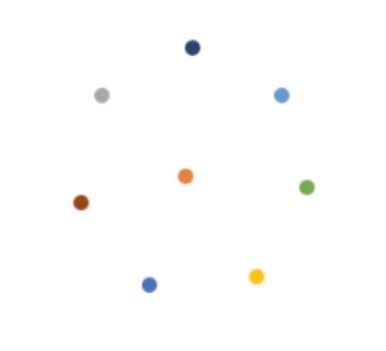
The 3 0D mass bodies rotate around each other, don’t settle down but instead exhibit a chaotic behaviour that is difficult, if not impossible, to predict. The so-called Three-Body Problem (though the fact it’s called a ‘problem’ has always troubled me, as if we can explain reductively the beauty of a non-linear chaotic system).
The intention of these 2 blogs is not to focus on the innovation itself (and so far none has been shown), but to explain instead how the innovation exploration was realised, and the difficulties encountered in doing so.
The above animation was generated in Microsoft Excel by a graph using VBA as a solver backend. As a mechanical engineer by training I knew what force laws to apply, the fact the gravitational fields drop off by 1/d^2, the concept of inertial momentum (m x v), time stepping etc. but I have little coding competence beyond recording an activity using Excel Macro record, then adding a loop around the recorded VBA (I’m assuming others with my limited skill set may have started off the same way!?).
Stack overflow in lieu of LLMs for implementation
As this work was done back in 2022, I of course relied heavily on Stack Overflow to implement a trial and error approach to what turned out to be a rat’s nest spaghetti junction of VBA scripting!
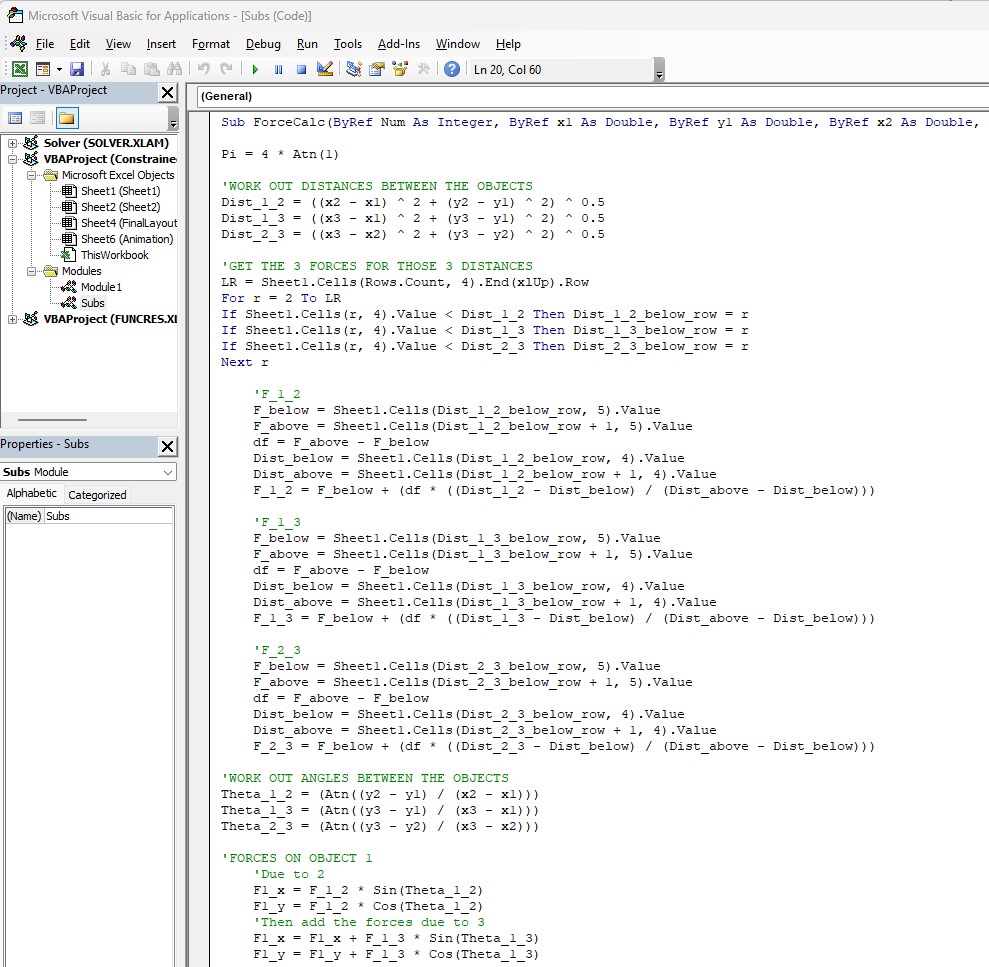
But it kind of worked and so I extended the generic ‘Force =f(distance)’ piecewise linear definition to divorce behaviour from gravitational reality:
A synthetic force field might be considered by that which exerts a force from a point to another point as a function of the distance between them. A piecewise linear definition of the Force=f(Distance) being simple and generic enough to prescribe. Based on the separation distance this force might be attractive (-ve) or repulsive (+ve). A zero force at a distance in this instance leads to a spatial separation constraint. With 3 points the resulting topology can be analytically determined. For more than 3 points such a separation distance cannot be assured, only attempted:
All good fun so far (at least I thought so), but where’s the industrial utility in all of this? OK, what about a force field for each point that attempted to maximise separation distance between N points in a given 2D space?
The practical value comes into its own for computational design of experiments: placing N trials evenly across an M-dimensional parameter space in a space-filling way. For sure Latin Hypercube spreads points across each variable but can still bunch up, and Sobol is fast and easy to extend but less happy in odd-shaped spaces. The opportunity of a force-field approach is that it’s extensible for M dimensions and naturally adapts to non-regular M dimensional constrained design spaces.
But by this stage my desire to further validate and compare the force-field approach had been subsumed by a lack of capability and even less available time.
It took ages
It really did. To go from my original desire to prototype an innovative ‘non-physics’ synthetic force field approach to act on N 0D mass particles to have something working, using VBA, Stack Overflow and my limited coding competence, took not only many days, but a lot of frustration and effort as I assumed responsibility for the coding of the methods I wanted to explore. Stack Overflow only took me so far to determine how to VBA a specific function correctly, the rest was up to me.
It was only 2 months after the above effort in 2022 that ChatGPT was released to the public. Since then everything has completely changed. My desire to extend the synthetic force field approach from 0D points to the tessellation of generic 2D shapes was daunting at the time. Since then I’ve achieved that in a fraction of the time. Part 2 of this blog series will explain how…
Disclaimer
This is a research exploration by the Simcenter Technology Innovation team. Our mission: to explore new technologies, to seek out new applications for simulation, and boldly demonstrate the art of the possible where no one has gone before. Therefore, this blog represents only potential product innovations and does not constitute a commitment for delivery. Questions? Contact us at Simcenter_ti.sisw@siemens.com.