Artificial intelligence (AI) is transforming the engineering world at a breathtaking pace. From optimizing designs to reducing time-to-market, AI is now a core component of how leading companies innovate. But as the demand for AI-powered solutions grows, so does the need for a workforce that can wield these tools confidently, creatively and responsibly.
That’s why Siemens is equipping students and educators with hands-on access to cutting-edge AI design tools, industry-relevant learning materials and recognized credentials.
Whether you’re a student eager to gain a competitive edge or an educator shaping the future of engineering education, this guide will show you how Siemens is helping bridge the gap between classroom learning and industry expectations through its academic programs, software tools and microcredentials.
Siemens’ new Expedite — Skills for Industry microcredential is designed to help students gain and verify key skills for today’s engineering workplaces. Learners can enroll now on Coursera or visit our website to learn more.
Why AI skills matter for the next generation of engineers
AI is no longer a “nice-to-have” in engineering — it’s an essential skill. From aerospace to consumer products, industries are turning to AI to streamline product development, automate repetitive tasks and enhance innovation.
Why should engineering students care?
The demand for engineers who understand AI-assisted design workflows is growing rapidly across nearly every industry. Employers are actively seeking candidates who can work efficiently with these tools, making AI fluency a highly marketable skill. For students and early-career professionals, experience with AI design tools can provide a clear competitive advantage when applying for internships or full-time roles. Beyond short-term benefits, learning how to work with intelligent systems also helps future-proof careers. As digital transformation reshapes engineering, those who can integrate AI into their design thinking will be well-positioned to lead innovation in the years ahead.
Learning AI in the classroom gives students an enormous head start. And with Siemens’ help, it’s easier than ever to get started.
What is AI-driven design in engineering?
AI-driven design refers to the use of artificial intelligence to assist, enhance or automate parts of the engineering process. These smart tools can reduce manual effort, improve decision-making and unlock new possibilities for creativity. Key benefits of AI in design include:
Constraint checking: Algorithms identify when a part or assembly doesn’t meet required constraints, reducing costly late-stage revisions.
Generative design: Designers input their goals and constraints, and AI generates multiple viable solutions in minutes.
Real-time optimization: AI can suggest layout improvements and streamline workflows while the user is still working on the model.
Predictive modeling: AI can analyze historical data to anticipate potential design flaws before they occur.
In the past, achieving this level of insight and optimization might have taken weeks. With AI, it happens in seconds, giving engineers more time to innovate.
How Siemens is bringing AI into the engineering classroom
Recognizing the importance of AI in the future of engineering, Siemens has launched a number of initiatives through its Global Academic and Future Workforce Program. The goal? Equip students and educators with access to professional-grade software that mirrors industrial workflows.
What the program offers:
Academic software access: Siemens provides professional-grade tools like NX CAD/CAM to partner institutions through academic grants.
Free student software downloads: Siemens offers student versions of NX and other software tools for student projects, competitions and more.
Microcredentials and learning programs: Specialized training to help students validate skills in areas like AI design, product lifecycle management and more.
The goal is simple: to prepare students for a seamless transition from education to industry. By making enterprise-level design tools accessible in the classroom, Siemens ensures that students are ready for industry from day one.
AI design tools: Siemens’ Designcenter suite, including NX and Solid Edge for students
To prepare students for the demands of modern engineering roles, Siemens provides hands-on access to industry-grade design tools, notably Siemens NX and Solid Edge. Both platforms are equipped with AI-enhanced capabilities that allow students to work smarter, faster and with real-world relevance.
Academic access to Siemens NX and Solid Edge
Through the Siemens Global Academic and Future Workforce Program, academic institutions can apply for grants that give students access to advanced design platforms used by leading manufacturers around the world.
NX is a high-end CAD/CAM solution used in complex product development (e.g., automotive, aerospace)
Solid Edge is a powerful, easy-to-learn mechanical design platform with built-in AI and cloud-connected tools — perfect for rapid skill-building and classroom use
Both tools include next-generation features that go beyond traditional 3D modeling, bringing artificial intelligence directly into the design process.
Key AI features in Siemens NX
For institutions with an academic partner grant, students can access the full version of NX with AI-driven tools, such as:
NX command prediction
NX command prediction learns how you use the software and intelligently brings the most relevant commands to the surface, saving time and reducing clicks.
NX molded part designer
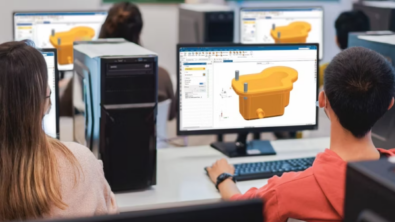
NX molded part designer uses AI to recommend design changes that improve manufacturability. It can:
Predict and correct draft angles
Suggest improvements based on historical data
Reduce iterations in molded part design
Note: The NX Student Edition available for individual download does not yet include these AI features. To access them, a professor must request a grant for institutional use. If you’re a student, ask your professor to apply here.
AI-driven innovation with Solid Edge
Solid Edge also offers students and educators a rich AI-enhanced experience, especially through its generative design and adaptive UI features:
Generative design
Students can input constraints (like weight, material and load conditions), and Solid Edge uses AI to generate optimized part geometries, often with organic forms that humans wouldn’t design manually.
Reverse engineering capabilities
Students can take advantage of capabilities that make it easier and faster to transform scanned data into usable 3D models. AI-powered mesh processing refines scanned data, while automated feature recognition quickly identifies geometric features. Intelligent surface reconstruction creates accurate surfaces from complex scans, and smart conversion tools efficiently turn point clouds into solid models, speeding up the entire workflow.
Adaptive user interface
Like NX, Solid Edge includes command prediction that learns from each user’s workflow and prioritizes tools that match their behavior — ideal for boosting productivity while learning.
AI-assisted modeling
Students can model faster with AI-assisted capabilities that boost efficiency and accuracy. Predictive command suggestions anticipate the user’s next steps, streamlining workflows. Automated feature recognition quickly identifies existing design elements, while smart dimension inference intelligently applies relevant dimensions based on geometry and context. Additionally, intelligent part classification organizes components for better reuse and data management throughout the design process.
Free student download
Unlike NX, the Solid Edge Student Edition does include many of the latest AI and generative design features — and it’s available for free download to all students. Download Solid Edge Student Edition.
Both platforms teach in-demand skills and align with how top employers use CAD today, giving students a head start in mastering AI-driven design. By learning either tool, students can learn how to work smarter, faster and more like an industry professional.
Both platforms teach in-demand skills and align with how top employers use CAD today — giving students a head start in mastering AI-driven design. By learning either tool, students can learn how to work smarter, faster and more like an industry professional.
Note: The standalone NX Student Edition currently does not include these AI features. To access them, your institution must have an academic partner grant. If you’re a student who is unsure, ask a professor.
Engineering skills: the Expedite – Skills for Industry microcredential
In addition to gaining hands-on experience with Siemens’ tools, students can now earn credentials that verify their knowledge. That’s where Expedite – Skills for Industry comes in.
What is Expedite – Skills for Industry?
Expedite – Skills for Industry is a microcredential from Siemens designed to validate core engineering and design skills for the modern workforce. Delivered through Coursera, the program is self-paced and accessible from anywhere.
Topics include:
AI-driven design principles
Product lifecycle management (PLM)
Digital twin and simulation
Sustainable engineering practices
Professional skillslike project management and cross-functional collaboration
Upon completion, students earn a digital badge that can be added to résumés, LinkedIn profiles or job applications, instantly signaling job readiness to employers.
Financial aid is available through Coursera. Learn more on the Coursera website.
Why it matters: Expedite – Skills for Industry is the only credential of its kind that combines technical excellence with workplace readiness, a winning combination for early-career engineers.
How educators can integrate Siemens AI tools into curriculum
While students can advocate for access, educators are the gateway to integrating these powerful tools into the classroom. Educators are key to building tomorrow’s workforce — and Siemens wants to make it easier for them to bring AI into the classroom.
Benefits of integrating Siemens tools:
Makes engineering courses more engaging, modern and industry aligned
Prepares students with in-demand digital skills
Encourages project-based learning through industry-leading tools
How to get started:
Apply for an academic partner grant. The grant provides institutional access to Siemens NX and other software platforms.
Use included curricular resources to design labs, assignments or capstone projects around AI-enhanced workflows.
With support from Siemens, educators can turn traditional engineering courses into launch pads for high-impact careers.
Launching a career in AI-powered engineering
AI is transforming engineering faster and more significantly than most students realize. It’s not just about knowing how to design; it’s about knowing how to design intelligently.
Next steps for students:
Check if your institution has access to Siemens NX with AI tools
Ask your professor or program coordinator about Siemens academic grants
Enroll in the Expedite – Skills for Industry microcredential
Learn how AI can augment your engineering workflows
Show future employers you’re prepared with modern, marketable skills
By combining hands-on experience with certification opportunities, Siemens is empowering students to not only learn AI but to lead with it.
Ian Mark
Ian Mark is a content specialist on the Siemens global academic marketing team. He writes about all the ways that Siemens academic program is helping drive positive change in the world of engineering education.
January 21, 2025Unlock your potential with Siemens software From designing complex structures to optimizing system performance, the ability to use advanced software...