Advanced robotics and AI in industrial manufacturing- Episode 6 transcript
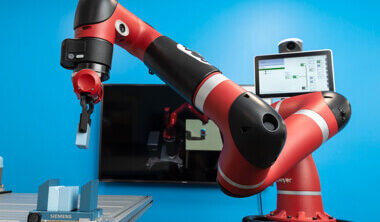
Alex Greenberg: Yeah, I was saying in the personal grade insights from Rahul, and I think the main purpose of AI for robotics is to enable a robot at the end. Game is a one off, right. Reaching a state where a robot, whether a humanoid or just an arm equipped with vision and sensing would be able to execute A1 off of a certain product without any explicit programming, I think this is the Holy Grail.
And once we reach that, we are in an area where we just use simulation to train those robots and also to validate scenarios without any explicit programming effort.
The robot will be able to handle a one-off scenario and go on with the other tasks. The end game is really exciting where in a highly customized world, we will have a one-off product or thousands of configurations of the same product and the robots will be able to handle it with just a short demonstration or even a verbal explanation from the engineer using some generative AI techniques for example.
You would be able to translate what you tell the robot to the emotions that the robots will actually perform in order to execute the manufacturing task. This is again very exciting domain and looking forward to see what comes out because every day there are news in this domain and new developments come to life everyday almost every day.
Chris Pennington: Alex, in these sessions we always try to have one eye on the future and think about what’s coming in the next 5-10, fifteen years. And you mentioned then reaching the Holy Grail, but when we reach that Holy Grail, there’s going to be another Holy Grail on the horizon.
I wanted to ask, what do you think is up there in 10 years, 15 years’ time, or perhaps even less, at the rate that things are changing, what do you seek in the coming year? Do you think we’re going to see fully automated robotic systems on shop floors?
Alex Greenberg: Very difficult to predict. I think we have no choice. I think the macroeconomics is driving us to that the world is suffering of shortage of labor there is this is a no trend in the world. People are less inclined to do those dull, repetitive jobs, we would definitely need automation to take over.
I definitely see there is a lot of push to introduce the smart AI based automation that would enable robots to take over in a quick and efficient way. I definitely see them in 10-15 years. We will see much more automation and intelligent information, which means without any need of programming. Maybe some small demonstration or kind of like instruction to the robot, even verbally.
The robot will be able to perform that even extracting from some digital twins of the product itself.
The products are designed today using 3D tools. The design itself will be assisted by AI and it will be designed for manufacturing so that the robots or the intelligent robots that need to build this product would be able to derive the assembly tasks directly from the design and the design would take into account the fact.
That there would be an intelligent robot that will assemble this product, so this will be kind of an entire ecosystem driven by AI from the design phase of the product, which will take into consideration the manufacturing aspects and in the manufacturing, itself will be handled by and der.
From the design by those intelligent AI driven robots, in order to perform the assembly tasks.
I see.
Rahul Garg: Yeah, I was just going to say, just hearing you say some of these things, we recently had a chance to meet with some senior leadership of a global leader of industrial robot manufacturers, and their vision is to basically, to put it very simply, is robots making robots, right? And that’s where they are trying to drive their innovation is, is using robots to make the robots that they sell eventually then I that gives you a sense of how automated things are gonna be looking in the future as we speak.
Alex Greenberg: Right. Yeah, definitely. I mean a robot by itself is a complex machine.
it’s natural that you would imagine kind of like in a not so far future, by the way, robots today are also utilized in building robots. It’s not the entire building sequence, but if you look at the robot as any other machine, so obviously there is some automation in the manufacturing robots, but I understand the implication.
That’s definitely an exciting trend where the machines that are used for manufacturing will also manufacture themselves in order to support the high volume of such robots that would be required to build the products of the future.
Rahul Garg: I think some great insights on how AI is, is and how production systems are going to be changing the future. And I think one of the things that is not so in the future but actually happening event today as we speak is bringing in the industrial metaverse and as we bring in new simulation capabilities and working with partners, recognizing each partner is bringing in their own strength and capabilities and skills.
Can you talk a little bit about what are we doing around this, the whole topic of industrial metaverse, which is what it is first of all, and then how we are working with partners and how we are working in to bring in advanced robotics in that context as well?
Alex Greenberg: Certainly, Raul, thanks for asking that. Of course, as you mentioned, we have started the collaboration with NVIDIA on industrial metaverse several years ago and there are a lot of aspects for that engagement in many in many domains in the product design in simulation, in product simulation in manufacturing simulation. But if we talk specifically about robotics.
definitely there is a lot of stuff that NVIDIA develops that we can collaborate with them on.
With the flavor of advanced robotics, so as I’m as we mentioned AI driven robots are based on data sets. Very large data sets that they need to be trained on, OK. In that sense, collaborating with NVIDIA on Omniverse and the potential of generating vast data sets that are required for training such robots is one domain.
Another domain is the sensors. OK, so in such an environment you need high fidelity sensors that would. I’m talking about vision, sensors, lighters and so on and so forth. And so, you need some fidelity to be to be able to again to equip the robots with the perception capabilities that they would have in the realistic world, but you replace it with the photorealism that NVIDIA introduces into the omniverse environment.
Again, you save all the need to have this physical equipment on the shop floor in order to train the robots, you replace it with a very high-fidelity photorealistic environment. Also equipped with high fidelity sensors. So, this enables you to simulate those scenarios and to validate them without the need for any, again for any physical equipment and test the AI layer of these robots using the 3D environment. Cutting the cost and cutting the times to market of such solutions. And again, we are in the business of being fast to market. as soon as you engage in such a high-fidelity simulation, you cut the costs and the time it requires you to train the system to test it, to validate that in specific manufacturing scenarios and then take it to the shop.
All in all, there is a lot of potential in this collaboration. We are working on that as we speak.
We have discussion in discussions with NVIDIA on various cases. For example, the bin picking I mentioned previously which requires high fidelity physics behavior and virtualization of camera sensors. But also, other topics like synthetic data. Creating large data sets for training robots, humanoids are a topic. Looking forward for what we achieve with NVIDIA as well.
Rahul Garg: I think this is very good Alex. It’s highlighting that with NVIDIA and the industrial metaverse, we are not only getting the realistic and high-fidelity real-time visualization, but more importantly, it’s also bringing in the ability to do using that industrial metaverse for training, for testing, and operating the AI agents. Which become very important as we go into the realm of more flexible robots.
Chris Pennington: And Rahul. I know you were lucky enough this year to attend CES and just with this theme of having one eye on the future, are there any things from CES that you brought away thinking about that? I wasn’t expecting that. That was something that’s really surprised and excited you.
Rahul Garg: Yeah, I think a good question, Chris. At CES, which is the Consumer Electronics Show,
you think that it’s going to be talking more about consumer electronics, but first of all, the show has become a more of an industrial electronics place as well. And what was most exciting to me was the confluence of AI and pretty much everything we’re doing.
And pretty much every part of our lives and every part of production they were, they had robots there talking about using them for, as Alex said, highlighted in a nursing environment and a cooking environment to using a robot to do something as simple as EMP. Your dishwasher, which something I’m sure most of us don’t really enjoy, but you got to do it and bring them into a full-fledged production environment for welding purposes when you’re trying to assemble a car.
I think the growth and adoption of robots is going to be exponential in the next few years. That’s the one big thing I came out of at CES, and it’s we are going to see a lot more rapid adoption of robots, not just in the industrial environment, which has been going on for, for decades. But bringing that even into the into the consumer environment is where I see a lot of that happening as well.
very, very exciting in terms of how this whole field is going to be changing.
Alex Greenberg: And as you mentioned, Raul, I think AI is the key. Once you have those intelligent robots that are able to do to perform tasks in the manufacturing environment or at home, just simply by conversing with them or showing them this is the secret, they’re lowering the bar.
Of course, the cost of the robot is a factor as well, but as soon as they become achievable in terms of cost, this will make the market much bigger and the and will put the robots in our apartments, hopefully helping us with those daily tasks that no one wants to do.
And, this is really exciting. Thanks for mentioning that, Rahul. I think this lowering the barrier and our interaction with robots will be our future, and it’s a pretty exciting one because I assume and I hope it will, makes our make our lives easier.
Rahul Garg: No, I agree, Alex. I think and that’s where we can comment, right, bringing in the years of experience we have had on the industrial side using that to bringing that to the next level to bring in more flexibility on the industrial side and then bringing that even on to the consumer side right as customers start looking to how to bring these into real life and.
Chris Pennington: I did have one final question for both of you really. Maybe Rahul, you can go first, but we talk about domestic robots, and I know you. You guys seem both very excited by having your dishwashers emptied.
Do you see the diversification happening between commercial or commercial robots like that or domestic robots and industrial robots? Are they going to have a lot of technology shared or is it going to be something that kind of really diverges into different developments?
Rahul Garg: Yeah, my thought is on the commercial side. One of the key areas where the robots would be different is the payload that they would be needing to work with the right vehicle that they’ll be needing to carry or the part that they’ll be needing to assemble. These can be very extensive and very big and huge on and so the challenges that Alex was talking about around safety and compliance and all that are very, very critical in those situations. Whereas on the on the consumer side, it’ll be a little bit more forgiving, number one.
And number two the ability of what the robot can do or cannot do will also be reduced by what it’s designed for by that. What I mean is will not be expecting you to do too many heavy lifting things. If it misses picking up a plate and putting it on the counter by 1/4 of an inch it’s OK. The plate should hopefully still not fall off the counter, but if you miss a well by 1/4 of an inch it can have a dramatic impact on the overall safety and stability of the vehicle that you’re welding.
These kinds of nuances are still going to be very critical, and I feel that that’s where the differences will still continue to be and rise as we speak, or at least be present and dominant. That’s my thought Alex.
Alex Greenberg: Yeah. Thanks. I think you touched the point, Raoul, is that the challenges are kind of different in a domestic environment? For home use and in the industrial domain as you mentioned, in industrial, you have to be very precise and very robust. But on the other hand, the environment is more controlled. So, for example, you would be able to build an infrastructure to replace the battery of the robot if it’s a humanoid.
But you’re right, the task itself have has to be very the manufacturing task is to be in high quality and robust and repeatable. On the other hand, in the home environment you have, you don’t have to be that precise when you empty the dishwasher, but on the other hand, you have to be able to act in a less structured environment like the home. There are people around, there are objects moving around. And that’s challenging.
And again, also the challenge is to like the charge like most of the these robots are operated on batteries and you would need to find the robot solution and not to charge them every 10 minutes right then and there for that would be less functional. So, I think the challenges are different in those environments in my opinion, actually the home environment could be a little bit more challenging also because of regulation and safety.
But I think there is a lot of commonalities as well. definitely there will be synergies between what the robot will be able to perform and train to do in manufacturing environment in the home. I remember a conversation I had a very with a robotics expert in the domain of advanced robotics, and he said, “once we can put a robot in the kitchen, we have solved the problem.”
Rahul Garg: Yeah, yeah. Exciting time for it. Just going to conclude by some very exciting times in our lives ahead.
Chris Pennington: Really interesting observations from both of you there. Alex, thanks for joining us today and sharing all your expertise. It’s been a really interesting session and royal as ever. Thank you for joining us as well and helping the conversation along and sharing your knowledge too.
Thanks everybody and hope to see you in the next session.
Rahul Garg: Thank you.
Alex Greenberg: Many thanks and thanks for having me.