Battery PLM: scaling battery innovation from lab to production

🆕 Teamcenter Battery PLM solution
Battery development is complex and fragmented. Teamcenter Battery Lifecycle Management connects engineering, manufacturing and compliance to scale innovation and reduce risk.
A battery is a soufflé in a race car
As both a battery expert and an amateur French chef, I’ve learned to spot patterns across my disciplines. Today, I want to highlight the intricate complexity of creating the perfect soufflé. Cooking a soufflé is a masterclass in precision: the slightest imbalance of ingredients, temperature, timing, or pressure can cause it to collapse. But when you get it right, the result is a culinary masterpiece, light and airy, a delightful experience dating back to the 18th century.

Battery development isn’t so different. Imagine trying to mass-produce those delicate soufflés in the middle of a race car – where recipe, heat, pressure, timing, traceability, software, mechanics, and safety are all in motion at industrial speed. Just as with that delicate dish, the smallest deviation can derail the result. But when you get it right, you have a technological marvel that powers our world.
No matter the region, business model, or size of the enterprise, battery teams all face the same reality: they are under intense pressure to innovate faster while keeping engineering, manufacturing, quality, and compliance perfectly aligned.
Battery PLM for faster innovation
This is why we developed Teamcenter Battery Lifecycle Management, a battery product lifecycle management (PLM) industry solution that can be deployed on the cloud with Teamcenter X or on premises Teamcenter. The battery industry needs a PLM solution that understands how battery products are developed, validated, released, industrialized, and continuously improved—from cell to module, pack, and battery energy storage systems.
The battery development challenge
One of the most striking aspects of battery technology is this: a problem you can barely see can create a consequence you cannot ignore. A small variation in coating, moisture, particle distribution, weld quality, or thermal behavior can quietly travel through the process and later show up as lost performance, scrap, warranty risk, or worse.
Battery PLM is a multi-domain race
It is no longer enough to optimize chemistry in the lab and hope the rest of the organization can absorb the consequences. Battery companies must connect electrochemistry, material science, mechanical design, electrical architecture, embedded software, manufacturing engineering, quality, and regulatory compliance in one coherent flow. When these disciplines operate in silos, companies end up with late design changes, difficult root-cause analysis, rework during industrialization, and painful gaps between what was learned in development and what was released to production. Add growing pressure around battery passport readiness, traceability, and sustainability, and the need for a better operating model becomes obvious.
Introducing a purpose-built battery PLM
As part of the Siemens Xcelerator business platform, Teamcenter Battery Lifecycle Management provides an Engineering Bill of Materials (EBOM)–centric digital backbone designed specifically for the realities of battery development.
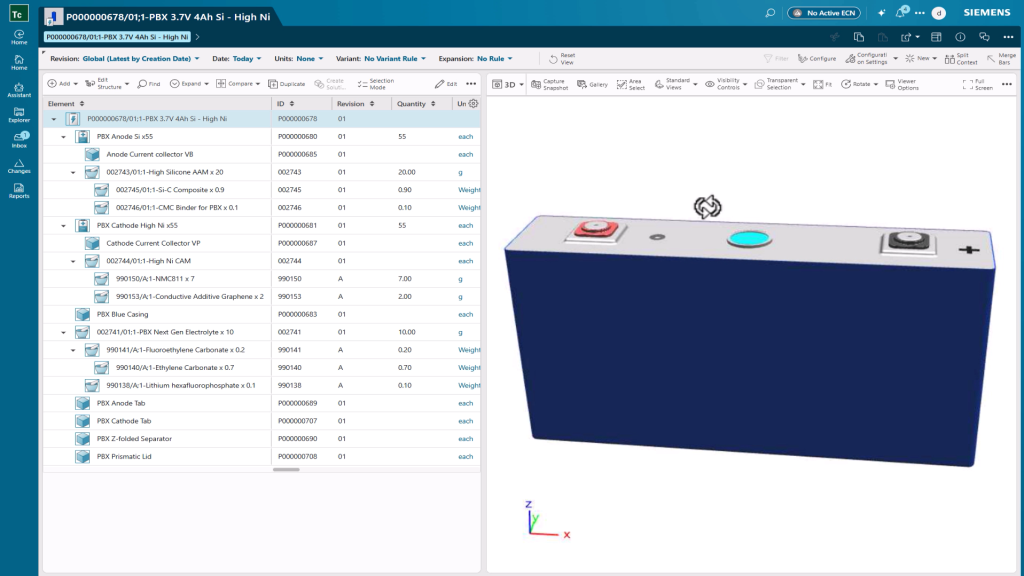
Most PLM systems were originally designed for traditional discrete industries such as automotive and aerospace. Battery development, however, presents a fundamentally different set of challenges. It brings together electrochemistry and process‑driven experimentation with mechatronics, electronics, embedded software, and large‑scale industrial production. This combination reshapes every aspect of the battery PLM environment—from the data model and user interface to release processes, traceability needs, and cross‑team collaboration.
Battery companies do not have the luxury of spending years figuring this out by themselves. They need a platform that comes ready for their world. That is why we built battery-specific data structures, user experiences, and workflows so teams can move faster with less customization and less reinvention.
Centralized EBOM management
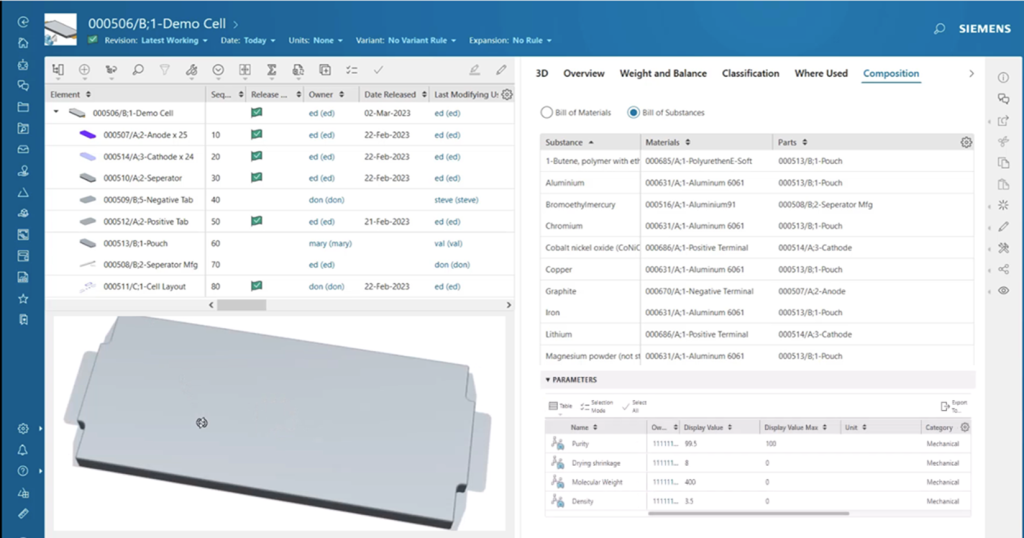
The platform uses EBOM as the central framework for holistic product definition, structuring the battery from electrode and cell ingredients all the way to cell, module, pack and containerized system. Material composition, engineering properties, software baselines, documents, 3D models, and lifecycle states can be managed in one controlled environment. For battery companies, this matters because a clean and governed product structure is not just good engineering hygiene; it is the foundation for traceability, design reuse, variant control, and battery-passport-ready digital records.
Industrialized Design of Experiments (DoE)
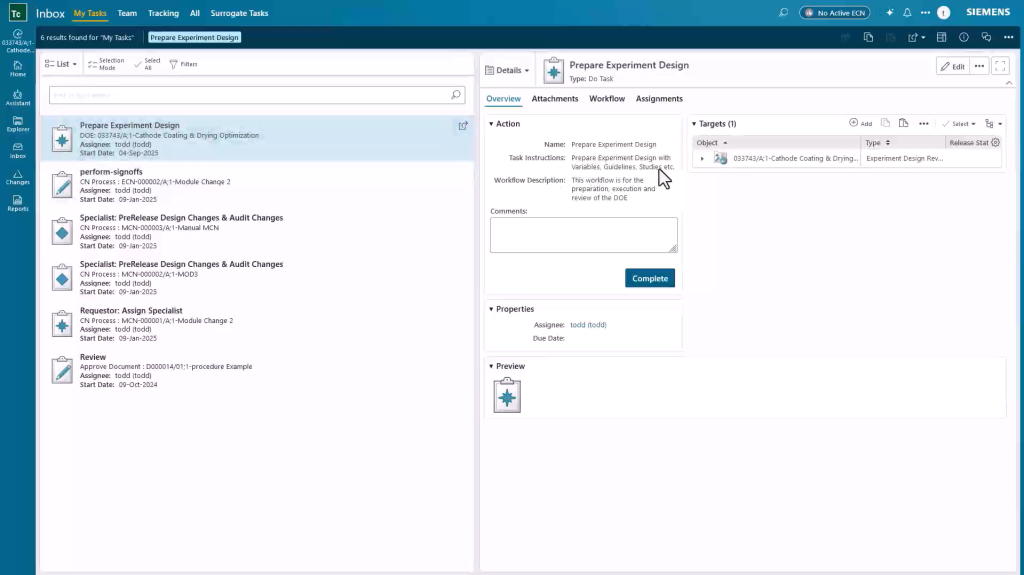
Battery development is full of learning loops. Teams may run hundreds of experiments to understand formulation choices, process windows, performance trade-offs, aging behavior, and manufacturability. The problem is rarely a lack of data. The problem is losing the context around that data. This solution helps industrialize Design of Experiments by allowing teams to define campaigns centrally, manage parameters in a structured way, and relate lab results, pilot-line outcomes, and virtual simulation outputs back to the exact configuration being evaluated. That makes learning reusable instead of tribal.
Cross-disciplinary collaboration
Battery designers, cell engineers, pack engineers, test teams, software specialists, quality leaders, and manufacturing engineering can collaborate in a unified environment. That reduces the classic horizontal disconnects between disciplines, and vertical gaps between the cell and system. Decisions become easier to trace. Changes become easier to assess.
Secure and scalable cloud delivery
Teamcenter Battery Lifecycle Management is also available through Teamcenter X as a cloud-based SaaS solution. For many battery companies, especially fast-scale organizations, this is a practical advantage. It simplifies deployment, supports distributed collaboration, and lowers the burden on internal IT while keeping the system secure and scalable.

Real benefits that matter
I have spent about 15 years helping companies deploy and adopt battery PLM, and the constant I see across each case is that a well-adopted battery PLM backbone is a game changer for engineering efficiency. When product data, change processes, and decisions are structured properly, teams do not just document their work better. They work better. With Teamcenter Battery Lifecycle Management, the benefits are tangible:
- Faster, smarter decisions by connecting cell, module, pack, and BESS development within one controlled product definition
- Less rework and fewer release errors through structured change management and clearer cross-functional impact analysis
- Stronger compliance readiness with traceable product records that support battery passport, quality, and regulatory reporting needs
- A better foundation for AI because agentic AI depends on structured, governed, and connected engineering data rather than disconnected files and informal knowledge
Battery PLM matters right now
In the era of Agentic AI, structured product and process data become strategic infrastructure. Companies that build this foundation early will be in a much stronger position to scale lifecycle intelligence across their business. Teamcenter Battery Lifecycle Management helps create that foundation.
The bottom line of battery PLM
As regulatory expectations rise and the race for better batteries intensifies, good chemistry alone is not enough. The winners will be the companies that can turn learning into industrial execution faster, with fewer surprises and stronger control across the lifecycle.
Teamcenter Battery Lifecycle Management provides a unified solution that reflects the complexity of battery development and helps teams move from innovation to industrialization with more discipline, more traceability, and more speed.
Start fast and grow with Teamcenter X | Make smarter decisions with AI-powered PLM
Table of Contents