Teamcenter Semiconductor Lifecycle Management: Modern PLM for the semiconductor industry

I have spent most of my career in the semiconductor industry, and one thing has remained constant: semiconductor companies have never lacked custom, specialized tools.
We have tools for requirements, IC design/verification, manufacturing, quality and enterprise planning. Those tools are critical. But as products and processes have become more complex, the challenge increasingly sits between them.
Why does connecting all this information matter, and how do we keep maintaining so many custom tools?
For semiconductor companies, those questions become especially important because the semiconductor lifecycle rarely happens in one system, one organization or even one location.
Requirements become programs that drive new product introductions. Designs rely on process technologies and PDKs, while IP is developed and incorporated into die designs. Tapeout produces mask sets, and advanced package requirements drive complex 3DIC packaging. Product and process definitions then connect through manufacturing and quality to production, suppliers, and sites.
Each step produces important information. The real challenge is maintaining the relationships between them.
That’s where PLM designed for the challenges of our industry steps in. With Oracle Agile support ending in 2027, companies have another reason to modernize rather than carry existing silos into a new system. It is an opportunity to create the connected data foundation that AI and agentic workflows depend on.
That is the problem we built Teamcenter Semiconductor Lifecycle Management to address,
PLM built for semiconductor success
Teamcenter Semiconductor Lifecycle Management is not a generic PLM system with a semiconductor overlay added on top. It brings together the proven enterprise PLM strength of Teamcenter with purpose-built semiconductor data models, processes, and workflows to manage the complexity of the semiconductor lifecycle from design through manufacturing.
It can be deployed either on-premises or on the cloud with Teamcenter X, It supports the different ways how semiconductor industry operates, including IDMs, Foundries, and Fabless companies, as well as collaboration with OSATs and internal manufacturing operations. Those out-of-the-box semiconductor capabilities are designed to help companies accelerate time to value without having to build the semiconductor context into PLM from scratch.
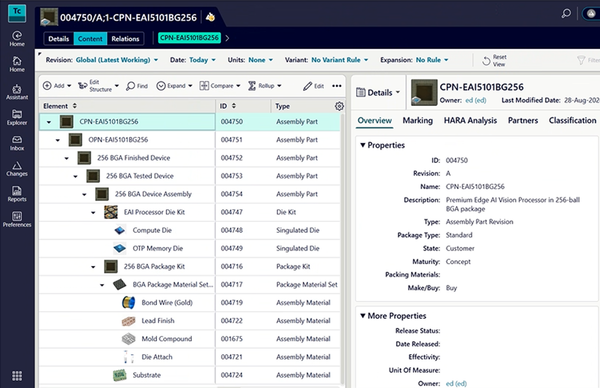
Semiconductor products challenge the traditional PLM narrative centered on part numbers and BOMs. The definition and lifecycle can include requirements, programs, IP, die designs, PDKs, wafer process technologies, GDSII/OASIS files, mask sets, advanced package data , manufacturing process definitions and quality information.
It manages the relationships among those records and leaves the specialized design and manufacturing tools in place.
Connect design to manufacturing
Design teams need to trace requirements, internal and external IP, die designs, process technologies and tape-outs. Manufacturing teams need the product definition, bin definitions, test definitions, mask sets, MBOMs, process planning, and plant resources. Quality and Product Engineers need to collaborate on NPI and PPAP planning, issue management with 8D problem solving and CAPA. The changes and approvals between them decide whether the right product is built with the right process. Teamcenter Semiconductor Lifecycle Management supports a digital thread with IP and design-data mapping, multi-domain CAD and connectivity across PLM, ERP, MES and quality.
Teams can then answer which IP went into a die design, which tapeout revision went into a mask set, and what non-conformance corrective action generated a BOM ECN, without rebuilding the answer from several systems.
Make anywhere without losing the thread
Where and how something is made matters as much as what is made. A product definition may originate in one organization, manufacturing planning in another and production at an external site.

Having a system that supports the “golden triangle” of PLM/QMS/MES to ERP allows for full traceability and strong change management.
Connecting these systems keeps the product, process and change context intact across organizations and manufacturing sites. That is what enables “make anywhere” without losing the digital thread.
Bring quality and compliance into the same lifecycle
A quality event should trace back to the product, process or change that caused it. Teamcenter Semiconductor Lifecycle Management puts PLM, quality and compliance on one platform, connecting NPI and NTI milestones with APQP planning, FMEAs, audit findings, issues, CAPA and change management. It also covers material management and substance compliance, reliability test planning and functional safety.
When something changes, teams see what it affects. When an issue occurs, they trace it back to the lifecycle data behind it, with audit and compliance evidence linked to the product.
AI-ready data starts with a connected digital thread
A connected digital thread removes the brittle data mapping and metadata propagation that custom, single-use applications create. It also gives machine learning models, predictive analytics and AI agents what they need: clean, contextualized data with the relationships intact, such as which IP, process technology and mask set belong to which product and what changed along the way.
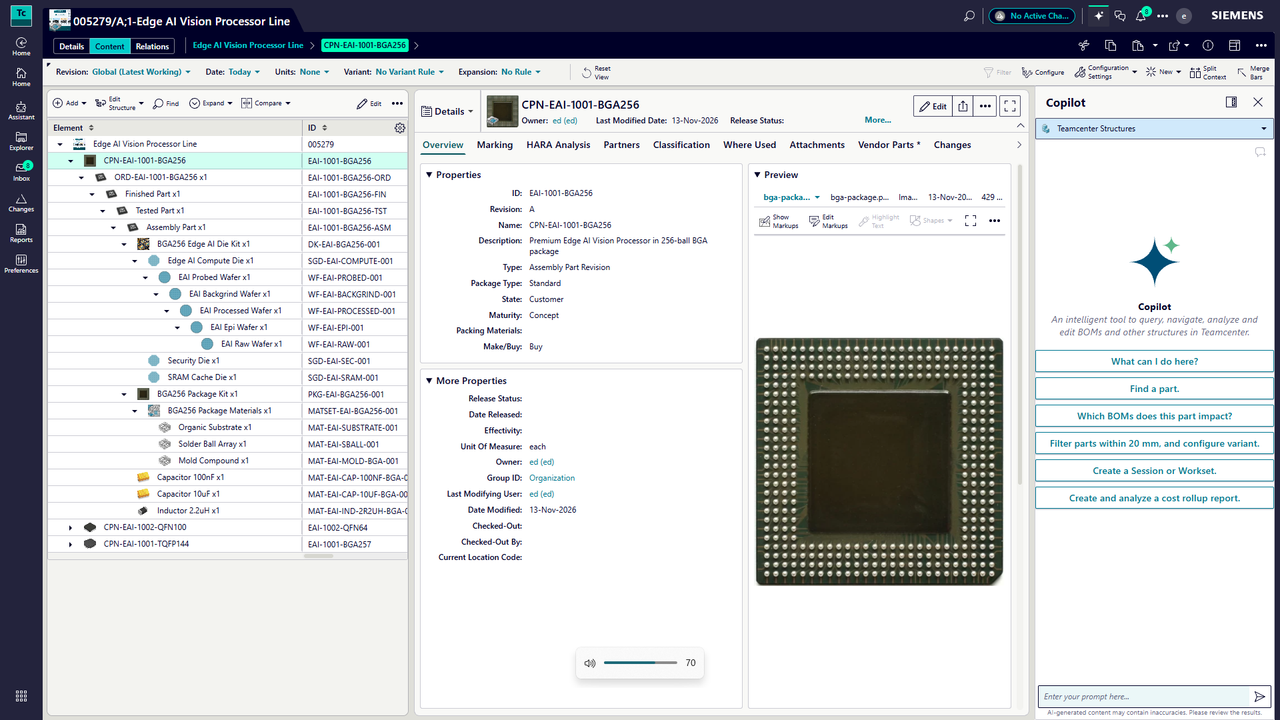
Read more about our AI leadership, including recent recognition from Gartner.
Start with the problem that matters most
A semiconductor company does not have to solve the whole lifecycle on day one. Teamcenter provides the PLM platform for cloud or on-premises deployment, and Teamcenter Semiconductor Lifecycle Management adds the semiconductor capabilities. Some teams begin with NPI, others with IP and design data, design-to-manufacturing traceability or quality, then extend the digital thread over time.
The semiconductor digital thread is bigger than any one tool
I don’t believe one application should hold every activity in the lifecycle management of semiconductor products. Our industry is too specialized for that.
Specialized engineering and manufacturing systems keep doing what they do best, while a common lifecycle connects their information. Teamcenter Semiconductor Lifecycle Management gives foundries, fabless companies and IDMs that thread from requirements and NPI through IP, design, manufacturing and quality, across the systems, organizations and sites that make up the industry.
The value comes from the connections that turn data into a product.
Frequently Asked Questions
What is Teamcenter Semiconductor Lifecycle Management?
Teamcenter Semiconductor Lifecycle Management is a semiconductor-ready PLM solution built on Teamcenter, deployed on-premises or on the cloud with Teamcenter X, and designed to connect product lifecycle, semiconductor design data, manufacturing, quality and compliance information. It provides a common environment for managing the information and processes that span the semiconductor lifecycle, from early design through manufacturing and end-of-life.
Who is Teamcenter Semiconductor Lifecycle Management designed for?
Teamcenter Semiconductor Lifecycle Management supports the different business models that make up the semiconductor industry, including Foundries, Fabless companies and IDMs. It is designed around semiconductor-specific data, processes and workflows while providing flexibility to work with foundries, OSATs, internal factories and other partners across the value chain.
How is Teamcenter Semiconductor Lifecycle Management different from traditional PLM?
Traditional PLM provides an important foundation for managing products, programs, configurations and change. Teamcenter Semiconductor Lifecycle Management builds on that foundation with capabilities designed specifically for semiconductor companies.
This includes semiconductor-specific data models and workflows for processes such as die and mask management, technology and chipset design artifacts, multi-domain design data, manufacturing planning, quality processes and compliance. Instead of treating semiconductor information as a separate island, it becomes part of the broader product lifecycle.
Does Teamcenter Semiconductor Lifecycle Management support quality and compliance?
Yes. Product lifecycle, quality and compliance processes can be managed on the same Teamcenter platform. This brings semiconductor development milestones together with quality planning, FMEA, audit findings, CAPA, change management, substance compliance, reliability planning and functional safety processes.
Connecting these activities helps teams manage quality as part of the product lifecycle rather than as a separate downstream activity.
How does Teamcenter Semiconductor Lifecycle Management help companies planning for the end of Oracle Agile support?
Oracle Agile support ends at the end of 2027, which gives semiconductor companies a reason to review their PDM and PLM environments now. Teamcenter Semiconductor Lifecycle Management offers a PLM solution, deployed either on-premises or on the cloud as a SaaS solution, built around the semiconductor lifecycle. It can absorb separate PDM environments and replace custom, single-use applications, bringing requirements, programs, IP, design data, manufacturing definitions, quality and compliance into one connected environment.
Companies do not have to move everything at once. They can start with the processes creating the most friction, such as NPI, IP and design data, or quality, and extend the digital thread over time. The move away from Agile also creates an opportunity to simplify the PLM environment and consider how those processes should work going forward.
How does a connected digital thread support AI in semiconductor lifecycle management?
Machine learning models, predictive analytics and AI agents need data that is consistent and keeps its relationships. When information sits in disconnected systems and is linked through custom mappings, that context gets lost. Teamcenter Semiconductor Lifecycle Management connects requirements, IP, design data, mask sets, manufacturing definitions, quality records and changes in one lifecycle.
Teamcenter provides the traceable, contextualized data foundation. Teams can then use it to support predictive analytics, design-yield optimization and faster decisions, and to build agentic workflows on top of it.
Read more about our AI leadership, including recent recognition from Gartner.
Is Teamcenter Semiconductor Lifecycle Management a product or an overlay?
Teamcenter Semiconductor Lifecycle Management is a supported Siemens industry solution, not simply an overlay, based on Siemens Teamcenter software. Development began in 2018, with the solution becoming a fully supported offering in 2022. Since then, Siemens has continued to invest in new capabilities through regular releases shaped by our work with semiconductor customers.
🧠 Make smarter decisions with AI-powered PLM
🚀 Start fast and grow with Teamcenter X
🚗 Take the Teamcenter X 30-day test drive
🌟 Learn more about Teamcenter solutions
Table of Contents