How to master sustainable product development with Teamcenter and Makersite

We all know the industry standard: the vast majority of a product’s environmental footprint is locked in during the design phase. But for most engineers, the real struggle isn’t knowing that fact—it’s having the data early enough to do something about it.
Despite this, many engineering teams receive sustainability insights far too late—often after critical decisions have already been locked in. To achieve true sustainable product development, engineers need environmental intelligence early enough to influence the design.
In our latest video demonstration, we show how the integration between Teamcenter Sustainability Lifecycle Assessment and Makersite creates a closed-loop sustainability workflow, allowing teams to make better environmental decisions before a product is ever released.
The challenge: Moving sustainability upstream
In traditional workflows, Life Cycle Assessments (LCA) are often disconnected from the actual design process. By the time a report is generated, the Bill of Materials (BOM) is finalized, and the opportunity for meaningful change has passed.
To solve this, Siemens and Makersite have partnered to bring sustainability intelligence directly into the PLM environment.
Step 1: Initiating the LCA request in Teamcenter Sustainability Lifecycle Assessment
The process begins where the engineering work happens in Teamcenter.
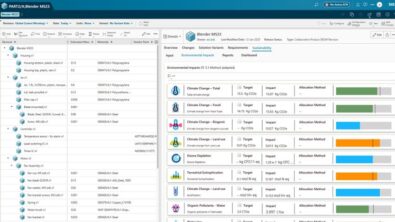
Engineers work with a fully defined BOM, including materials, supplier info, and weight. Within Teamcenter, you can now:
- Define environmental goals directly against the product structure.
- Set carbon threshold values at both the product and individual part levels.
- Track environmental performance in real-time as the design evolves.
With a single action, the engineer initiates an LCA request. The BOM is automatically pushed to Makersite with no manual data preparation required.
Step 2: Automated supply chain modeling with AI
Once the data reaches Makersite, the heavy lifting begins. Using AI and machine learning, Makersite automatically maps each component to a massive network of external environmental data.
This creates a digital twin of the supply chain, covering:
- Raw material extraction
- Manufacturing processes
- Regional supply chain variations
The LCA is calculated instantly across multiple impact categories, providing a granular view of the product’s footprint.
Step 3: Closing the loop and scaling reports
The true power of this workflow is that it is closed-loop. The results are sent back to Teamcenter Sustainability Lifecycle Assessment, allowing engineers to review sustainability insights in their native environment.
Because the analysis is connected to the live product model, any changes to the BOM or supply chain are reflected immediately. This makes environmental reporting:
- Scalable: No need to start from scratch for every design iteration.
- Repeatable: Standardized data supports Environmental Product Declarations (EPD) and Product Environmental Footprint (PEF) reporting.
- Actionable: Engineers can compare alternatives (e.g., different materials or suppliers) to see the immediate impact on their carbon goals.
Design for a greener future
Sustainable product development isn’t just about reporting on the past; it’s about shaping the future. By connecting Teamcenter Sustainability Lifecycle Assessment and Makersite, we are empowering teams to understand their impact, compare alternatives, and support sustainability from the very start.
Ready to see it in action? Watch the full demonstration above to see how you can start reducing your product’s footprint today.