Transform your competitive edge with Teamcenter Sustainability Lifecycle Assessment
Sustainability is no longer a peripheral concern — it has become a defining factor for manufacturers to achieve a competitive edge. What began as a compliance exercise has now evolved into a core business strategy, empowering companies to win business, secure market access, and showcase responsible innovation. To thrive in this new landscape, manufacturers must go beyond merely measuring the environmental impact of their products. They need scalable, accurate, and verifiable insights across their entire product portfolio to meet growing market and regulatory demands.
This transformation is driven by two critical focal points: regulatory reporting and eco-design.
Regulatory reporting: From burden to strategic opportunity
As sustainability becomes a fundamental criterion in procurement decisions, manufacturers must now produce environmental disclosures such as Product Carbon Footprints (PCFs), Lifecycle Assessments (LCAs), and Environmental Product Declarations (EPDs). These are no longer optional extras — they are essential for participating in large bids and preserving revenue streams.
However, the operational challenges are immense:
- Volume: Manufacturers with hundreds or thousands of products must assess each item’s environmental impact
- Accuracy: Disclosures must meet increasing transparency, traceability, and consistency requirements
- Inefficiencies: Reliance on manual processes and scattered data systems creates roadblocks to meeting these demands at scale
Eco-Design: Creating better products using data-driven insights
Scaling environmental impact measurement unlocks valuable opportunities to design greener, more competitive products. With reliable sustainability metrics:
- Businesses can reduce carbon footprints, optimize material use, and enhance product lifecycle performance
- Environmental performance becomes a strategic design consideration alongside cost, manufacturing efficiency, and quality
However, operational blockers abound:
- Knowledge gaps: Engineers often lack expertise in interpreting LCA data, limiting sustainability-informed decisions
- Overstretched teams: Sustainability professionals are managing increasing workloads with insufficient resources
- Outdated tools: Existing processes often fail to support iterative design-level decision-making, slowing innovation
Introducing Teamcenter Sustainability Lifecycle Assessment
To address these challenges, Siemens introduces Teamcenter Sustainability Lifecycle Assessment — a groundbreaking solution that seamlessly integrates sustainability intelligence into the Teamcenter ecosystem. By embedding environmental, regulatory, and cost insights into product development workflows, this solution makes sustainability actionable from the very beginning of the design process.
What is Teamcenter Sustainability Lifecycle Assessment?
Teamcenter® is a central platform where manufacturers manage complete product definitions, such as the bill of materials (BOM), materials, manufacturing processes, supplier information, and more. With its powerful integrations across MCAD, ECAD, simulation, and manufacturing tools, Teamcenter provides a reliable foundation for early-stage product development.
The new sustainability module integrates advanced capabilities from Makersite, leveraging AI, lifecycle assessment expertise, supply-chain risk analysis, and cost modeling to enrich BOM data with actionable environmental intelligence.
How Teamcenter Sustainability Lifecycle Assessment works
- Data transmission: Teamcenter sends product BOM, materials, manufacturing processes, and supplier part information to Makersite using the new LCA Integration Gateway.
- Semantic modeling: The gateway’s provider-agnostic semantic model ensures accurate, consistent data transfer to Makersite’s platform.
- Data enrichment: Makersite integrates Teamcenter data with over 140 external sources and uses AI/ML to fill gaps, building fully ISO-compliant LCA models.
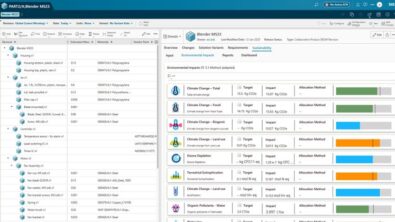
- Actionable insights: Environmental metrics, supply-chain risks, cost insights, and other KPIs are calculated and published back into Teamcenter, enriching BOM data with strategic sustainability intelligence
Key benefits of Teamcenter Sustainability Lifecycle Assessment:
With Teamcenter Sustainability Lifecycle Assessment, manufacturers can:
- Embed sustainability in design: Add actionable environmental, cost, and supply-chain insights directly into engineering workflows.
- Improve accuracy with AI: Use automated data enrichment and AI-powered gap filling to accelerate LCA processes.
- Scale transparency and compliance: Standardize reporting using consistent, traceable, and ISO-compliant models for the entire portfolio.
- Automate environmental reporting: Streamline the creation of PCFs, LCAs, and EPDs without relying on manual, time-intensive spreadsheets.
- Meet regulatory and market demands: Confidently address compliance, tender, and customer requirements, reducing risks and improving response times.
- Design greener products: Optimize sustainability alongside traditional design criteria, such as cost, manufacturability, and supply-chain resilience.
Transform sustainability into a competitive advantage
Teamcenter Sustainability Lifecycle Assessment empowers organizations to design greener, safer, and more competitive products — not as an afterthought but as an integral part of the product development process. As sustainability continues to define market success, this solution equips manufacturers to turn compliance challenges into opportunities, driving both profitability and environmental stewardship.