How to Manage Concurrent V-Model Development with Traceable Baselines Sets in Polarion
In today’s fast-paced product development landscape, managing complex projects, especially in regulated industries, is a constant challenge. The V-model, with its emphasis on structured development, verification, and validation, remains a cornerstone for ensuring quality and compliance. But how do you apply this rigorous model when you’re developing multiple product releases or variants concurrently?
Enter Polarion.
Polarion helps manage concurrent V-model development by creating immutable, traceable baseline sets for requirements, design, and test artifacts across releases and variants. Using Polarion Collections, teams can support parallel development streams while maintaining approved hand-offs, end-to-end traceability, and audit-ready evidence. This makes it easier to control change, reduce version confusion, and coordinate validation across complex product programs without duplicating data or losing compliance context.
The Challenge of Concurrent V-Model Development
Imagine your organization has dedicated teams for each phase of the V-model: a Requirements Team, a Design Team, an Implementation Team, and a Testing Team. Now, picture them working on Release 1.0, Release 2.0, and various product variants, all simultaneously. Each release and variant needs its own set of requirements, designs, and test cases, evolving at different rates.
The core problem: How do you ensure every team is always working with the “correct versions” of requirements, specifications, and test artifacts for their specific release or variant, without creating chaos or sacrificing traceability?
Traditional approaches often lead to:
- Version Drift: Teams accidentally using outdated requirements.
- Manual Overhead: Tediously linking and re-linking artifacts for each release.
- Duplication: Copying common requirements across multiple projects.
- Compliance Headaches: Difficulty proving what was approved when.
Enter Polarion Collections: Your V-Model’s Best Friend
Think of a Polarion Collection as an immutable, time-stamped snapshot of a specific set of Work Items (requirements, test cases, design elements) and Documents from across your project. Once created, it’s a frozen, unchangeable reference point.
Here’s how Collections, especially when used hierarchically, revolutionize concurrent V-model development:
1. Defining Each V-Model Phase as a Linked Collection
Instead of one giant “Release Collection,” we can map each V-model phase to its own dedicated Collection.
Example for Release 1.0:
- Release 1.0 Product Collection (Top-Level): The overarching snapshot of everything for Release 1.0.
- Links to: Release 1.0 Requirements Collection, Release 1.0 Design Collection, Release 1.0 Test Collection, etc.
- Release 1.0 Requirements Collection: Contains specific versions of all approved requirements for Release 1.0.
- Created: After requirements analysis and formal approval.
- Links to (Downstream): Release 1.0 Design Collection (meaning the design is based on this specific set of requirements).
- It should be noted here that for large projects, each collection could contain several hundred modules or documents that each could contain thousands of requirements. Each requirement can link to other requirements within the same document. Within the same collection, or even upstream to other collections work products.
- Release 1.0 Design Collection: Holds specific versions of approved design specifications.
- Created: After design is complete and approved.
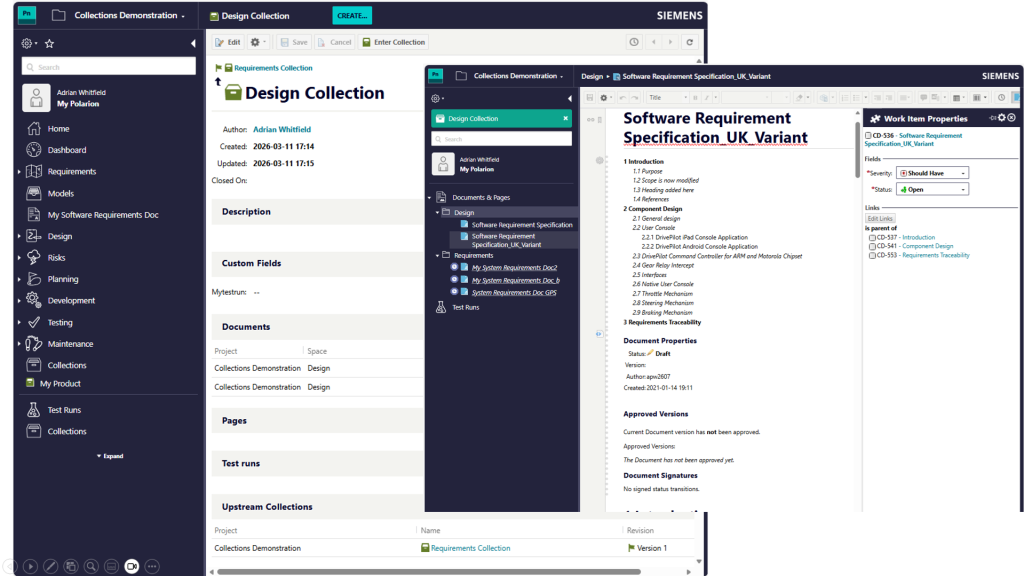
- Links to (Upstream): Release 1.0 Requirements Collection (critical for traceability) – supported by Polarion Collection hierarchy feature.
- …and so on for Implementation, Test, and other phases.
This hierarchical structure (supported by Polarion collection hierarchies) provides:
- Granular Baselines: Freeze progress at the end of each V-model phase.
- Crystal-Clear Scope: Each team knows exactly which baselined collection they are working against.
- Enhanced Traceability: The links between collections provide an unbroken chain from requirements to design to test, crucial for verification and validation.
- Complex reuseable structures: Collections are hierarchical and can be reused in different structures without the need to copy.
2. Concurrent V-Model Development: Empowering Parallel Progress with Confidence
One of the most significant advantages of using Polarion Collections in this structured way is how they facilitate true concurrent V-model development. This isn’t just about different teams working on different things; it’s about enabling multiple V-model cycles to run in parallel, each with its own definitive set of artifacts, without confusion or conflict.
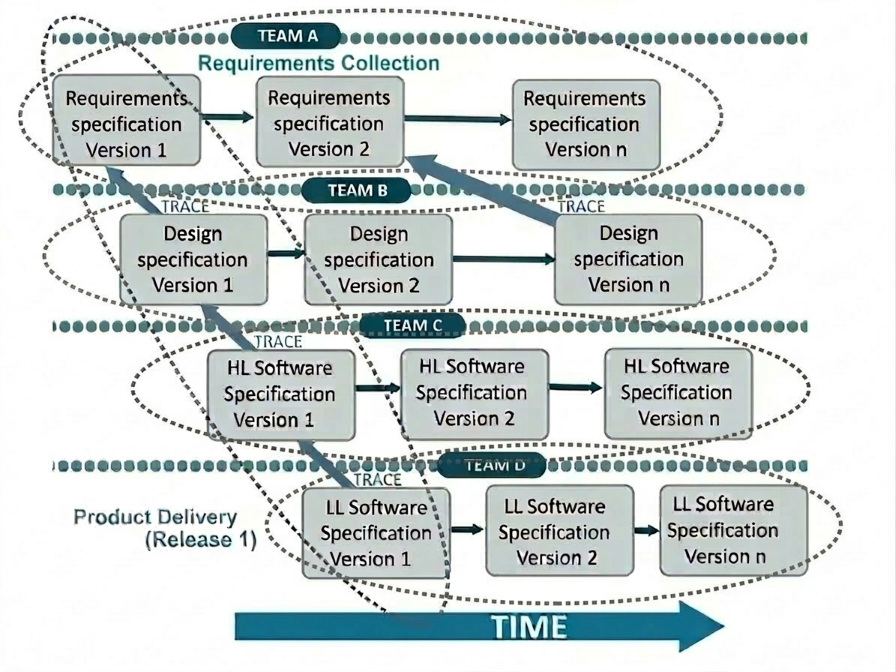
Imagine a scenario with horizontal teams:
- The Requirements Team (Team A) is busy defining and refining the Release 2.0 Requirements Collection. They are collaborating with product management and stakeholders, gathering input for the next major product iteration.
- Meanwhile, the Design Team (Design B) is actively working on the Release 1.0 Design Collection. Crucially, they are basing their detailed design work on the approved and baselined Release 1.0 Requirements Collection. They know exactly which requirements to address and can proceed with confidence, even as the Requirements Team is already looking ahead to Release 2.0.
- Concurrently, the Testing Team (not shown on the diagram below) is executing tests against the Release 0.9 Test Collection for a hotfix or minor update, ensuring the stability of the current production version.
The Key Enabler: Immutability and Explicit Linking
Because each Collection is an immutable snapshot, it acts as an unchangeable contract for a specific V-model phase and release. When the Design Team starts working on Release 1.0, they explicitly link their Release 1.0 Design Collection to the Release 1.0 Requirements Collection. This link is precise and unambiguous.
This means:
- No Accidental Contamination: The Design Team working on Release 1.0 will never accidentally pull in a requirement change that was intended for Release 2.0 (unless explicitly chosen and linked). The boundaries between releases are clearly defined by their respective Collections.
- Independent Progress: Teams can advance through their V-model phases independently. The Design Team doesn’t need to wait for the Requirements Team to finish all future requirements, and the Requirements Team doesn’t need to worry about the Design Team’s progress on a previous release. Each team has its own “source of truth” for its current scope.
- Controlled Hand-offs: Collections serve as formal hand-off points. Once the Release 1.0 Requirements Collection is approved, it’s the definitive input for the Release 1.0 Design Collection. This formalizes the transition between V-model phases, ensuring that subsequent teams are always working from an approved baseline.
- Clear Accountability: Each Collection clearly defines the scope and approved artifacts for a given stage, making accountability and auditability straightforward.
In essence, Polarion Collections provide the necessary “airlocks” and “checkpoints” that allow multiple V-model lifecycles to coexist and progress in parallel. This empowers specialized teams to work efficiently on their assigned phase for a particular release or variant, knowing they are always building, verifying, and validating against the correct, formally approved versions of the work products relevant to their specific development stream, even as other teams are moving ahead on different releases or working on different aspects of the overall product portfolio.
3. Streamlined Change Management
Change is inevitable. Polarion Collections handle it gracefully:
- Controlled Evolution: If a requirement in an already baselined Release 1.0 Requirements Collection needs modification, you create a new version of that collection (e.g., Requirements Collection v1.1).
- Easy Updates: Downstream collections (like your Design Collection) can then be updated to reference these new, corrected requirements. Polarion can automatically update the links to the upstream Requirements Collection, so integrity is maintained, making updates efficient and auditable.
- Impact Visibility: This process provides a clear audit trail of changes and helps visualize the impact across your V-model, ensuring no critical step is missed.
4. Powerful Reuse for Common Functionalities and Compliance: The Ultimate Efficiency Play
This is where Polarion Collections truly demonstrate their strategic superiority for platform development and highly regulated environments:
- “Core Component” Collections: Establish dedicated Collections for any reusable module or functionality (e.g., “Secure Login Module Requirements”). This collection becomes the single source of truth for all its requirements, design, and test cases.
- Strategic Linking for Reuse: Other product-specific collections (e.g., “Product A Release 1.0 Requirements”) can simply and powerfully link to this “Core Component” Collection. This is vastly superior to copying, which quickly leads to divergence and maintenance nightmares.
- Unassailable Compliance Collections: Create Collections for “Company Coding Guidelines,” “Industry Standard X Requirements,” or “Regulatory Mandate Y.” Every project can then link to these, providing irrefutable evidence of compliance without any duplication of content.
Unlocking Strategic Benefits through Reuse:
- Single Source of Truth: Updates to a shared component’s definition occur in one central, controlled location, propagating automatically and reliably to all linked projects.
- Massive Reduction in Effort & Cost: Eliminating duplication translates directly into faster development cycles, significantly lower maintenance costs, and reduced risk.
- Unprecedented Consistency & Quality: All products leveraging shared collections inherently adhere to the same approved, high-quality standards.
- Simplified, Bulletproof Audits: Demonstrating compliance or component reuse becomes a straightforward, transparent, and auditable process, saving countless hours and mitigating risk.
Conclusion: Polarion Collections for Concurrent Development, Traceable Baseline Sets, and Audit-Ready Change Control
By strategically implementing Polarion Collections, your organization gains an unparalleled mechanism to:
- Maintain absolute control and end-to-end traceability throughout the hierarchy of the entire V-model lifecycle.
- Enable truly concurrent development across an intricate portfolio of releases and variants with unwavering confidence and precision.
- Adapt efficiently and robustly to change without ever sacrificing integrity or compliance.
- Maximize reuse and standardization across your product lines, leading to monumental gains in efficiency, product quality, and regulatory compliance.
- Next generation baseline management with built in revisioning. Work efficiently without creating unnecessary deep copies of work products.
- Ready today for small and large teams no matter how you are organized and how complex the development process and product dependencies are.
Polarion Collections are not merely a feature set; they are a foundational strategic tool for conquering the complexity of modern product development. They ensure that “all teams work with the correct versions of lifecycle products” every single time, providing a competitive edge that less mature solutions simply cannot match. This is the difference between managing complexity and mastering it.
If you’re new to Polarion, now is a great time to take a look, with an easy-to-use trial at Polarion ALM trial | Siemens Digital Industries Software