How Arizona State University is redefining education and lifelong learning through microcredentials
In fields like AI, microelectronics and digital manufacturing, the distance between what the workforce knows and what industry needs is widening at an alarming pace. According to the World Economic Forum, nearly 40 percent of workers’ core skills will change dramatically or become obsolete by 2030, underlining that lifelong learning is now an urgent imperative.
So how can educational institutions and businesses alike work to build learning infrastructure that stays abreast of these rapid paradigm shifts?
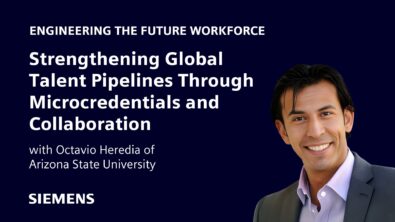
On this episode of Engineering the Future Workforce, we sat down with Octavio Heredia, Director of Global Outreach and Extended Education at Arizona State University’s (ASU) Fulton Schools of Engineering. With nearly 23 years at ASU, Heredia leads initiatives connecting industry, academia and learners worldwide, focusing on high-demand fields like microelectronics and AI. His work designing scalable, industry-aligned pathways makes him uniquely positioned to address how universities can bridge the gap between what they teach and what industry needs.
For Heredia and ASU, stackable microcredentials are emerging as an essential tool for closing the talent gap at the speed of industrial change.
Listen on Spotify
Listen on Apple
Delivering targeted, customized learning experiences where they’re needed most in industry with microcredentials
The biggest challenge in addressing the engineering skills gap isn’t finding or establishing the requisite knowledge but making it more accessible to working engineers and other lifelong learners. That’s where microcredentials offer a powerful, dynamic complement to traditional engineering degrees.
Heredia shared a compelling example of how this new modality works in practice. ASU recently partnered with a global semiconductor company that needed to upskill 60 engineers across three global sites in semiconductor device physics on an accelerated time frame.
“We were able to find relevant content and expertise from different courses, pull them out and organize them into a new structure and quickly deliver that particular content,” Heredia said.
Using a stackable microcredential framework, ASU delivered targeted training in weeks instead of years. Engineers gained immediately applicable skills, the company met urgent business outcomes and learners earned verified credentials at each milestone.
“What was different about it was using our microcredential framework to offer a learning experience highly focused on the learning outcomes and highly focused on the skills and competencies that the client wanted.”
For Heredia, it’s important that employers understand that microcredentials verify that “it’s not just new knowledge, but it’s new knowledge put into practice.” He’s not alone: according to Coursera, 94% of human resources and talent leaders want credentials to include endorsements, but only 31% of issuers at present include them.
Siemens now offers two ABET-recognized credentials. Learn more about Expedite – Skills for Industry and Design for the Circular Economy.
Empowering learners to tell their own story
One of the most compelling aspects of our conversation centered on learning and employment records and how they allow students and professionals to showcase the full range of their capabilities.
Traditional transcripts tell a linear story: courses taken, grades earned and a degree conferred. Learning and employment records offer a richer story, aggregating formal degrees, microcredentials, project work, certifications and verified skills into a single, portable record that learners control.
Heredia articulated the vision:
“How do we provide learners with the mechanisms for them to bring all of their learning into one place and really can empower them to now be able to tell their own story of their achievements and their own journey? We’d like to help them showcase that they know the technologies and the tools and that they offer a rich background of knowledge and skills from their different experiences. And we’d like to do it in a way that allows them to tell their own story of how they’re the best candidate for that job.”
For employees, this means career mobility. For employers, it allows for greater visibility into workforce capabilities, allowing talent leaders to identify individuals with specific, verified competencies.
Building not just engineers, but “master learners”
Perhaps the most transformative aspect of this new infrastructure is its emphasis on mindset over credentials alone.
Heredia shared ASU President Michael Crow’s vision: “President Crow has really brought this vision of, ‘We’re not creating engineers, we’re not creating lawyers, we’re not creating marketing graduates. We are creating master learners.’ We want our students to build the habits, the knowledge and the experiences that allow them to learn and achieve anything they want.”
By creating transdisciplinary learning experiences and stackable pathways that meet learners where they are, institutions can shift from credentialing endpoints to enabling continuous growth. A mechanical engineer can add AI expertise through microcredentials. Similarly, a mid-career professional could pivot into a new discipline without starting from scratch. Learning becomes personalized, verified and continuous.
Solving the engineering skills gap requires new infrastructure and learning modalities: agile credentialing systems, deep industry-academia partnerships and learner-centric records that capture the full arc of professional growth. The institutions and companies building this infrastructure today are architecting the future of work.
Want to hear more from Octavio Heredia about ASU’s approach to microcredentials, global partnerships and the future of lifelong learning? Listen to the full conversation on Engineering the Future Workforce.
Watch on YouTube
Engineering the Future Workforce
Engineering the Future Workforce explores emerging and best practices that are empowering the next generation of engineering talent. The series will showcase conversations with leading voices from academia and industry who are committed to improving learners’ digital skillset and mindset to accelerate innovation.
Listen on: