What’s new in Parasolid v 38.0

The latest release of Parasolid, version 38.0, is now available.
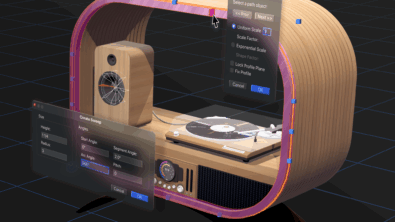
This release further extends Parasolid’s core modeling capabilities in the areas of surfacing and blending, providing finer application control features. Enhancements are also introduced in key areas of active development, such as lattices and modeling on general bodies. The release includes new modeling and application support features.
Surfacing
In this release, Parasolid can report additional information on surfaces:
- Extensions as a result of a modeling operation – based on this information, the application can choose whether to create its own extended surface instead of the one created by Parasolid
- Whether b-geometry is a helical curve or surface
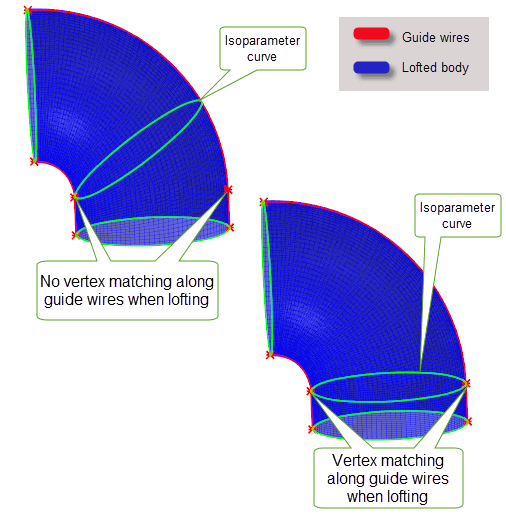
Additionally, more intuitive control over the shape of lofts is introduced – the shape of a lofted body can be controlled by vertex matching along guide wires
Blending
In this release, support is extended for constant-width blends:
- Re-blending of constant-width blends in face change operations
- Includes complex configurations, such as overflows
- constant-width blend can have a G2 cross-section

Faceting and rendering
Parasolid supports the generation of a mesh of polygonal planar facets to represent the faces of an accurate part, for use in visualization, rendering and simulation. Enhancements in this release include:
- Improved precision when faceting blends
- Output of polyline data for edges when faceting
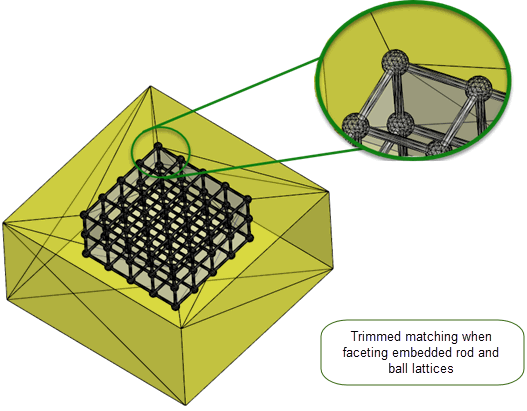
- Finer application control and improved performance of faceting for embedded rod and ball lattices
- Support for the visualization of standalone implicit pattern lattices
Operations on general bodies
Parasolid supports the creation and editing of general bodies, that can consist of a combination of manifold, non-manifold, cellular and mixed-dimension parts, allowing to bring virtually any 3D design concept to life.
In this release, more complex modeling operations are supported for:
- Regions of a general body that are locally manifold – blending, face replacement, clash repairment during face replacement and local operations on faces
- Cellular bodies – edge imprint, sectioning, extreme points calculation and blend identification
- Cellular bodies with embedded lattices – extension of a sheet body to the target cellular body

Lattices
In this release, modeling support on lattices is extended:
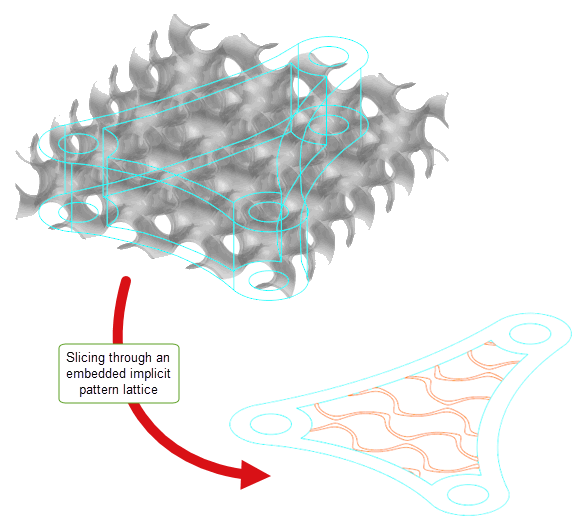
- Cellular bodies containing implicit pattern lattices
- Slicing and enlarging
- Calculating the mass properties and local density of the sub-topology
- Embedded lattices
- Parasolid will return a manifold body if possible when imprinting a frame onto a region
- Containment calculation – it is possible to choose whether the points are considered to be inside the body when anywhere within a latticed region or when only inside the latticed material of the region
Modeling support
Several enhancements have been introduced to support modeling operations: C2 curves can be generated when using arc-length parameterization, boxing functionality can return axis-aligned boxes for regions and shells and applications can now control whether to check for missing geometry – useful for interoperability workflows.
Application support
Enhancements in application support include:
- Multiple part files can be transmitted where the parts include instances that belong to more than one assembly and have a common part
- Tracking information for sets of patterned faces and their original input faces
- Python binding – still beta-test – can be used for any kind of application including ones to be made generally available
- Improvements to diagnostic – the application can use this information to resolve issues in the model data
To know more about Parasolid, visit the product page https://plm.sw.siemens.com/en-US/plm-components/parasolid/ or request a free 60 days trial https://resources.sw.siemens.com/en-US/parasolid-free-evaluation/.
Parasolid is part of the Siemens PLM Components portfolio, a set of advanced, industry-proven Software Development Kits integrated by 3D applications in product design, simulation and manufacturing. To know more, visit PLM Components | Siemens Software.
If you are developing next-generation software for 3D product design, simulation or manufacturing, join us in Cambridge, UK, on April 28-29, 2026, for the fourth PLM Components Innovation Conference. This is a unique opportunity to understand the value of PLM Components and joining Siemens’ open software vendor ecosystem.
To know more and register for the free event, visit PLM Components Innovation Conference 2026 | Siemens Software.