Europe’s AI sovereignty can be won through manufacturing
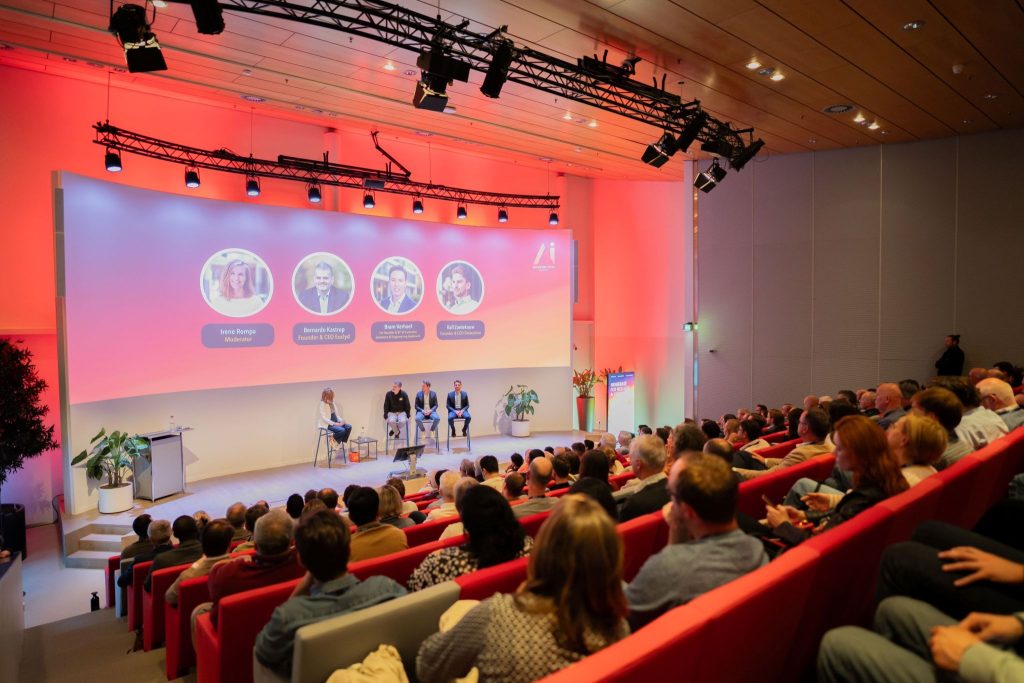
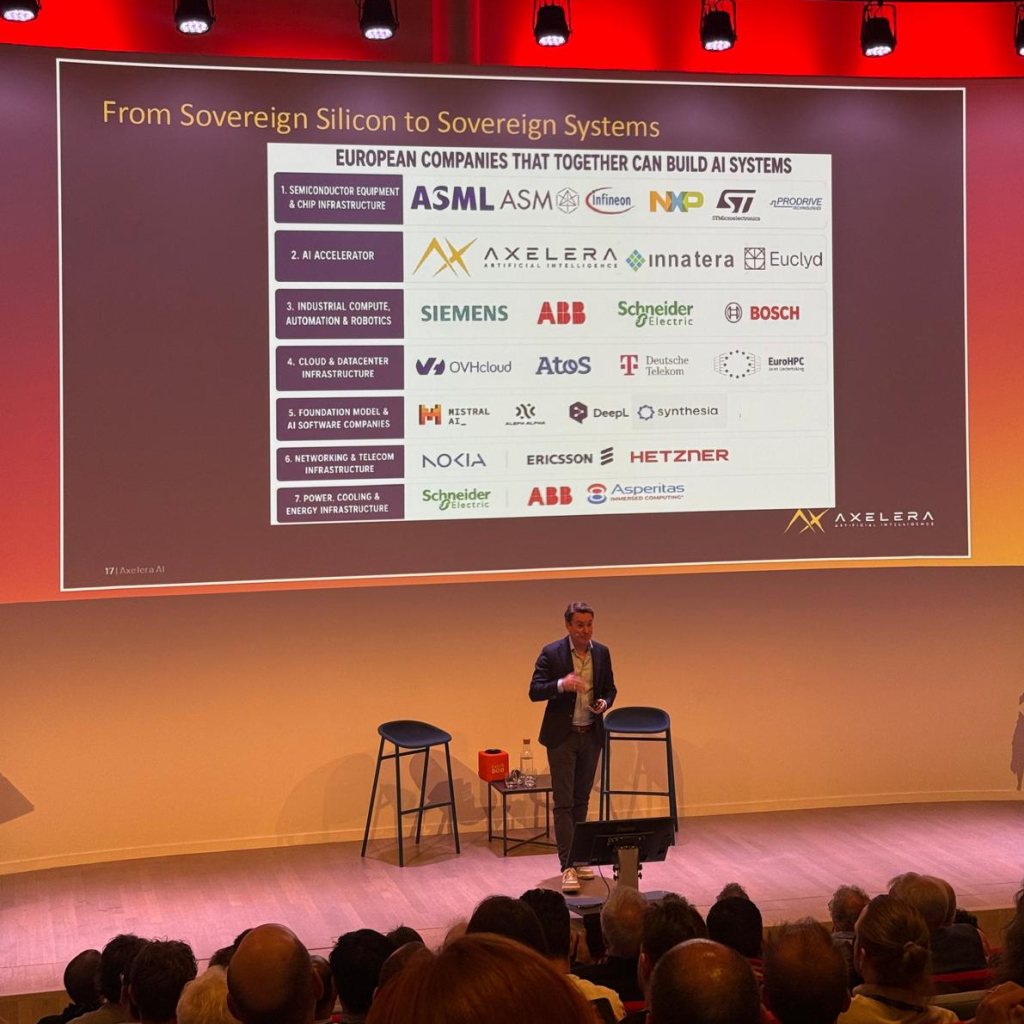
At the AI Meet-Up XL: Towards Europe’s Full Stack AI Sovereignty at the High Tech Campus Eindhoven with Bernardo Kastru (founder and CEO of Euclyd), Bram Verhoef (co-founder & VP Axelera AI) and Ralf Zoetekouw (Founder & CEO Datacation), one message stood out clearly:
Europe has not lost the AI race.
That statement came from Bernardo Kastrup and it was one of the strongest moments of the evening.
In a global AI landscape dominated by US hyperscalers and growing geopolitical dependencies, his argument was refreshingly pragmatic: Europe still has world-class engineering talent, semiconductor expertise, industrial infrastructure, and deep research capabilities.
What Europe lacks is not technical capability. It lacks speed, industrialization, and confidence.
I found this perspective particularly relevant because the AI sovereignty discussion is often reduced to consumer-facing foundation models and applications. But the real strategic challenge is much broader.
AI leadership increasingly depends on semiconductor manufacturing, compute infrastructure, energy efficiency, robotics, and the ability to industrialize innovation at scale. That is where Europe still has a unique position.
Bernardo believes we don’t necessarily need the latest process nodes to remain competitive in the AI race. Instead, Europe can focus on larger chips and chiplet-based architectures that can be manufactured on more mature, cost-effective, and less supply-constrained technologies, rather than relying exclusively on the latest and most advanced nodes (e.g., 2 nm).
While the resulting form factors may be larger, Bernardo argued that Europe does not need to win on every front. In applications such as consumer electronics, where size, power efficiency, and form factor are often critical differentiators, leading-edge nodes may remain essential. However, in strategic domains such as defense, datacenters, industrial systems, and AI infrastructure, the requirements can be different.
His point was that AI sovereignty is not about competing everywhere; it is about identifying where Europe can create the greatest strategic advantage. By focusing on areas where performance, resilience, security, and manufacturing excellence matter more than achieving the absolute smallest geometry, Europe can build meaningful AI sovereignty while leveraging the industrial strengths that already exist across its semiconductor ecosystem.
AI sovereignty starts with industrial competitiveness
One of the strongest themes throughout the event was that Europe should stop trying to replicate Silicon Valley.
Europe’s strength has never primarily been consumer platforms. It has been industrial technology. From semiconductors and photonics to automation, robotics, and precision engineering, Europe remains deeply embedded in the foundation of the global technology ecosystem.
This was highlighted by Bram through three strategic domains where AI sovereignty matters most:
- Defense systems
- Robotics and industrial automation
- AI infrastructure
All three depend heavily on advanced manufacturing capabilities.
At this point, the key challenge is no longer whether Europe can design or deploy AI systems. It is whether it can industrialize them efficiently, at scale, and with sufficient control over cost, energy, and supply chain complexity.
This is precisely where Siemens DISW helps manufacturers move from AI ambition to industrial execution. Industrial AI sovereignty is not achieved only through chips or models, but through the ability to connect product design, simulation, factory planning, manufacturing operations, and production execution into an AI-powered continuous digital thread.
By connecting these domains, manufacturers can reduce complexity, accelerate innovation cycles, improve resilience, and optimize industrial systems long before physical deployment.
From AI ambition to industrial execution
Many of the challenges discussed during the event are already being addressed through Siemens’ Digital Manufacturing solutions. The semiconductor industry is becoming increasingly software-defined. Manufacturers need to simulate, optimize, and validate highly complex production environments before physical deployment.
This is where the comprehensive digital twin acts as a living engine of predictive intelligence. The digital twin allows manufacturers to model fabs, production flows, automation systems, energy consumption, and operational bottlenecks in virtual environments before implementation.
This directly supports several of the challenges raised during the event:
- Accelerating semiconductor manufacturing ramp-up
- Improving production efficiency
- Reducing operational risk
- Optimizing energy usage
- Enabling scalable industrial AI deployment
We don’t view AI as a standalone technology but as a capability embedded across the digital thread. By combining AI with simulation, automation, manufacturing operations, and industrial data, organizations can move beyond isolated use cases toward scalable Industrial AI that delivers measurable business outcomes.
As AI infrastructure grows, energy efficiency is also becoming a strategic concern. This point was highlighted when discussing the different compute and energy requirements across drones, robotics, and data centers. This is another area where digital manufacturing and industrial AI become essential.
The ability to optimize factories, automate operations, and create closed-loop manufacturing intelligence will increasingly determine industrial competitiveness.
Industrial AI is Europe’s strategic differentiator
AI becomes most valuable when it is deeply connected to domain expertise, operational processes, and proprietary industrial knowledge. And that is precisely where Europe has an advantage. Industrial AI is fundamentally different from consumer AI.
In manufacturing environments, the highest-value AI systems are often specialized models trained around engineering constraints, factory operations, quality inspection, and production optimization.
Europe generates enormous amounts of high-value industrial and engineering data through its manufacturing base. The challenge now is weaving this IT and OT data into a unified fabric to build scalable, trustworthy Industrial AI capability.
Unlike consumer AI, industrial AI creates value through deep integration with physical products, production systems, and engineering workflows. Europe’s industrial base provides a unique foundation for building these capabilities at scale.
The next AI race will be won on the factory floor
The strongest takeaway from the event was not that Europe is behind. It was that Europe may finally be starting to recognize where its real strengths lie.
Not in copying Silicon Valley. But in combining semiconductors, automation, industrial software, AI, and advanced manufacturing into a uniquely European industrial AI ecosystem.
This is exactly why digital manufacturing will become increasingly strategic in the AI era. Because the next phase of AI leadership will not only be defined by who builds the best models. It will also be defined by who can industrialize AI at scale.
The next phase of AI leadership will not be defined solely by who builds the best models. It will be defined by who can connect AI innovation with industrial execution.
The organizations and regions that successfully combine AI, industrial software, automation, and manufacturing expertise will be best positioned to create sustainable competitive advantage.
Europe already possesses many of these ingredients. The opportunity now is to industrialize them at scale.
Learn more about the how on our website.