Next-Gen Aerospace Demonstration with Rolls-Royce at Hanover Messe 2025
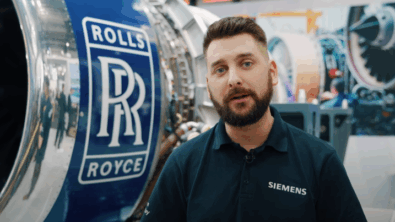
At Hannover Messe 2025, Siemens presented a conceptual digitalization showcase that re-imagines how advanced software and AI-powered manufacturing tools could help Rolls-Royce optimize the design-to-manufacturing processes for aerospace components.
The goal was clear: take an existing part and see how digitalization might make it lighter, stronger, and more efficient. What followed was a journey through the entire digital thread, showing how each stage builds on the last to unlock smarter design-to-manufacturing decisions.
Explore what’s possible when Siemens digitalization powered by AI meets aerospace engineering and beyond.
Step 1: Teamcenter X — The Digital Backbone
Every transformation needs a foundation. Here, it begins with Teamcenter X, Siemens’ cloud-based PLM platform. Think of it as the central nervous system of the digital twin: connecting people, data, and decisions. It doesn’t just start the process, it keeps everything in sync from concept to final inspection, ensuring traceability and control every step of the way.
Step 2: NX Design — Where Ideas Take Shape
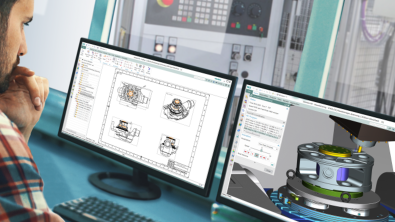
With the data managed, the team moves into NX design. The part is loaded with model-based definition (MBD) from Rolls-Royce, meaning all the critical details — dimensions, tolerances, annotations — are already embedded in the 3D model. No separate drawings, no guesswork. The design intent flows directly into every downstream activity.

Step 3: Simulation — Putting the Part to the Test
Now comes the fun part: testing ideas before making anything physical. This is where Simcenter’s STAR-CCM+ simulates fluid flow to optimize the geometry for oil movement through the pump. This helps check how the component stands up to stress, fatigue, and real-world forces. By combining these insights, engineers can see where material is needed — and where it isn’t — long before cutting metal or printing parts.
Step 4: Topology Optimization — Redesigning for Strength and Lightness
Armed with simulation data, the team applies topology optimization. This is where the part gets a futuristic remodeling: unnecessary material is carved away, leaving behind an organic, lattice-like structure that’s both lighter and stronger.
Step 5: Additive Manufacturing — Printing the Future
The optimized design is then prepared for 3D printing. This step involves:
- Setting the orientation for best surface quality and minimal print time.
- Using nesting tools to position multiple parts efficiently.
- Generating automatic supports so the print succeeds the first time.
Before committing to the 3D print, engineers run a build process simulation. If distortions or bends are predicted, compensation models tweak the geometry so the finished part prints within tolerance.
Step 6: NX CAM with AI — Smarter Machining, Faster Programming
Once printed, the part still needs finishing, which is where NX CAM, now equipped with an AI-powered Co-Pilot, enters the digitalization storyline. Instead of manually setting up every toolpath, engineers simply select a feature, and the Co-Pilot offers intelligent machining suggestions, such as cutting depth, tool choice, and even strategies to speed up cycle times.
Step 7: Virtual Machining — A Digital Trial
To make sure everything will run flawlessly, the part is tested in a virtual machine environment. The G-code is simulated with Siemens’ Run MyVirtual Machine, creating a true-to-life preview of what will happen on the shop floor.
The demo also showcases adaptive machining: measuring features as they’re cut, adjusting tool wear in real time, and re-machining if needed. The result is flawless precision without costly rework.
Step 8: Automated Inspection — Closing the Loop
The journey ends with inspection. Thanks to the embedded NX CMM programming, when integrated with Model-Based Definition (MBD), automatically generate probing paths for quality checks. No manual setup, no extra data entry — just fast, automated validation tied directly to the digital twin.

The Result: What’s Possible with Digitalization
This demonstration shows what Siemens Xcelerator portfolio can achieve, including a next-generation part
- A part that’s 25% lighter, saving fuel and improving efficiency.
- A design that’s 200% stiffer, boosting performance and extending service life.
- A seamless digital thread where data flows without barriers — from design through simulation, optimization, manufacturing, and inspection.
This is a vivid illustration of how digitalization and AI-powered tools could help aerospace leaders like Rolls-Royce achieve new levels of sustainability, performance, and innovation.