Mendix Roadmap: From Low-Code to Agentic Business Outcomes
When ChatGPT launched on November 30, 2022, it reached one million users in five days — faster than Netflix, Spotify, or Facebook. Ray Kok, CEO of Mendix, opened a recent keynote at Realize Live by asking the audience to consider that date’s significance. It marked not just a technological milestone, but the beginning of what Mendix calls the “agentic era” — a fundamental shift in how enterprises approach digital transformation. Unlike the manual enterprise of the past or the digital enterprise of the last two decades, this new era asks a different question: How do we equip AI agents to work alongside humans to actually execute business tasks? For Mendix, answering that question means evolving from a low-code development platform into one that enables organizations to build agentic workflows at enterprise scale. Here, Kok and Koert Hagoort, SVP of R&D, outline a roadmap that moves beyond AI-assisted coding to agents as operational companions — and the governance frameworks needed to deploy them responsibly in production. Learn more about the Mendix platform here.
Ray Kok
The Agentic Era
Let’s talk about the Mendix roadmap, and specifically about an evolution. AI is a very good opportunity to evolve the value proposition of Mendix. We’ll talk about how we are transitioning from low code to agentic business outcomes.
Why this matters: we’re in the world of yet another transformation. This transformation is all about how we take advantage of AI when it comes to building out the enterprise workflows that many of our customers are already building with Mendix.
To set the stage, consider this date: November 30, 2022. That’s the launch date of ChatGPT. Think about the evolution we’ve seen since then. In the first five days, it hit one million users. To put that in perspective, it took Netflix about three and a half years to get there, Spotify five months, and Facebook two months. The adoption rate is quite remarkable.
But the significance runs deeper. It brought us into a new era — what we call the agentic era. This term summarizes the next evolution of digital transformation for any type of business operations.
We’re all familiar with the past. Most of us were busy running around with spreadsheets, emails, and Teams messages. The last two decades took us pretty far in establishing the digital enterprise, and Siemens has been on the frontier of that transformation. Now, the next transformation is about how we take advantage of AI and specifically agentic AI. What’s interesting about agents is that they can execute business tasks. They’re not just a search engine. They’re a piece of technology that enables you to actually get things done.
The Evolution of Enterprise Technology
The use of logic, the core foundation of computing and software, has always been around. Our core product portfolio — Teamcenter, Opcenter, Simcenter — has always been about how we use enterprise software as a service to automate parts of the business. It got more interesting when we worked on machine learning. Why? Because it can actually predict. Many of our customers, especially in manufacturing operations, have machine learning solutions in place.
It then got interesting again with November 2022 with the next level of AI capability: content generation. But I’m personally excited about agentic AI because it can actually turn AI into a companion worker. It can actually get work done.
AI Without People Is Just Automation
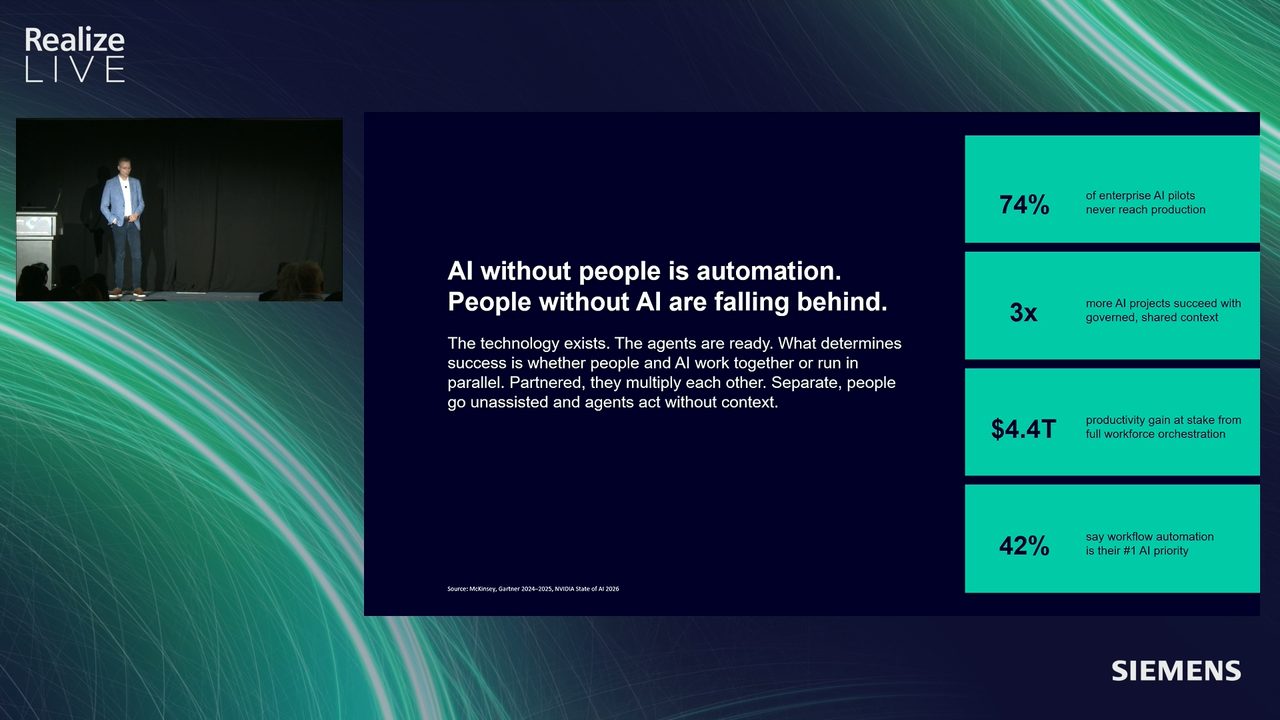
Now, if you think about the opportunity, this is not just about technology. I’m sure you’re reading the same articles as I am about how AI, if you just pursue it as a technology, is not necessarily successful. What we’re seeing is: AI without people is just automation. But, if you aren’t using some form of AI as part of your job, you’re falling behind.
What we’re trying to go after is this: how do we establish the agentic enterprise where agents and humans can actually work together?
Why? The number we’re looking at is $4.4 trillion in projected productivity gain from full workforce orchestration. For Mendix, it’s all about how we allow you to actually build these agentic workflows so you can go after that next level of productivity in your company.
The Gaps: Why Agentic Transformation Is Hard
The challenge is that when I work with companies like yours, there are gaps. These gaps are meaningful. Companies trying to implement generative and agentic AI typically run into an issue: the connective tissue between AI, people, apps, processes and oversight. How do you make this whole ecosystem work together?
In the first five days, ChatGPT hit one million users. It took Netflix about three and a half years to get there, Spotify five months, and Facebook two months. The adoption rate is quite remarkable. – Ray Kok
It starts with data. If your data is messy, your AI will be even messier. So, it’s about how we capture the institutional context of your company’s know-how and enable that to start building agentic workflows.
You also need to integrate AI and specifically machine learning. Generative AI isn’t necessarily good at predicting. You still want to use machine learning for outlier detection, forecasting, and classification. You want to build applications where AI is foundational, not a bolt-on.
Other challenges are fragmented processes and lack of unified governance, important since a lot of this requires a governance framework to go from POC to production.
Mendix’s Strategic Response
The Mendix of yesterday was all about low code. Using the principle of low code for automation is still our foundation. But, now we’re taking advantage of generative AI to build agentic workflows.
First, we’re eating our own dog food. We’re using AI ourselves for agentic development to further speed up how you build enterprise applications. We’re enabling you to build agentic workflows on the foundation we already have — deployment flexibility for classified and regulated industries, building application experiences that fit your business needs.
And this is not future musing. We’re already working with quite a few customers on becoming an agentic enterprise. A great example is our continued partnership with Jabil. We started in 2022 on becoming a digital enterprise, focused on automation and process orchestration for production — shop floor and top floor. This is about real value. How do we turn this agentic AI era into actual ROI?
Koert Hagoort
Who’s Using Mendix
Jabil is a broad customer using Mendix for multiple manufacturing use cases, and they’re experimenting with AI very actively.
We build teams together. We see how we can link what we do in R&D with what they’re doing in their projects and research, and the initiatives they want to get into production. That gives us important input into our prioritization process for product updates. We do this with multiple customers, and we’re always open, through our product managers and field teams, to discuss these kinds of initiatives.
Mendix as a Platform for the Full Software Development Lifecycle
Let me start with some foundations we’ve built over 20 years. We define Mendix as a platform for the software development lifecycle — from ideation through development to production and eventually retiring that app.
We have many different scenarios. Sometimes Mendix is used to fill a temporary gap, solving a problem for a year and retiring it after a year. In other cases, we have core systems running for five, even 10 years. We approach this always from the principle of looking at the full lifecycle because that’s how we provide the most value.
AI without people is just automation. What we’re trying to go after is how do we establish the agentic enterprise where agents and humans can actually work together. – Ray Kok
An important change now is that the way software is developed is changing. The way software itself is architected, the solution architectures — these are changing under the influence of these technologies. We’ve already moved into accelerated coding using assistants. Now we’re getting into a phase where agents become part of the development process and part of the running solution. That puts very different requirements on how solutions are built and how they operate.
From Testing to Evaluation
One current trend is to put much more emphasis on spec and test-driven development. Why? Because development itself is becoming shorter, easier, faster. There’s more need to make sure what you start working on is actually right. Then if you’ve defined that properly, you want to make sure what you’ve built does what it’s supposed to do.
In the world of AI we’re getting into, testing is often called evaluation. An evaluation is a test, but it’s something you do at development time and at runtime because of the nature of these new systems.
The old way was spec defined deterministically. You could test a set case against what you specified and verify the outcome is correct. As soon as you have an LLM in the picture, that old way of testing is not possible anymore. You need a different approach, which we call evaluation. And that needs an evaluation framework. That’s an important part of our roadmap.
Applications Are Evolving
In the past, Mendix focused a lot on applications. The key goal was operational efficiency — bringing data from different systems together and building a workflow across those systems. We called it a single pane of glass. Not just to look at what’s happening, but to take action.
Now, under the influence of GenAI, development is becoming faster, and you can use the same GenAI capabilities in your applications. A straightforward way is to build a Mendix application that integrates with an LLM, does an API call, and makes your application smarter. That’s smarter workflows.
Then the next step, where it becomes harder, is when agents actually start doing work. We’re seeing some explorations in this area. The technology is definitely there, but everything else needed to bring this to production is not yet there. You need a lot of governance. You need to continuously evaluate if results are correct. You need much higher maturity on your data and how you deal with AI.
That’s where the biggest development is. That’s where our roadmap focuses — to make the step from straightforward task-based solutions to full agentic work.
Four Key Product Themes
We define our roadmap in four key product themes.
- Agentic Development. This is all about developing applications, agents, and integrations with Mendix. Very developer-oriented.
- Solution Architecture. The resulting solution architecture for applications and agents. When you start needing orchestration. The most straightforward form is workflow. A more advanced form is agentic orchestration where agents deal with events dynamically.
- Enterprise-Grade Platform. This builds governance structures to give you visibility into your portfolio of applications and agents running in production.
- Fourth: Integration into Siemens Xcelerator. One of the driving forces of our innovation in the last two years has not been pure Mendix R&D, but integration with other products in the Siemens Software portfolio. At the solution level, we’re integrating with Teamcenter and Opcenter. At the platform level, we’re building the agentic framework that underlies all solutions we build as Siemens Software. It’s a big lift. It’s something Mendix independently could not pull off, but we’re seeing the benefit of being part of the Siemens portfolio materialize into real innovation power.
Release Policy Change
Before I go into the themes, a quick update on our release policy because we’ve recently changed this. Typically Mendix releases two yearly annual major releases. Right now Mendix 9 is the oldest supported, and 10, 11… 11 is the current release we’re working on. We’re moving toward 11.12 LTS, the long-term support version.
In our old policy we had an LTS every two years. Because we’re seeing such high speed of innovation, especially with new AI capabilities coming into the platform, we needed to increase our tempo. Our release process has changed to have every six months a long-term support version.
On Mendix 11, we’ll have 11.12 out by end of June. Then 11.18 at end of December, and six months later 11.24. All three will be supported as long-term support versions, meaning you get security fixes and high-priority bug fixes along the lifecycle of Mendix 11.
We’re doing this to make sure new innovations in these versions can be adopted quickly without worrying about stability and production quality for important apps running in production.
When we get to Mendix 12, we’ll go back to an annual LTS cycle — 12.6 as midterm support, then 12.12 as long-term support. With this roadmap ahead, we’re planning updates to make sure we get all AI improvements needed for agentic development, governance frameworks, and integration into the Siemens landscape.
This release policy is a very fundamental change for us. There are some questions around it, so let me clarify.
Does it mean I have to upgrade all my applications every six months? No. That’s the essential point of LTS. You can leave your applications on that LTS for as long as you want. There’s of course a support term, but that can be years.
What this does for us is make it possible that if you do have a use case where you want to use some of these agentic capabilities we’re releasing in the roadmap, you can immediately adopt them. You do not have to wait until next year. You can take one of these LTS versions, look at the features and capabilities there, and then decide based on that whether to adopt it.
AGENTIC DEVELOPMENT
Maia: The Mendix AI Assistant
What we’re doing for agentic development is introducing Maia, the Mendix AI assistant. We’re following in the footsteps of the big AI labs — Anthropic, OpenAI. We started thinking about this in 2022, but it took us quite some time to get our act together.
These tools are typically built and optimized and trained on code. Although we do a little bit of code in Mendix, we mostly use models, and they don’t work out of the box for Mendix models. A lot of our R&D investment is going into making the Mendix modeling language suitable for working with these tools — Claude Code, GitHub Copilot. Our Mendix-specific version is Maia.
Development itself is becoming shorter, easier, faster. As soon as you have an LLM in the picture, the old way of testing is not possible anymore. You need evaluation. And that needs an evaluation framework. – Koert Hagoort
We’re not looking at Maia as a direct competitor of Claude Code or GitHub Copilot or Cursor. If you’re comfortable working with those tools, they bring great power. Our strategy is that those tools also need to work with Mendix. Practically, we’re building low-level APIs on the Mendix model to allow you to use those tools to generate Mendix applications from start to finish and maintain them in production.
One very high-potential example: implementing security fixes in an app that’s in production. It’s typically something people fear because it’s risky, but it needs to happen. You can’t delay it too long, but it takes time away from work on added value. This process will definitely be streamlined by using these technologies.
If you’re comfortable with Claude Code, use it with Mendix. We have Mendix CLI. It’s being experimented with on a large scale in the community. But if you’re not comfortable on the command line and prefer Mendix Studio Pro and Maia, that’s the way to go.
Twelve months ago, Maia was not that capable. With the latest releases — 11.9, 11.10, 11.11 are monthly releases — we’ve picked up pace. We’ve nailed down how we make these GenAI tools work with the Mendix model. We’ll continue this tempo after Mendix 12 through 18. We’ll get to a point where Maia can literally do anything you want to do with a Mendix app.
Twelve months ago we weren’t confident we could make this. Today, we’re very confident. Maia. Maia Make will be a real developer companion that can do many specialized tasks that today are still difficult — integration, UI, you name it.
Maia Plan: Translating Ideas Into Requirements
Maia Make does not stand by itself. We talk about the software development lifecycle starting with the idea. The idea typically translates into a plan. That’s where Maia Plan comes in.
Maia Plan helps you create better requirements and do it faster. The plan can be based on documents, PDFs, other context documents you have. You bring it into the Mendix platform, it structures it, organizes it, and brings it into our epic and user story structure.
It’s interactive. You can start with a document — a requirements document or something else you have — and it asks you questions based on the initial results to confirm the direction you want to go, the scope you want to include. It looks at your goals, makes sure they’re clear, scope is clear, then builds that interactively into a set of user stories and helps you prioritize them. That’s setting you up for your project.
Maia Make: Building the Application
Then you switch over to Maia Make. It’s evolving very rapidly. It can build Mendix models. The UI is interactive. It starts from an initial proposal, then you can use it to build from that, perfect it, and add missing elements.
It starts with a prompt where you ask what you want it to do. Then you have an interactive dialogue where it builds out the scope and different elements of your application. It creates a domain model — the data you’ll store in your application. From data you move on to the UI, the pages built on top of it, and the logic and integrations.
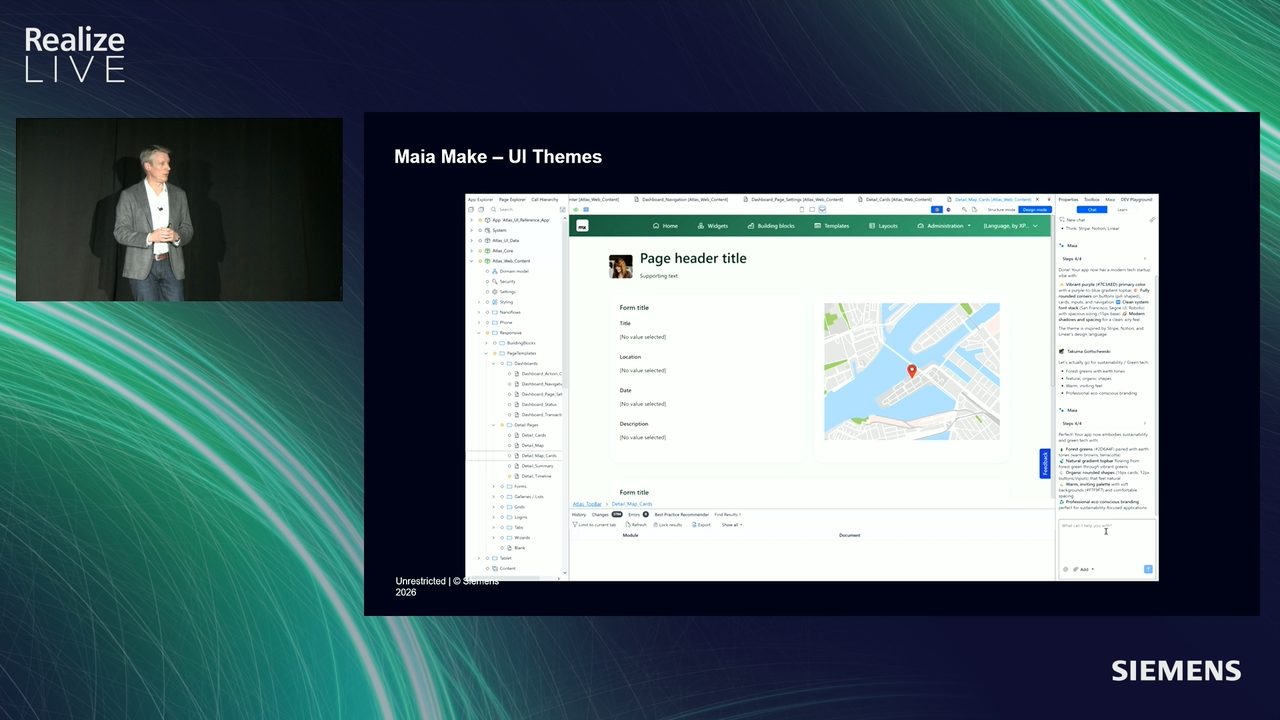
One thing that’s always difficult: once you have basic logic and integration in place with your data, you need it to look good. UI is a specialization in Mendix. Mendix is so flexible at the front end that you can do anything with styling, with React components, whatever you want. But that’s a specialty skill set, and not many people have all those skills and the time to work weeks on an application perfecting it.
That’s another area where Maia plays a big role. It can put together UIs that not only look great but are fully functional. It’s not a prototype. It works and connects to what you’ve built in the backend.
You design iteratively. You start with your first idea, ask Maia to build it, then look at it and think about what changes you want. Here’s a simple example: Maia builds the UI based on the Mendix theme — blue. But you want it to be a Siemens app, so you switch it from Mendix blue to Siemens green to fit into your landscape. You can bring in Maps components or any web component you have to fit your page.
Extending Maia: MCP Server and Bring Your Own Agent
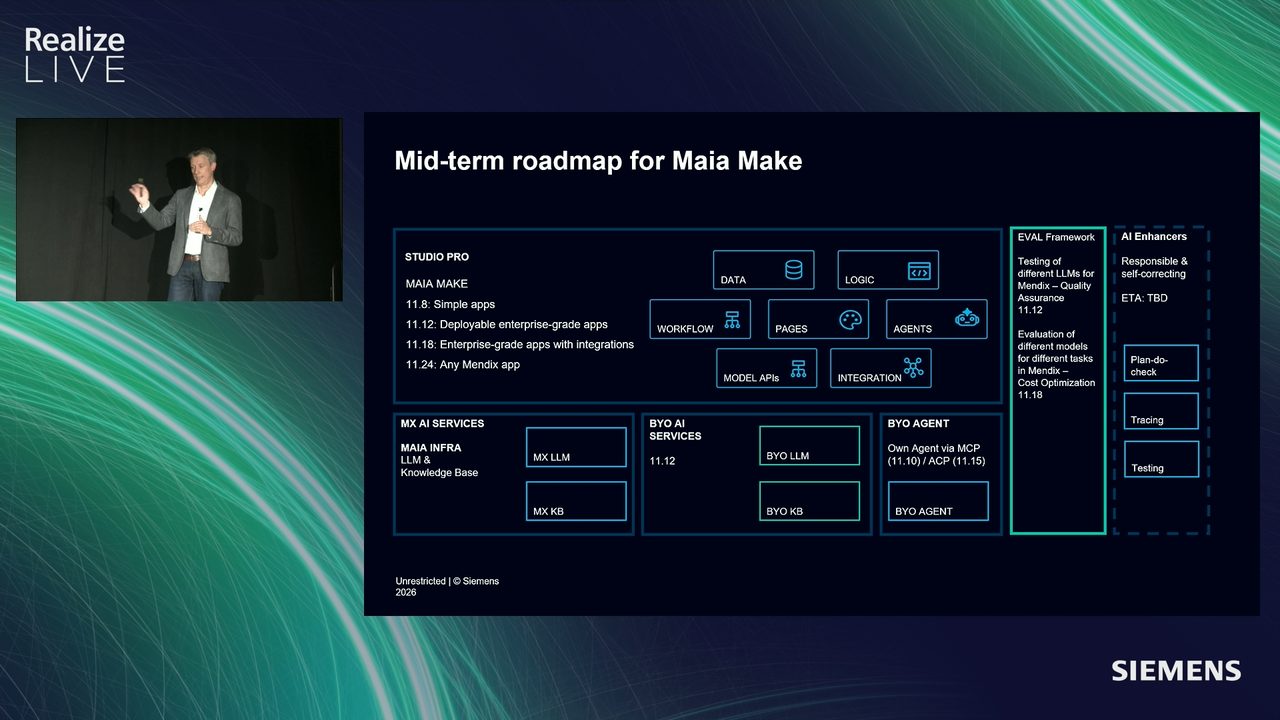
Besides Maia, in this AI agentic age, we have an MCP server inside Studio Pro. This is a very recent release from Mendix 11.10. We also have the capability to integrate with your bring-your-own agent. This can be your Claude Code. The typical setup now is Visual Studio Code with Claude Code embedded. That’s another way all of this works, and it works because at the bottom layer it’s using the same technology.
The low-level APIs we’re building out are used by Maia — we call it the Model API. They can also be used by your bring-your-own agent or by the MCP server. This brings flexibility and power, and speaks to the extensibility and openness we maintain for Mendix.
One example of what you could do: an MCP server together with the Mendix CLI. A particular use case we’re seeing multiple customers experiment with is technology migrations. You have something built in one technology. For whatever reason, the technology is outdated or the contract is ending. You need to bring it to another technology stack.
This is a fairly common situation in any enterprise. The tools, specifically the command line tool, can help a lot with database migrations and application migrations. Because it’s now such a powerful tool landscape, you can not only migrate what you have to a new version or new technology platform. That by itself isn’t very interesting — you get the same thing running on something else. But you can now include new added value into that process without immediately having to build a big budget and big team.
Take the great things already there that are useful, extend them, and migrate them to a new technology platform where you have runway for another five to 10 years.
Maia Roadmap: From Companion Developer to Operator
We’re supporting all this with the Maia roadmap. The emphasis from 11.12, our LTS release, to 11.18 is going to be on the right side — the evaluation frameworks.
At 11.12, we’re establishing Maia as a very good companion developer. Then the next step is developing the companion tester and the companion operator. The tester typically works in the development environment. The operator looks at your running app in production — whether it’s on Mendix Cloud, private cloud, or on premises — and provides operational insights and governance onto the runtime environment.
AGENTIC APPLICATIONS AND ORCHESTRATION
The Shift in Application Architecture
Our second theme is agentic applications and orchestration. The fundamental shift is in how an application itself is built.
The typical architecture of an application has a UI layer, a logic layer, and an integration layer. On top you have the data it needs to connect to. What we’re seeing now is a shift from this deterministic, predefined process to something that includes agentic elements — agents running inside.
In the middle you see agentic elements. On the left you see a new form of integration: MCP. Not MCP as we have it in Studio Pro, the development tool, but MCP Server in the actual application you built with Mendix, which makes that application accessible for MCP clients in the landscape. That’s a new technical way to integrate with an application. Then there are agent protocols where agents can speak together.
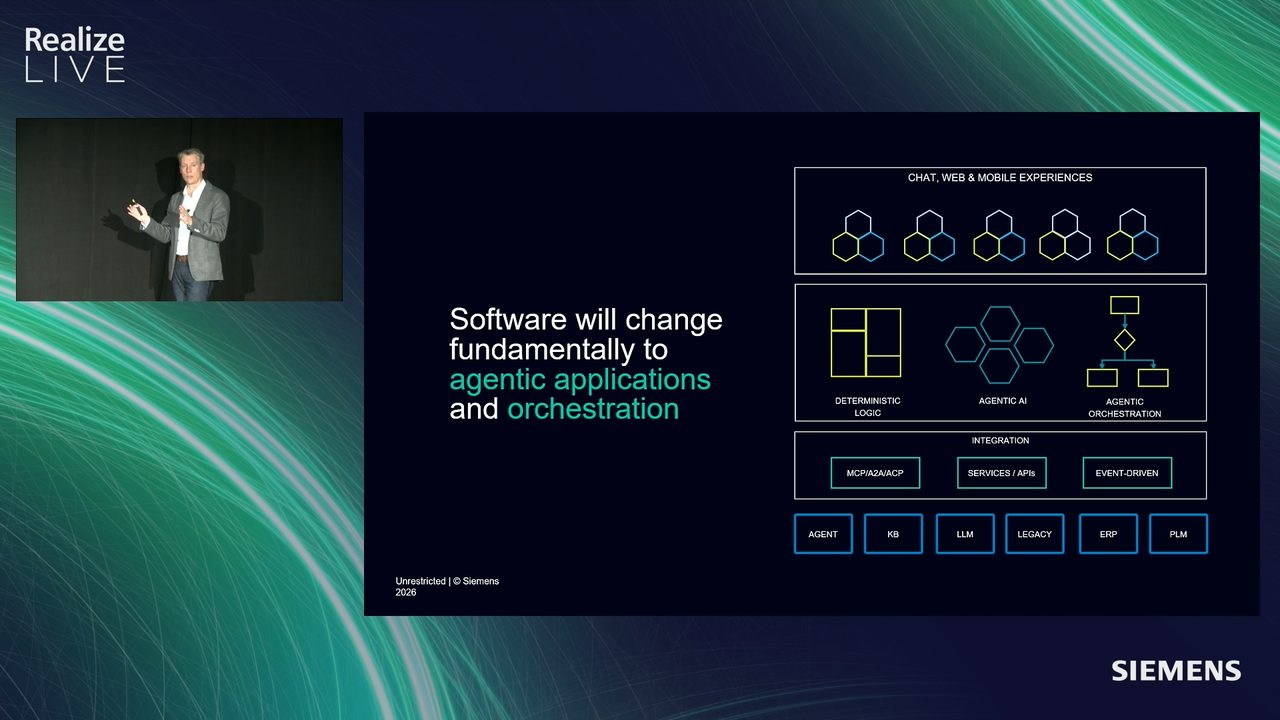
This becomes relevant when you get to a multi-agent landscape. Then you also need orchestration. This kind of setup is by its nature much more complex. It requires new tools, guidelines, and guardrails.
Guardrails are something we’re implementing in this context to make sure you can deploy your application with guardrails implemented in it, and can be exposed to company-level guardrails defined in the environment. A simple example: putting control on language being used. If you have such a policy defined in your company environment, you could apply that to a Mendix application using any of these integration protocols. If you don’t have that yet, you can implement it in the Mendix application itself as a specific application guardrail, then scale it up later to a portfolio.
The Path to Autonomy
We’re on a path from orchestrating with humans in the loop between applications and agents to a situation where agents will become more autonomous. I’m saying explicitly “more autonomous” because I’m careful there. The end state of fully autonomous agents is desirable. It provides benefits in automation, efficiency, and productivity. At the same time, there’s still a lot of work to be done — not only in the Mendix platform, but on your side — to define policies within which such a system can work.
That’s related to reliability and the ethics involved. In human-in-the-loop scenarios, there’s always a human who is responsible. If an agent makes wrong decisions, how does that work? Who’s responsible? There needs to be governance and control before you can release such a system to production.
A minor consequence could be cost — a cost overrun — but you can survive it. On the other extreme, if you use this kind of technology in a manufacturing environment, there’s actual health and safety involved. Then it becomes a very different consideration.
The Agent Development Lifecycle
The development lifecycle for an agent is similar to app development, but significantly different in approach. It’s not only a technology aspect of the platform. It’s also a new way of working we all have to learn.
It introduces a lifecycle tailored to agents. Testing and validation, learning and improve — something we’ve always wanted to do with applications — is still there, but takes a different form. It’s much more dynamic, much more evaluation-based.
Agent Kit and Agent Builder
In the Mendix platform and roadmap, we’re building a couple of assets. One is the Agent Kit. It’s already released. You can use this to build a Mendix application that embeds an agent. You can take it a step further and build a Mendix agent. That could be something that is headless, doesn’t have a UI. Typically a Mendix application right now would have both a UI and an LLM integration. That’s the best place to start. But you can take it further.
We also have the Agent Builder and the Agent Editor. Both are being integrated into Studio Pro. We have them as separate applications already today, but the experience for developers for both builder and editor will be integrated into Studio Pro and become part of the lifecycle a developer is working with.
Example: Combining Mendix, Graph, and AI
Here’s an example of a straightforward Mendix application. What’s interesting is that it starts with a typical Mendix UI and conversational input. But in the backend, it’s not only a Mendix application with its own database. It’s also using an integration to the knowledge graph. Graph Studio in the back has been used to set up a knowledge graph. This example looks at production failures and tries to figure out where they’re coming from and the root causes, being able to move toward solving them.
The GenAI part is helping you go through that process faster, quicker. The graph in the background gives semantic meaning to the data, which increases the quality of what the application shows you. The steps the application proposes are much more grounded in real data and real meaning in your context.
That’s one example of the power of different portfolio elements coming together — AI Studio for a machine learning model, Graph for knowledge graph and semantics, and then Mendix and agent technology.
Workflow With Agents: Human in the Loop
To orchestrate an agent, the first step is using a workflow. We’ve now included an agent as a step in the workflow. This brings a typical workflow model where a specific task can be outsourced to an agent. Still human in the loop because the human is deciding, making the real decisions left or right in the flow of this workflow. But the work is actually being done by an agent.
Event-Driven Workflows
Here’s an important change coming to workflows that have an agent: events.
A typical manually defined workflow has predefined steps, and the user is the one taking action — saying now it’s ready to go to the next step, now it’s ready for approval, approval is done, now do the work.
In agentic workflows, there are events that get triggered and the workflow needs to respond to the event. The event can literally be an agent that completes a task and sends an event “done,” and the workflow automatically goes to the next stage. That’s the next level we’re incorporating.
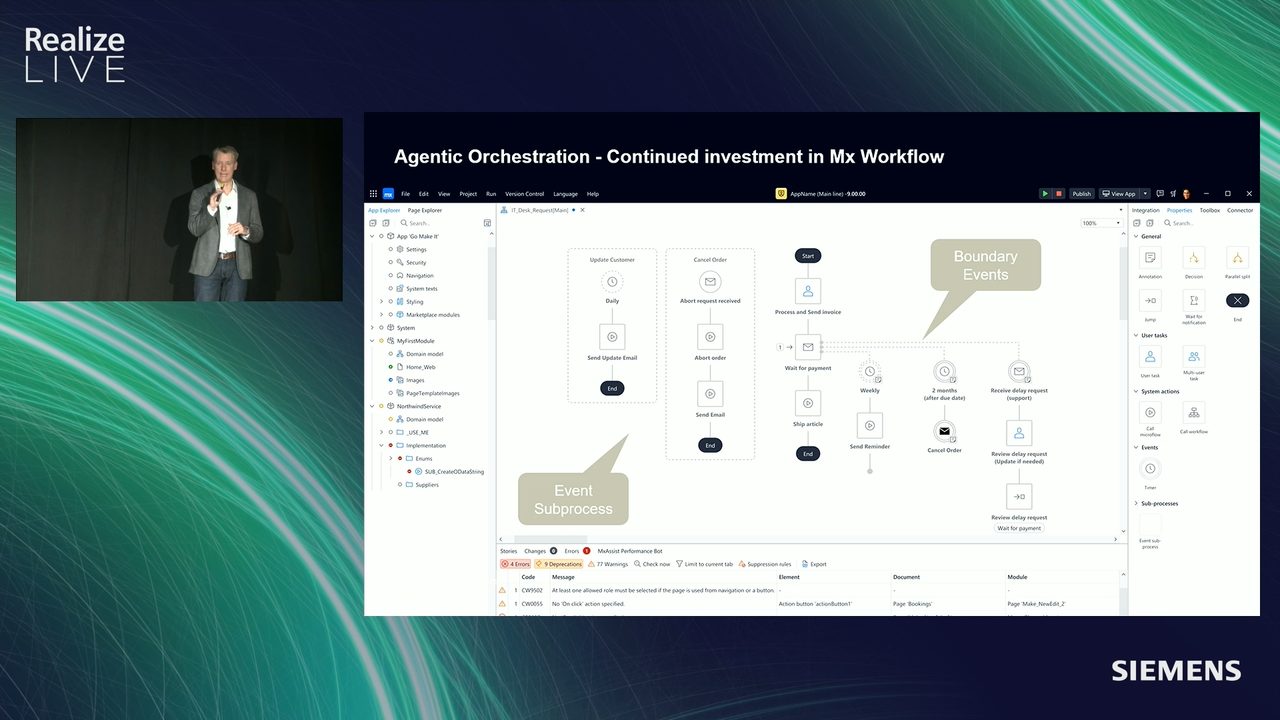
This is still relatively straightforward. One agent. But we’re building toward a future where agentic workflows need even more orchestration. You might have a Mendix workflow integrated with, for example, a Teamcenter workflow, and a business process running across multiple systems. The Mendix application and the agent might be one or multiple steps in the total end-to-end process.
Testing Agentic Systems: Beyond Monitoring
Now you have to test such a system. This is what I was talking about when saying you need evaluation. In the past, for applications running, you do tracing, you do monitoring to see runtime behavior. But because you have that non-deterministic aspect now, you not only need to monitor the activity that’s happening at the system level. Even if all systems are green and okay, you also have to actually look at what the system is producing. Are the results still okay?
That’s where traces are used as a technical way to do the evaluation. This is a new aspect we’re focusing on with our roadmap.
LLM Choice
Another key part of our roadmap is that we define the Mendix platform as being agnostic to the LLMs running underneath it. This is important because it gives you portability. You can choose a cheaper model if the use case doesn’t require a frontier model. Opus 4.8 just came out. You can use it — it’s great — but it’s also very expensive. There are many cases where you don’t need the power of a frontier model immediately and can drop to cheaper, more available models or an open-source model.
That’s a key part of our strategy, whether you integrate that into your application, your agent, or Studio Pro. We’re following the agnostic deployment model: bring your own. We will provide one, but if you have your own preference based on your use case, you can switch.
The Orchestration Spectrum
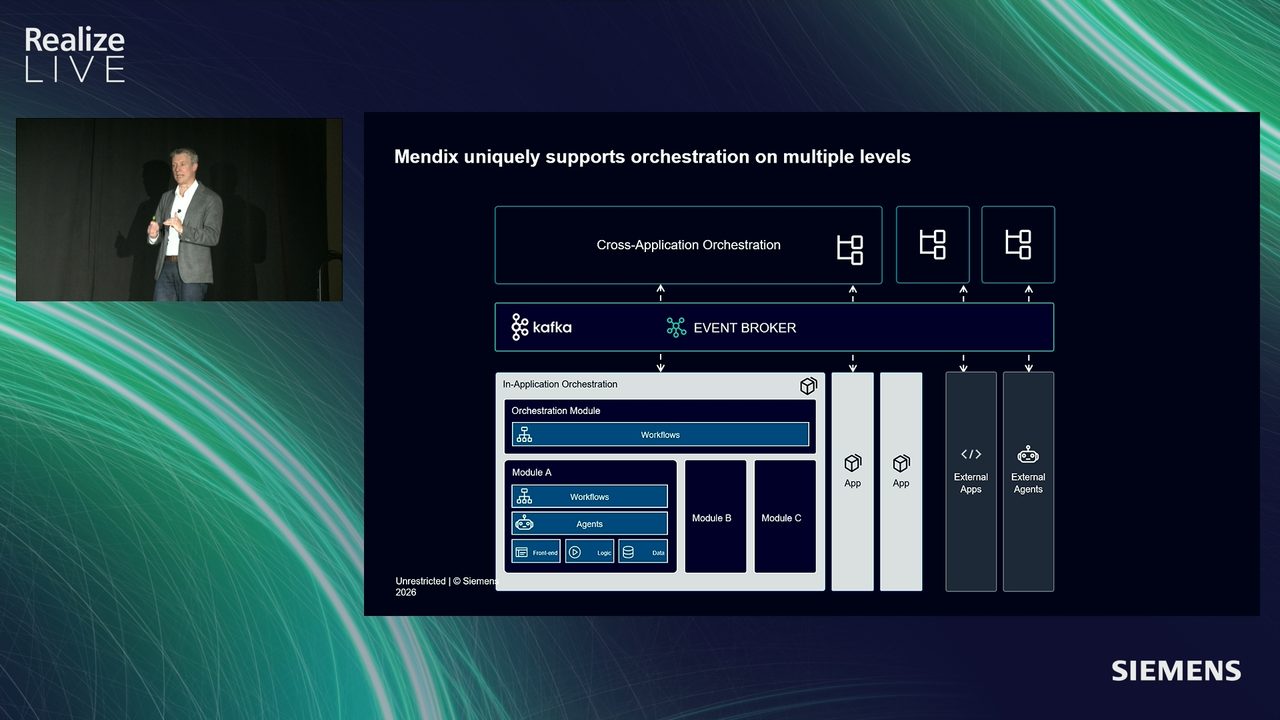
The spectrum we’re thinking about for orchestration starts with the workflow we currently have driving the process — typically human in the loop. In the middle, you still have the human in the loop making decisions, but there’s already an agent involved. You introduce the non-deterministic part there. Toward the right, agents are doing more and more of the work.
This is the big promise, and this is where we’ll be building toward together with colleagues in other Siemens teams. This is where you get end-to-end workflows spanning multiple systems — PLM, MES, ERP — where you can also get the biggest benefit by bringing data from those systems together and then taking action on that.
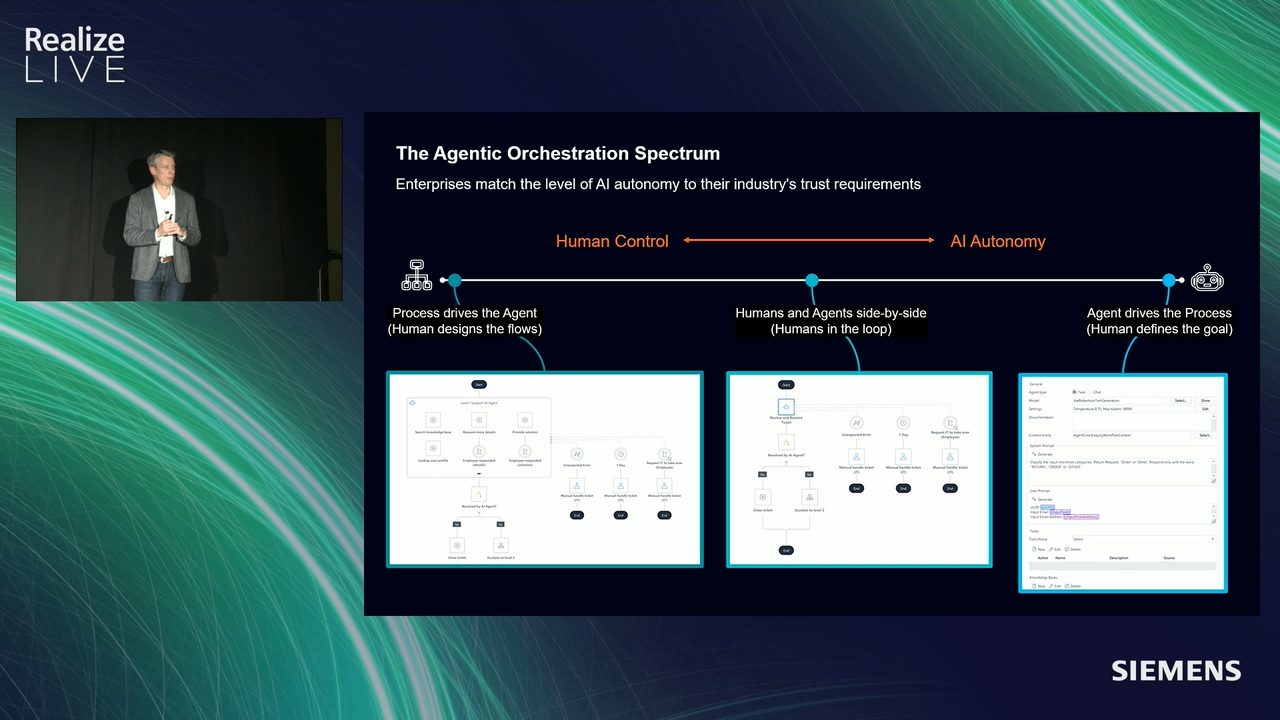
Our approach is to build with an architecture similar to this. You might or might not be familiar with an event broker. It’s not a mandatory aspect of such a solution architecture. That’s why I say it might look like this. But if you go all the way to agentic orchestration across multiple systems, you’ll definitely need a component that has the role of an event broker — brokering the events literally coming from the different agents and making sure the total process keeps running.
For a more simple application, you wouldn’t need that. You could still integrate an agent into a Mendix app and just build the logic inside the Mendix app. But for larger systems, this is definitely an enterprise architecture you’d be looking at.
ENTERPRISE-GRADE PLATFORM
Visibility Across Agents
For our enterprise-grade platform, our roadmap focuses on visibility. Partial visibility is a key risk for agentic systems. You understand what’s happening in one area — an application, an ERP, a Mendix app — but you don’t have full visibility into what’s happening with the agents that are connected.
That’s where you need something that goes from traces — which already exist technically today — to evals and expands observability across the system landscape.
When you go down this path, at some point you’ll end up with a fleet of agents, similar to how you end up with a fleet of systems running. You’ll need governance across that whole portfolio and across that whole fleet.
That’s our investment area for 11.18 and we’ll continue on that for 11.24.
The Agent Registry
One of the first pieces we’re delivering is called an agent registry. This is a nice example of collaboration we’re doing with peers inside Siemens software.
This registry becomes a central piece of the landscape. We’re taking an open and extensible approach. Siemens will offer an agent registry. Mendix will be integrated into that. The other products will be integrated into that. So you have visibility for the portfolio.
But we’re also making that extensible to any other registry following the same agentic standards. Can be a registry from another vendor like SAP or ServiceNow. Probably most will have a registry and we want to make sure those can be connected and integrated — what’s called a federated principle.
This is needed because that’s the way to make it possible to have agents built in Siemens technology communicate and collaborate with agents built in SAP or third-party technology.
More from Realize LIVE.