Poorly designed pumps use more energy than you think. Here’s how to improve pump performance.
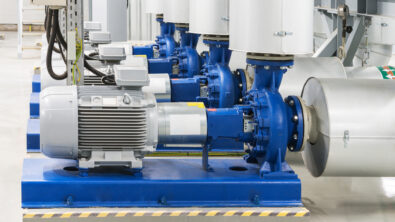
Pumps are everywhere. From industrial settings for power generation, water treatment and manufacturing to residential use in HVAC systems, automobiles and even your coffee maker.
All of us depend on multiple pumps every day, which means there are more pumps than people in the world.
With the proliferation of so many pumps and the rising cost of electricity to run them, it’s more important than ever to develop higher-performing pumps that cost less to run, operate more efficiently, and contribute fewer greenhouse gas emissions.
Pump performance: By the numbers
Before we get to designing and manufacturing more efficient pumps, let’s examine why the world needs efficient pumping solutions and how much energy could be saved.
Studies from the International Energy Agency (IEA) show pumps account for nearly 20 to 25 percent of electricity use, and more than 30 percent of those pumps operate at less than optimal efficiency.
That’s a lot of wasted energy and higher operating costs.
According to the IEA, the water and wastewater industry alone consumed 978 terawatt-hours (TWh) of energy in 2020. They predict that number will grow to 1,252 TWh by 2030 and to 1,473 TWh by 2040.
That’s just the water and wastewater industries. AI data centers and the growing HVAC sector rely heavily on pumps for climate control.
Regardless of the industry, the energy costs to keep a pump running are typically four times the initial cost of purchasing a pump, according to Pump Systems Matter, a non-profit organization.
Just imagine the electricity that could be conserved and the energy costs that could be cut with a small increase in pump performance and efficiency.
How can manufacturers achieve better pump performance?
Pumps have traditionally been treated as “stock” items or “off the shelf.” They’re chosen to match specific operating conditions under which a device is expected to perform.
However, systems rarely operate under the same exact conditions of a pump’s design specifications. Plus, equipment usage typically evolves during its operational lifetime, requiring pumps to perform outside of their intended design.
Pumps are complex components, both in terms of geometry as well as the transient physics of the fluid inside. Yet, they rarely undergo detailed design analysis, either as an isolated component or as part of a more intricate, finely tuned system.
Physical prototypes are time-consuming and costly. Digital simulation solutions can provide necessary data early in the design process, saving both time and money.

Simulation tools like 3D computational fluid dynamics (CFD) can be used to enhance pump performance, increase efficiency and accelerate the design process.
One pump manufacturer found success with Simcenter. They were able to explore performances of multiple digital prototypes simultaneously, speed up their design cycles, and design and manufacture energy-efficient products.
For a more in-depth discussion about using CFD simulation to improve pump performance, watch this on-demand webinar. Or, you can download this free white paper to learn how you can get the most out of pumps and compressors with simulation software.
The companies that design and manufacture these pumps need to strive for better pump performance – to improve energy efficiency, lower overall costs and reduce carbon emissions.
The companies that adapt and move faster with simulation tools will win the market and lower energy costs for their customers.