Enhancing CAPA process with digital quality tools

How can organizations successfully manage the Corrective and Preventive Action (CAPA) methodology into their strategic quality-driven approach during digital transformation to address daily challenges and regulatory requirements effectively?
Manufacturers in the medical devices, vitro diagnostics and digital health sectors face challenges such as evolving regulations, patient risks, competition and budget constraints. Due to industry complexity, traditional quality systems usually lack the needed features for new product development. However, by leveraging a collaborative platform, organizations can establish a closed-loop quality and compliance management approach that prioritizes continuous improvement.
Manufacturers must adopt a strategic quality-driven approach in their digital transformation efforts to navigate the ever-evolving landscape of challenges and requirements. This approach is essential for accelerating the delivery of innovative products to market in a timely and compliant manner.
Trends in the MedTech industry
Market demands for medical device manufacturers continue to grow more challenging as healthcare providers expect products that are increasingly powerful, tailored and connected. Simultaneously, health authorities continue to mandate compliance with ever-changing regulatory requirements.
- Lack of collaboration – Reduce the potential for miscommunication and late identification of design and quality issues, which can add time and effort to revisions.
- Rapidly changing marketplace – Implement a fully digitalized business to plan, control and adjust your products and processes.
- Impeding innovation – Support rapid technological product advances from development to production to lessons learned.
Face key industry challenges with quality best practices
Traditional quality systems often provide limited support for new product development initiatives or maintaining the expected quality rate. These systems typically operate within disconnected data silos, leading to error-prone processes and insufficient collaboration among key stakeholders.
Despite thorough planning, unexpected problems may arise, prompting the need to effectively address such situations and maintain consistently high-quality standards with still focus on continuous improvement. In fragmented systems, the lack of cohesion can hinder communication, leading to inefficiencies and errors.
To overcome these obstacles, manufacturers can adopt a unified digital solution that offers real-time visibility across the product lifecycle, supporting traceability, quality management and compliance. This digital transformation integrates disparate systems into a cohesive platform, enhancing efficiency and collaboration across departments. It’s essential that a closed-loop quality system not only identifies issues but also enables their resolution, implements corrective measures and feeds insights back for continuous improvement.
A quality-driven approach for continuous improvement
A quality-driven approach for continuous improvement is essential for manufacturers striving to enhance their operations and meet regulatory standards.
A collaborative platform plays a vital role in supporting a closed-loop quality (CLQ) management approach that places a strong emphasis on continuous improvement. In the face of increased competitive pressures and ever-changing regulations, manufacturers can overcome these obstacles by embracing an integrated digital solution that provides real-time visibility throughout the product lifecycle. This solution enables traceability, robust quality management and compliance adherence.
Siemens Digital Industries Software facilitates the digital transformation, empowering companies to evolve into digital enterprises committed to sustainable excellence. We provide closed-loop quality and compliance tools that can help to reduce costs by optimizing design, production and approval processes. By leveraging digital tools, organizations can optimize their operations, foster innovation and effectively meet the evolving demands of the industry.
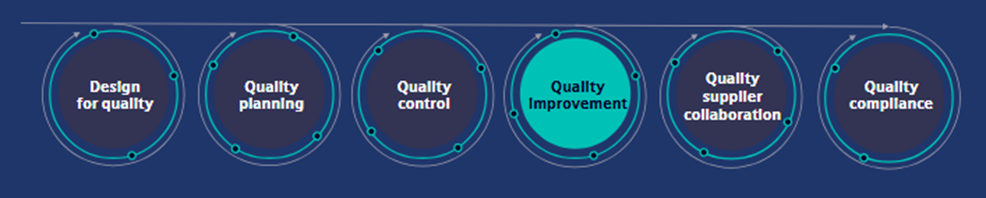
Using a PLM backbone for enhancing quality processes
Manufacturers must redefine the roles for product lifecycle management (PLM) and QMS, recognizing they go beyond traditional paradigms. Using a unified PLM solution with native quality and auditing tools like Teamcenter Quality, MedTech companies can benefit from functionalities for structured quality procedures based on detailed documentation and analysis. Combined, these tools play a critical role enabling companies to achieve significant cost savings by streamlining cross-domain collaboration. Most important, this gives upper management teams confidence about having consistent quality improvement and compliance with standards, helping their companies meet business objectives.
– Stephen Rozow, Co-founder and General Manager, Mach Medical
Managing CAPA processes with digital quality tools
Corrective and preventive action (CAPA) is an important methodology to support the quality improvement process. Stringent guidelines are recommended for CAPA implementation, but organizations often struggle with inefficient processes, which can lead to compliance gaps. This white paper explores CAPA’s importance, strategies for issue management and problem-solving best practices to enhance quality excellence.
Because an advanced closed-loop quality and compliance approach is so important, Siemens has developed a Quality Management System (QMS) to help MedTech companies streamline core processes, expedite market submissions and continually improve products.
Teamcenter® Quality software, part of the Siemens Xcelerator business platform of software, hardware and services, is an enterprise-wide QMS solution that embeds quality and compliance management directly into the lifecycle of medical devices. Teamcenter Quality delivers capabilities for capturing quality issues, customer complaints and nonconformances to support a formal process and systematically investigate, analyze and resolve quality issues, streamline the definition of measures to prevent recurrences and report the results in a clear and intuitive manner.
Specific Teamcenter Quality capabilities
Teamcenter Quality supports the CAPA process. Streamlined and guided workflows facilitate efficient handling of nonconformances and deviations so supporting issues are addressed promptly and correctly. Users benefit from prioritizing actions based on severity and set a foundation for maintaining audit-ready electronic records and signatures. By implementing such an organized methodology, manufacturers can enhance compliance and apply recommended quality management best practices.
- Indentify the issue – Streamline issue identification to enable efficient, targeted problem-solving. Capture deviations and defects as nonconformances (NCs) or quality issues, then trigger CAPA processes for a life science organization.
- Plan all relevant activities – Create a specific quality project to track events, milestones, actions, supplier and customer information.
- Define the team – Select the right persona and assign roles for all team members (for example, owner, approver and supplier).
- Describe the problem – Define an accurate problem description, including all the defect steps and relevant information.
- Define immediate actions – Identify early immediate actions as the initial rapid response to contain the problem.
- Brainstorm with multidimensional root-cause analysis – After defining the containment actions to be performed, the CAPA owner can use “is/is not” methodology to define the problem statement and then perform a root-cause analysis to find the source of the problem. To facilitate the process of analyzing and brainstorming, Teamcenter Quality Problem Solving module supports a detailed defect analysis and root cause tools, like Ishikawa diagram and the 5 Whys method.
- Define and implement corrective and preventative actions – Creating corrective and preventive actions is the successive step that is guided with automated workflows to streamline communication and properly manage the problem-solving process. Correlating issues to deliverables and guiding the root-cause analysis with a common failure catalog for consistency across the quality master data.
- Maximize the effectiveness of change management – After conducting the analysis, if a change is necessary, Teamcenter collaboration platform facilitates the process. Quality engineers can directly initiate a change request and propagate it seamlessly. Various types of changes can be initiated, empowering the team to kickstart change requests directly from the quality department, ensuring prompt delivery to the appropriate stakeholders.
- Create a CAPA report – Complete and document your CAPA process by using reporting tools.
Additional useful capabilities
- Analyze the performance – Using Teamcenter enables users to analyze the performance based on the available default active summary reports.
- Close the loop in your root-cause analysis – Teamcenter Quality enables users to align different quality objects in a closed loop. Integrating CAPA back into an FMEA or having a common change management enables companies to realize the greatest benefit from the continual improvement process.
- Enhance a multi-site collaboration network – When managing a CAPA process in a multisite collaboration network, you may gain valuable insights that should be shared across sites. In such instances, sharing this information with relevant sites enables users to implement the lessons learned and prevent similar issues. Furthermore, if an issue affects or is the responsibility of another site (for example, when the same product or part is produced at multiple locations), the CAPA process can be transferred to the relevant site for appropriate action.
- Provide visibility into CAPA processes – In addition to comprehensive process analysis, third party auditors for industry certifications may require providing evidence of audit trail. Generating an audit trail report provides a chronological record of all CAPA activities, decisions and actions, including specific problem-solving actions. A Teamcenter Quality workflow audit offers insights into workflow steps, and a secure login mechanism and e-signatures validate user actions.
Leverage quality management cross-domain collaboration
An effective CAPA process enhances overall quality outcomes in highly regulated MedTech. Manufacturers can achieve significant improvements across various aspects of quality assurance and compliance.
Here’s a recap of the key benefits:
- Faster CAPA closure rates
- Data-driven decision-making with advanced analytics
- Improved collaboration across departments
By taking advantage of Teamcenter Quality, medical device manufacturers accelerate their digital transformation and achieve quality excellence.
Want to see Teamcenter Quality in action? Learn how Mach Medical, a contract manufacturing company, is revolutionizing orthopedic manufacturing with Siemens’ solutions.
📖 Mach Medical relies on Teamcenter Quality for success
🎥 How Mach Medical transforms orthopedic manufacturing with Siemens quality solutions
If you would like to learn more about the solution and software capabilities, please have a look at the latest whitepaper!