Enhancing electrical engineering design, integration, and automation with Siemens Capital

Introduction to electrical design optimization
Electrical/electronic (E/E) systems design is changing significantly. As industries embrace electrification, automation and software-defined functionality, design complexity continues to increase exponentially. Modern vehicles, aircraft, industrial machinery and heavy equipment now rely on deeply interdependent domains that span electrical architecture, embedded software, network communications and sophisticated wire harness manufacturing.
Each decision – whether architectural, software-related, or manufacturing-oriented – ripples across dozens of disciplines.
This complexity exposes the limits of traditional approaches to E/E design. Fragmented environments slow down development and introduce inconsistencies, while manual workarounds struggle to keep pace expanding variables, regulatory pressure and supply-chain volatility. To thrive in this era, you need a unified, intelligent, model-driven platform that can automate workflows and scale with demand.
Siemens Capital AI-powered software was built to address these challenges with an end-to-end E/E systems engineering environment that supports generative design, cross-domain integration, automated validation and scalable deployment. Its model-based digital twin connects architecture, electrical design, networks, software flows and harness engineering in one continuous thread, on-premises or in the cloud.
In this article, we provide a comprehensive overview of Capital solutions and their capabilities, the challenges they solve and how the digital thread unlocks a new level of speed, accuracy and automation.
Why E/E engineering needs a new approach
E/E systems grow more complex every year, combining high-voltage architectures, embedded software, real-time networks and thousands of configuration variants. Meanwhile new regulations such as ISO 26262, ISO 21434, the EU CRA, and FIPS raise the bar for verification and cybersecurity. Engineering teams must coordinate globally, design for manufacturability and validate designs continuously – all under extreme pressure to reduce cost and time-to-market.
However, many barriers exist. Fragmented electrical, mechanical and software workflows create data inconsistencies and force re-entry across domains. Expanding datasets overwhelm traditional processes, manual wiring and network design slow development, and harness engineering adds constraints around routing, labor and suppliers. Meanwhile, rising security and compliance requirements demand traceability and stronger lifecycle governance.
Overcoming these challenges requires an integrated, 3D aware, model-based E/E environment that unifies domains, automates rules and maintains continuity from architecture through design, validation, costing, manufacturing and service. Only a single digital thread can eliminate rework and support innovation at modern system scale.
How does Siemens Capital address modern E/E complexity?
Capital approaches these challenges by offering three core strengths.
- It establishes a comprehensive E/E systems digital twin. Every engineering artifact, from high-level architectures to wiring diagrams and harness documentation, shares the same underlying model – ensuring consistency and traceability across the lifecycle, along with AI assistance.
- It’s designed as part of an open, extensible ecosystem. It integrates naturally with Teamcenter, Polarion Application Lifecycle Management (ALM), Mechanical Computer-Aided Design (MCAD) environments, manufacturing systems and external tools.
- It gives organizations a choice of cloud or on-premises deployment. The cloud-based Capital X environment simplifies IT burdens, centralizes data and supports geographically distributed teams. On-prem versions can be tailored for customers who need full local control.
These pillars turn Capital into a complete workflow engine with the latest AI technologies for architecture definition, electrical and software design, network engineering, harness manufacturing, validation, configuration, cost optimization and technical publications.
To understand its scope, it helps to explore the major capability areas represented in the Capital Capability “wheel.” Let’s dive in.
The Capital Capability Wheel: A Comprehensive View of E/E Systems Engineering
Below is a diagram of the Capital Capability Wheel.
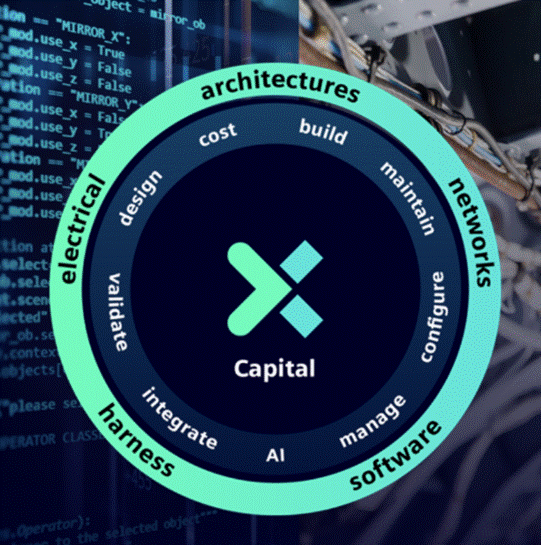
The outer circle of the wheel represents major engineering domains, including hardware and software architectures definition, networks design, embedded software, electrical systems integration and harness engineering. The inner circle represents the lifecycle activities that support them, such as managing configurations, validating designs, generating service and other documentation, integrating with other domains and scaling through automation and Cloud technologies. Together, these layers form the blueprint of a modern E/E development ecosystem.
In the following sections, we break down each domain and lifecycle activity to show how Capital streamlines, connects and elevates them across the entire engineering process.
Architectures: establishing the foundation of E/E systems
Everything begins with a well-defined E/E architecture. The architecture tools within Capital let engineering teams create a detailed, model-based representation of system structure, capturing how electrical components, embedded software functions and communication networks interact across the product. This architectural model becomes the authoritative foundation for every downstream activity.
Because Capital is natively integrated with Teamcenter MBSE, SysML and Polarion ALM, architecture teams can link requirements directly to design decisions. They can trace changes across domains and ensure continuous alignment between electrical, software and systems engineering. Requirements from both Polarion and Teamcenter remain connected to the evolving architecture, maintaining compliance and reducing late-stage rework.
Capital also enables holistic E/E optimization. Teams can maintain E/E platforms, allocate functions with load awareness, run scenario-based trade studies through APIs and manage change through controlled build lists. Device Interface Control (DIC) is model-driven, so component data sheets can be reused to ensure consistency through device libraries and provide authoritative interface definitions.
From this foundation, Capital drives the detailed design disciplines forward. Engineers can automatically generate logic design proposals, derive correct-by-construction network topologies and export a bill-of-functions for electronics design. The result is an architecture that actively orchestrates and accelerates the entire E/E development lifecycle.
Why would people use Capital for E/E architecture design?
- Saves time by integrating E/E with system architecture, collaboration, build list automations
- Boosts collaboration through Teamcenter, Polarion ALM integrations, and Capital’s collaboration
- Reduces overload risk through balanced upfront functional allocation & system impact analysis to avoid late surprises
- Lifts quality by checking design rules and generating network topology and electrical design proposals
Capital X: cloud-enabled collaboration and scalability
While Siemens Capital has long been offered as an on-premises solution, the Siemens Capital X solution delivers the same power plus cloud-native benefits: simplified infrastructure, automatic updates, global collaboration, and elastic scaling. Teams can work from anywhere, onboarding is faster, and IT overhead drops dramatically.
The cloud becomes especially valuable for organizations dealing with supply-chain dispersion, multiple engineering locations or global collaboration needs.
Networks: designing communication systems that scale
Modern E/E systems depend on dense, time-sensitive communication networks that link sensors, actuators, controllers and complex software functions. As platforms increasingly mix protocols such as Ethernet, CAN, LIN, FlexRay, AUTOSAR and common ARINC standards, manual network design has become difficult to scale and highly prone to timing, loading and configuration errors.
Capital addresses these challenges by automating core elements of network engineering. The tool can generate complete, correct-by-design network topologies, synthesize protocol-specific communication and run live timing and bandwidth analysis, helping to ensure every signal meets its deadline. Built-in rule checking and consistency validation remove the need for expert-only manual procedures, shrinking design cycles and providing scalability for complex architectures.
Capital can derive network structures directly from validated systems models, trace requirements through Polarion ALM, and publish consistent, supplier-ready specifications. Teams can manage multi-protocol environments in one place while maintaining full visibility into performance behavior. They can also integrate domain data incrementally, understand impacts of changes quickly and deliver predictable outcomes without rework.
Why would people use network design with Capital?
- Improved lead times by automating design steps and reducing reliance on scarce experts
- Correctness through continuous timing analysis and comprehensive rule checks
- Simplified collaboration with end-to-end traceability, supplier API generation, and requirements linkage
- Seamless transitions across engineering domains for clearer impact analysis
“The Capital Networks design tool helped CEVT overcome these challenges, allowing our engineers to focus less on time-consuming manual work and more on high-value tasks that help us differentiate ourselves and win in the marketplace.”
— Jeremy Parker, Operations Manager, Electrical Department, CEVT
Software: a model-based approach for complex, connected systems
Software failures have become one of the costliest issues in modern products, responsible for 21 million U.S. recalls in 2021 alone, totaling roughly $105B in direct costs. The root cause is rarely coding error; rather, it’s the disconnect between software engineering and the electrical and network systems it depends on.
What’s more, manual re-entry of information, misaligned feature models and limited traceability lead to slow 12-week update cycles and chronic integration uncertainty.
Capital helps eliminate these disconnects by linking software architecture directly to electrical and network models. Engineers can map software components to ECUs, visualize behavior under real network constraints and understand system impact instantly. This model-based approach ensures that software evolves with the physical system – not in parallel silos.
Through connected workflows, teams can generate software architectures from validated systems models, trace requirements through Polarion ALM and Teamcenter and deliver consistent API specifications to suppliers.
These capabilities are especially critical for Software Defined Vehicle (SDV) programs, which must support continuous updates, cybersecurity compliance and functional safety integrity across increasingly large global fleets. While traditional embedded workflows struggle under these pressures, Capital enables teams to automate production code generation (C/C++, Java, Ada) from UML models, adhere to open standards such as SysML, UML, AUTOSAR, UTP and OSLC, and integrate with established IDEs and model-based environments, all while maintaining rigorous traceability.
Testing is fully integrated into the workflow. Capital lets teams reuse system-level test cases, perform software-in-the-loop validation, auto-generate test vectors and measure both requirements and code coverage. This decreases rework and accelerates iterations, while ensuring software remains aligned with electrical and network design.
For software engineering, capital enables:
- Rapid, change-friendly iteration by seamlessly propagating system updates into software architectures
- Automatic generation of supplier APIs with full requirements traceability
- Predictable integration through continuous architecture-driven testing and model-based code generation
- Reduced rework and re-entry through generative domain transitions that keep all design data synchronized
Embedded software: high-integrity logic for software-defined systems
As products evolve into software-defined platforms, embedded software teams face escalating complexity. ECUs run more features, support over-the-air updates and must maintain cybersecurity and functional safety across millions of vehicles for years. Traditional embedded workflows that rely on manual traceability, hardware-dependent testing and siloed processes cannot keep pace with this growth.
Capital addresses these pressures by integrating embedded software development directly into the broader E/E ecosystem. Its scalable execution environment supports everything from resource-constrained MCUs to multicore processors, including AUTOSAR 24-11 compliant implementations.
By validating software behavior against real electrical and network constraints, Capital ensures that embedded logic remains aligned with the system architecture, even as requirements evolve. Virtual validation allows teams to test early and often without waiting for hardware, supporting continuous integration and dramatically accelerating iteration.
Capital also embeds functional safety and cybersecurity rigor up to ASIL D, helping teams meet emerging regulatory standards while reducing manual effort.
With automation, rapid setup, CI/CD support and cross-platform deployment (Windows/Linux), Capital makes high-integrity embedded development faster, more predictable, and easier to scale.
Benefits of Embedded Development with Capital include:
- Saves time with scalable, cloud-ready software engineering
- Accelerates development via virtual validation on hardware-independent platform
- Enables seamless collaboration through ALM and system-design integrations
- Improves quality with an integrated AUTOSAR-based solution and automated consistency checks
Electrical: from interactive design to generative automation
Modern E/E systems demand speed, accuracy, and cross-domain consistency. Yet, connectivity in electrical systems design has traditionally been one of the most manual and error-prone parts of the development process.
Capital transforms this workflow through different flows:
- Interactive electrical design, which guides engineers with intelligent automation and design rules
- Platform interactive electrical design, which enables engineers to define reusable architecture templates and manage variants across vehicle platforms
- Generative electrical design, which fully automates wiring connectivity generation creation for complex, variant-rich platforms
Together, these flows reduce dependency on scarce experts, accelerate development cycles and maintain a consistent, correct-by-design digital thread across the entire electrical architecture, along with the 3D mockup.
AI assistance enhances this process even further by helping engineers analyze design constraints, recommend optimal routing or connectivity options, and automatically identify potential conflicts or rule violations early in development. AI-powered tools can learn from historical designs and supplier component data, and suggest design alternatives. They can also automate repetitive engineering tasks and help teams evaluate tradeoffs between cost, weight, performance and manufacturability. This allows engineers to focus more on system-level innovation while maintaining design accuracy and consistency across increasingly complex electrical architectures.
Interactive flow
Interactive electrical design in Capital provides engineers with an intelligent, guard-railed environment that dramatically reduces errors and accelerates day-to-day design work. Instead of manually checking rules or cross-referencing requirements, they receive real-time guidance as they design.
Capital’s smart automation continuously enforces design constraints, captures expert knowledge through embedded rule checks and suggests appropriate components or connections as the system evolves.
This guided flow also maintains end-to-end traceability across the digital twin. Requirements are linked directly to design implementations, and any change to system intent can automatically drive updates downstream. Engineers can navigate complex design artifacts confidently, knowing the environment is monitoring consistency with the broader E/E architecture.
Because electrical, software and network abstractions are seamlessly connected, teams avoid the costly rework and miscommunication that arise when design data becomes fragmented.
Benefits include:
- Improved design quality and accuracy through reducing costly errors and rework for better profitability
- Increased efficiency and productivity by accelerating product development cycles
- Enhanced collaboration and communication
- Minimized development expenses and bring innovations to market faster
Platform interactive flow
In Capital, the platform interactive flow enables engineers to design electrical architectures at the vehicle platform level rather than at the individual variant level. Instead of manually defining connectivity for each vehicle configuration, engineers interactively define the core architecture, topology and reusable design rules that apply across many variants.
This way, engineers can create and manage platform-level electrical designs and visualizations, explore architecture options early and manage changes across multiple vehicle derivatives. They can:
- Define shared electrical architecture templates
- Manage variant complexity across multiple vehicle programs
- Navigate between logical topology and physical wiring representations
- Apply design rules and automation to enforce consistency across variants
Engineers can author both logical connectivity and physical wiring in the same environment, using rule-driven automation and integrated design validation.
Generative flow
As vehicle platforms grow in complexity, often supporting hundreds of configuration variants, manual schematic creation is too slow and error-prone, and overly dependent on senior experts who understand the full topology. Capital eliminates this bottleneck by using captured knowledge, design rules and architecture inputs to generate complete wiring diagrams at scale.
Capital analyzes logical connectivity and evaluates configuration options, then synthesizes correct-by-construction schematics aligned with manufacturing, electrical and architectural constraints. Because the environment catches issues early through advanced design-rule checks and built-in analysis, teams avoid the cascading rework that occurs when errors slip into downstream harness or mechanical processes.
Capital also supports modular and derivative harness strategies, helping to optimize platform cost and weight, and align design outputs with manufacturable harness structures.
With Capital, you can:
- Turn complexity into a competitive advantage with powerful automation that helps you optimize and innovate
- Shorten time to market with rapid design iteration and change management
- Reduce design costs by eliminating unnecessary rework with correct-by-construction design
- Improve cross-domain collaboration by synchronizing your logical 2D and 3D harness mechanical designs
Schematic generation
Creating and maintaining accurate electrical schematics manually can be time-consuming and prone to errors, especially as designs grow more complex. In Capital, schematic generation automatically converts logical electrical architecture data into clear, standardized diagrams. Because schematics are generated directly from the underlying connectivity model, engineers no longer need to draw them by hand, and the documentation stays synchronized with the design as it evolves.
Capital uses configurable rules and layout algorithms to organize components and connections into readable schematics that follow company standards. Engineers can refine the generated diagrams as needed while maintaining a live link to the design data, which means schematics update automatically when changes occur. A consistent digital thread across the electrical system design process is preserved.
Harness engineering: optimizing for manufacturability and cost
Harness engineering is one of the areas where Capital delivers its most differentiated value. Modern wire harnesses are incredibly complex, often spanning thousands of wires, connectors, splices, protective coverings and variants. Capital manages this complexity through a data-centric, model-driven approach that unifies conceptual wiring design with detailed manufacturing preparation.
With Capital, engineers can progress from logical connectivity to physical routing, flattening, formboard creation and documentation, all within a continuous digital thread designed to eliminate re-entry of data and reduce downstream errors.
Importantly, Capital can be used to design and engineer harnesses with manufacturing in mind. The platform automatically evaluates routing feasibility, validates configuration rules and considers material and labor constraints before a harness ever reaches the plant floor. Automated parts selection ensures that wires, terminals, seals and coverings are appropriate for the design intent, while engineering rule checks enforce consistency across variants.
These capabilities help teams quickly explore trade-offs in material choice, styling or topology, giving them an early understanding of cost impacts and engineering constraints.
Data validation and controlled change management
Through customizable design-rule checks, engineers catch issues early, before they propagate to harness assemblies or mechanical teams. Transparent versioning and assisted formboard generation help to ensure that every engineering change is correctly reflected in manufacturing documentation. This strengthens collaboration between design teams and suppliers, reducing the likelihood of late rework and costly engineering change orders.
Finally, Capital provides a robust manufacturing process and costing environment. The system can automatically generate structured bills of process (BOPs) and bills of material (BOMs), model production processes that can be reused across programs, and calculate labor and material costs with high fidelity.
Benefits include:
- Increased manufacturing efficiency through automation
- Shorter product introduction times with fewer corrections via design-to-manufacturing continuity
- Competitive advantage with extended configurability and customizability
- Automated manufacturing through seamless digital integration
Now we’ll examine what’s happening in the inner wheel, and how Capital ensures an end-to-end process.
Lifecycle functions that power the end-to-end process
While the outer wheel represents “what” teams design, the inner wheel represents “how” Capital helps organizations manage the design lifecycle: maintaining data accuracy, validating systems, managing variants, integrating domains and scaling through automation and the cloud.
Maintain: automating technical publications
Documentation is often one of the slowest and most manual parts of the E/E process. Manual, disconnected and error-prone processes can impact product quality, delay time-to-market and drive up costs. Teams often find it challenging to keep up with the rate of design changes, and at the same time, complexity is skyrocketing, overwhelming traditional processes. What’s more, a demographic shift is resulting in a significant skills gap, as experienced engineers leave the workforce and take their knowledge with them.
By generating publications directly from the authoritative engineering model, Capital helps to ensure that every diagram, instruction set and variant-specific document stays perfectly synchronized with the latest design data. This removes the risk of manual transcription errors and dramatically reduces turnaround time when engineering updates occur.
Because Capital transforms engineering data into publication-ready content automatically, teams can repurpose design information without tedious formatting or rework. Change management is easier, because updates to the model flow through to documentation in a controlled and traceable manner.
Capital can synthesize complete publication packages for delivery across multiple channels, including interactive web formats, traditional PDFs or fully integrated outputs for downstream hosting systems or embedded hardware/software platforms.
Capital also enhances the clarity and usability of technical content. Engineers and service teams can visualize information through rich 3D views, embedded images, videos and dynamically rendered wiring diagrams that support filtering by VIN, tail number or configuration. Advanced reporting capabilities allow users to view diagrams, generate project or library reports and run background publication jobs through a web-based interface, without having to install a client.
Together, these capabilities enable organizations to:
- Save time and money, while creating technical publications faster
- Automate workflows to align with frequent design changes and shorter project cycles
- Improve quality by eliminating manual errors and enabling data reuse and automated checks
- Deliver rich, tailored content to technicians securely over the cloud
Integrating all engineering domains into one digital thread
Capital’s integration capabilities eliminate the fragmented workflows that traditionally slow E/E development.
Instead of passing files between teams or relying on manual updates, Capital establishes a continuous digital thread from requirements, to electrical and software design, to mechanical integration, manufacturing and technical publications. This connected environment ensures that every downstream tool and process is working from the same authoritative data, reducing rework, improving traceability and enabling faster, more reliable decision-making across the entire product lifecycle.
Through tight, bidirectional integration with Teamcenter, engineers can add, associate and search Capital designs directly within the Teamcenter product structure. Electrical components stay synchronized with enterprise part definitions, supported by both manual and batch library updates.
Capital also integrates seamlessly with MCAD environments, enabling both 2D- and 3D-driven electrical design workflows. Through a Teamcenter mediated data exchange, electrical and mechanical teams can share harness geometry, routing paths and packaging constraints in a coordinated digital environment. This allows engineers to develop and validate harness designs directly within the vehicle’s 3D context, ensuring accurate routing and aligning electrical architecture with the overall product design. When it’s time to communicate with manufacturing, Capital can publish electrical BOMs, BOPs, reports and metadata straight into Teamcenter, ensuring every stakeholder is working from a consistent, up-to-date source of truth.
“We synchronize between Capital and NX so our integration team now knows where each harness and connector goes…. that simplifies a lot of the design changes, which allows us to quickly, rapidly iterate on all these designs.”
– Norman Rivera, Interconnect Engineering Manager, Firefly Aerospace
Design, validate, configure, manage: the core workflow loop
Across the inner wheel, Capital supports the essential lifecycle functions for E/E engineering with some AI assistance:
- Design: Engineers develop architectures, networks, electrical systems, and harnesses based on the shared digital model.
- Validate: Automated checks, timing analysis, electrical simulations, and rule-based validations ensure quality at every stage.
- Cost: Synthesize wire harness build processes, material and cost and distribute manufacturing tasks across production line workstations.
- Build: Formboard designers can create an optimized, ergonomic layout based on dynamic feedback of labor effort/times related to each component.
- Configure: Variant management tools allow teams to model thousands of product variations without increasing manual workload.
- Manage: Workflow control, data security, versioning, and traceability ensure organizations maintain governance and regulatory compliance.
These capabilities keep interdisciplinary teams aligned, efficient, and confident in the integrity of their designs.
Enabling continuous, connected engineering through automation
Capital’s automation capabilities stem from its model-based digital twin, a unified representation of the entire E/E system that drives consistency, eliminates manual interpretation and accelerates every engineering phase. By capturing architecture, behavior, rules, and constraints within a single authoritative model, Capital automates tasks that traditionally require significant manual effort: wiring generation, network configuration, variant management, documentation creation, manufacturability checks[EP6] and technical documentation preparation for maintenance.
This automation not only increases productivity but dramatically reduces the risk of human error across large, complex programs.
Because the digital twin spans the full lifecycle, Capital enables a seamless flow of data from requirements to detailed design to manufacturing and service. Requirements from ALM systems trace directly into design decisions; changes cascade automatically across connected domains; and downstream teams always receive up-to-date information without redundant re-entry.
The result is an engineering process that moves faster, maintains higher quality, and scales effortlessly as product complexity grows.
Delivering the future of E/E systems engineering
Engineering organizations across industries face the same reality: E/E systems are becoming more interconnected, more software-driven, and more complex every year. Legacy tools simply cannot manage the scale, speed, and accuracy required.
Siemens Capital provides the unified, model-based, AI-powered environment needed to meet this challenge head-on. Its digital thread connects architecture, software, networks, electrical systems, and harness manufacturing into one cohesive engineering ecosystem. Its automation – powered by generative design, intelligent validation and AI – reduces manual workload and accelerates decision-making. And its integrations, whether on-prem or in the cloud, ensure that every engineering discipline stays aligned throughout the lifecycle.
To learn more about Capital and Capital X for fast SaaS delivery, visit: https://www.siemens.com/capital