The electrical design playbook: streamlining workflows and driving innovation in electrical distribution systems

Introduction to electrical design optimization
In today’s technology-driven world, the design and implementation of efficient electrical systems has become increasingly crucial for businesses across various industries. Whether you’re working on complex industrial machinery, aerospace and defense aircraft or the latest software defined vehicles, the ability to optimize electrical design processes can make all the difference in terms of cost, time-to-market and overall project success.
However, traditional electrical design workflows often involve a myriad of complex tasks, from creating detailed schematics and panel designs to managing intricate data and ensuring effective collaboration between engineering teams. These challenges can lead to costly delays, design errors and suboptimal outcomes, ultimately hindering your organization’s ability to stay competitive and innovative.
Fortunately, there are advanced software solutions available that can help you overcome these obstacles and streamline your electrical design efforts. In this comprehensive guide, “The Electrical Design Playbook,” we’ll explore the fundamental tactics and best practices for optimizing your electrical design workflows, drawing on the expertise and capabilities of leading industry platforms.
Mastering electrical computer-aided design (ECAD) and schematic design
A comprehensive electrical design project encompasses multiple integrated layers that form the foundation of successful system implementation. These layers include:
- Detailed schematics and CAD drawings: Precise, well-organized data in diagrams that serve as the primary blueprint for your electrical systems, ensuring accuracy in component connections and system layout.
- Physical layout design: Optimized topology and component placement, leveraging intelligent algorithms to generate efficient spatial arrangements that minimize errors and maximize system performance.
- Bills of materials management: Automatically generated, comprehensive and hierarchical lists of components, meticulously documented and easily accessible for procurement and inventory management.
- Quality and safety standards: Integrated design review and approval workflows that ensure systems meet the highest standards of quality and safety, with built-in protocols for stakeholder feedback and sign-off.
- Comprehensive documentation: Detailed records of every aspect of the electrical design, facilitating smooth handover processes and supporting future maintenance and troubleshooting efforts.
This multi-layered approach, supported by advanced software solutions, enables teams to create electrical and wire harness designs that are maintainable, safe, and reliable throughout their lifecycle.
Advanced tools and software solutions
To stay competitive, electrical design demands automation and data-driven insight. ECAD software has become the cornerstone of modern electrical design, providing the comprehensive framework necessary for designers and engineers to tackle challenges that would be virtually impossible to address through traditional methods alone.
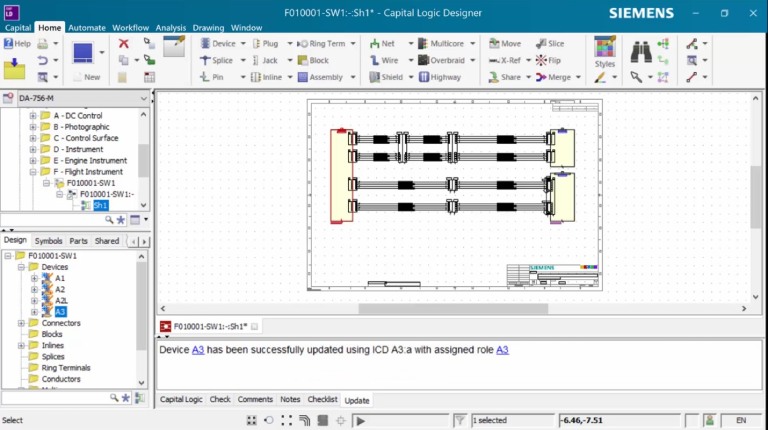
Leading software, such as Siemens Capital X, offers a robust suite of ECAD and harness engineering solutions that empower engineers to work with unparalleled precision and efficiency. Capital X offers powerful features such as:
- Model-based E/E systems development
- Interactive 3D modeling enabled by MCAD integrations
- Real-time design verification via customized Design Rule Checks (DRCs)
- Advanced automation including generative design
- Optimized harness engineering and manufacturing
- Comprehensive automated change management
- Electrical document publications
By mastering the ECAD design capabilities of advanced software solutions, you can streamline your workflows, improve design quality and ensure that your electrical systems are built to the highest standards of accuracy and reliability.
Integrating electrical design with engineering workflow
In the world of modern engineering, electrical design cannot be viewed in isolation. It is an integral part of a broader, interconnected ecosystem that spans multiple disciplines, from mechanical and structural engineering to software development and project management.
Recognizing this, leading electrical design platforms have been designed to seamlessly integrate with a wide range of engineering tools and workflows, enabling seamless collaboration and data exchange across your organization.
One of the advantages of these integrated platforms is their ability to facilitate cross-functional teamwork. By providing an environment for electrical design data, Capital X enables engineers, designers and project managers to access, review and contribute to the same set of project files, regardless of their physical location.
This level of integration and collaboration is particularly crucial in today’s increasingly distributed work environments, where remote and hybrid teams have become the norm. Robust version control and change management features ensure that everyone is working with the most up-to-date information, reducing the risk of costly design conflicts and rework.
Moreover, the seamless integration with other engineering solutions, such as those for mechanical design and product lifecycle management, allows for a truly holistic approach to engineering. By aligning electrical design with the broader product development ecosystem, you can ensure that your electrical systems are designed in harmony with the rest of your project’s components, ultimately leading to more efficient, reliable and cost-effective outcomes.
Optimizing electrical design with automation and analytics
The ability to leverage automation and data-driven insights is no longer a luxury – it’s a necessity. Leading electrical design platforms recognize this reality and have incorporated a range of powerful features to help you optimize your design processes and stay ahead of the competition.
One of the standout capabilities of these platforms is their advanced design automation tools. By automating component placement, wire routing and panel layout, the software frees up your team to focus on higher-value, strategic activities. This not only boosts productivity but also reduces the risk of human error, ensuring that your electrical designs are consistently accurate and reliable. Other benefits include:
- Increased efficiency: Automation streamlines repetitive tasks, reducing the time required for design iterations.
- Enhanced accuracy: Analytics help identify potential errors and inconsistencies, leading to more reliable designs.
- Cost reduction: By minimizing errors and optimizing resource usage, automation can lead to significant cost savings.
- Improved collaboration: Automated tools often facilitate better communication and collaboration among team members.
- Faster time-to-market: Efficient design processes allow for quicker development cycles, getting products to market faster.
- Scalability: Automation enables handling larger and more complex projects with ease.
- Data-driven decisions: Analytics provide insights that can inform better decision-making throughout the design process.
- Quality: Provides you with automated component selection according to your library.
By harnessing the power of automation and data analytics, advanced electrical design solutions can help you take your design efforts to new heights, driving innovation, improving competitiveness and ultimately, delivering better results for your customers and stakeholders.

Electrical design collaboration and team productivity
Success of any electrical design project relies on the ability to effectively collaborate and coordinate across teams. Siemens’ cloud-based Capital X solution acknowledges this reality and responds by facilitating electrical design collaboration in several ways:
- Centralized platform: Provides a single, centralized location where all team members can access the latest design files and updates.
- Real-time collaboration: Allows multiple users to work on the same project simultaneously, making real-time edits and seeing changes instantly.
- Version control: Tracks change and maintains a history of revisions, ensuring that all team members are working with the most current version of the design.
- Commenting and annotations: Enables team members to leave comments and annotations directly on the design, facilitating clear communication and feedback.
- Automated notifications: Sends automated notifications to team members when changes are made or when their input is required, keeping everyone informed and engaged.
- Role-based access: Allows administrators to assign specific roles and permissions, ensuring that only authorized users can make certain types of changes.
- Integration with other tools: Often integrates with other design and project management tools, streamlining the workflow and reducing the need for manual data transfer.
- Data analytics: Provides analytics and insights into the design process, helping teams identify bottlenecks and optimize their workflows.
Benefits of adopting SaaS for electrical design
Using SaaS (Software as a Service) for electrical design offers a range of benefits that go beyond just software convenience—it transforms how teams collaborate, manage projects, and scale operations.
- Anywhere, anytime access: Ideal for distributed or hybrid teams, cloud-hosted platforms enable designers to work from any location with an internet connection.
- No installation or maintenance: No need for complex setup or IT infrastructure. Automatic updates ensure access to the latest features and security patches.
- Lower upfront costs: Subscription pricing reduces expenses. Pay only for what you use, with flexible plans for teams of all sizes.
- Built-in version control: With changes automatically saved and tracked, teams can roll back to previous versions without the fear of data loss.
- Scalability: By adding or removing users and features as projects grow or shift, startups and large enterprises can operate with ease.
- Integrated tools & ecosystems: Many SaaS platforms offer integrations with MCAD, PLM, simulation, and manufacturing tools. This promotes smoother handoffs and cross-discipline collaboration.
- Enhanced data security: Cloud providers typically implement high-level encryption, access control, and compliance protocols. Centralized data storage reduces risk of local data loss or theft
By fostering seamless collaboration and enhancing team productivity, organizations can overcome complex design challenges with greater efficiency and coordination, at contained costs.

Industry applications of electrical design
The transformative power of advanced electrical design solutions is not limited to a single industry; rather, it spans a diverse range of sectors, each with its own unique challenges and requirements. By exploring how different industries leverage e/e systems design software, we can gain a deeper understanding of the versatility and tangible benefits.
Automotive industry
The automotive industry is a prime example of a sector that has greatly benefited from the adoption of comprehensive electrical design software. As modern vehicles become increasingly reliant on complex electronic systems, from advanced driver-assistance features to sophisticated infotainment systems, the ability to streamline the electrical design process has become a critical competitive advantage.
Leading automotive manufacturers have implemented advanced electrical design solutions to overcome the challenges posed by growing product and configuration complexity. Through automation, data-driven optimization, and seamless integration with the broader engineering ecosystem, automotive manufacturers have been able to reduce time-to-market, improve design quality, and achieve significant cost savings.
In the case of Navistar, they were able to reduce time-to-market by 25% while also achieving a 20% reduction in electrical design-related costs, by implementing Siemens Capital.

Aerospace and defense
The aerospace and defense industries are renowned for their stringent safety and reliability requirements, making electrical design an essential aspect of their product development processes. Advanced electrical design software has proven to be invaluable in these sectors as engineers create complex, mission-critical systems with unparalleled precision and efficiency.
Aerospace manufacturers, for instance, use these solutions to streamline the design of aircraft electrical systems, from power distribution to avionics. By automating repetitive tasks, providing data-driven insights, and facilitating cross-functional collaboration, these platforms have helped aerospace companies reduce design errors, accelerate development timelines, and ensure the highest standards of safety and performance.

Heavy equipment and industrial machinery
The heavy equipment and industrial machinery industries face unique challenges when it comes to electrical design, often dealing with the integration of power systems, control systems, and specialized components within rugged, mission-critical applications. Advanced electrical design solutions have proven invaluable in this context, enabling engineers to tackle even the most complex design challenges with confidence.
One example of a company that has transformed its electrical design workflows through the implementation of a comprehensive software solution is the Carraro Group. Through task automation, enhanced collaboration, and data-driven optimization, Carraro has been able to increase project throughput by 30% while achieving a 25% reduction in electrical design-related errors – delivering higher-quality products to its customers.
Across these diverse industries, the adoption of advanced electrical design software has consistently delivered tangible benefits, from improved efficiency and productivity to enhanced innovation and competitiveness. As the demands placed on electrical systems continue to grow, the ability to leverage these innovative solutions will only become more crucial for organizations seeking to preserve margin predictability.

Future trends in electrical design
Electrical design is rapidly evolving, driven by advancements in technology, changing industry demands, and the need for more efficient and sustainable solutions. As we look to the future, several emerging trends are reshaping the field of electrical design, offering new opportunities and challenges for designers and engineers. These trends not only promise to enhance the performance and reliability of electrical systems but also to address critical issues such as energy efficiency, environmental impact, and integration with other technologies.
- Integration of Artificial Intelligence (AI) and Machine Learning (ML): AI and ML will be used to optimize design processes and enhance system performance through data-driven insights.
- Increased use of automation: Automation will streamline repetitive tasks, reduce human error, and accelerate the design process, leading to faster time-to-market.
- Emphasis on sustainability and energy efficiency: Designs will focus more on reducing energy consumption, using renewable energy sources, and minimizing environmental impact.
- Advancements in materials science: New materials with superior electrical properties, such as high-temperature superconductors and advanced composites, will enable more efficient and robust designs.
- Enhanced collaboration tools: Improved collaboration tools will facilitate real-time teamwork across global teams, enhancing communication and efficiency.
- Internet of Things (IoT) integration: Electrical designs will increasingly incorporate IoT capabilities, allowing for smarter, more connected systems that can communicate and adapt in real-time.
- 5G and beyond: The rollout of 5G networks will drive the need for designs that can support high-speed, low-latency communication, particularly in areas like autonomous vehicles and smart grids.
- Cybersecurity focus: As electrical systems become more connected, there will be a greater emphasis on designing secure systems that can protect against cyber threats.
- Modular and scalable designs: Future designs will likely be more modular, allowing for easier upgrades and scalability to meet changing demands.
- Augmented Reality (AR) and Virtual Reality (VR) in design: AR and VR technologies will be used to visualize and interact with designs in a more immersive way, enhancing the design process and reducing errors.
By staying attuned to these emerging trends and incorporating the latest advancements in software, analytics, and connectivity, organizations can future-proof their electrical design processes and position themselves for long-term success in an increasingly competitive and technology-driven landscape.
Final thoughts and next steps
The challenges posed by electrical systems design and harness manufacturing can no longer be addressed through traditional, manual-intensive workflows and disconnected tools. That’s why leading electrical systems development software solutions, such as Siemens Capital X, have emerged as a game-changer for electrical design optimization. With an integrated and holistic approach to ECAD and harness design, engineers, designers and project managers alike are now able to work smarter, faster and more efficiently.
Throughout this “Electrical Design Playbook,” we’ve explored the key topics for streamlining your electrical design workflows, drawing on the expertise and capabilities of these advanced software solutions.
Ready to streamline your electrical design workflows and reduce time-to-market?
Download the free Capital X eBook, “Unlock the potential of cloud-based E/E systems design” or connect with a Siemens expert to see how Capital X can accelerate innovation, improve design accuracy and deliver measurable ROI.
Together, let’s redefine the future of electrical design and push the boundaries of what is possible in your industry.
FAQs – Frequently asked questions
What is ECAD software?
ECAD software, short for Electronic Computer-Aided Design software, is used by engineers to design, simulate, and document electrical systems, including schematics, panel layouts and wiring harnesses.
How does Siemens Capital X improve electrical design?
Capital X automates key workflows like harness engineering, schematic validation, and panel layout while enabling real-time collaboration and seamless MCAD integration.
What industries benefit from electrical design optimization?
Electrical design software like Capital X is used in automotive, aerospace, heavy equipment, and industrial machinery to reduce design errors, accelerate delivery, and improve product quality.
Can Capital X be integrated with other engineering tools?
Yes, Capital X integrates with mechanical CAD, PLM, and simulation tools to enable a connected engineering ecosystem, reduce manual rework, and align cross-domain workflows.