From idea to impact: How modern product design engineering powers innovation
Introduction
Product design engineering is the art and science of turning concepts into real-world products that work, last, and make an impact. It’s where creativity meets rigorous technical execution, covering everything from defining requirements to scaling manufacturing. It fundamentally shapes how businesses compete and how consumers experience technology in their daily lives.
As markets evolve and technical capabilities advance, product design engineers find themselves at the intersection of possibility and practicality, balancing what customers desire with what can be efficiently designed, manufactured, and maintained. This balance becomes increasingly crucial as product lifecycles compress and the pressure for meaningful innovation intensifies.
In today’s competitive landscape, the companies that master both the fundamentals and the latest advancements like digital twins, sustainability-driven design, and AI-assisted development, are the ones pushing innovation forward faster than ever.
What is product design engineering?
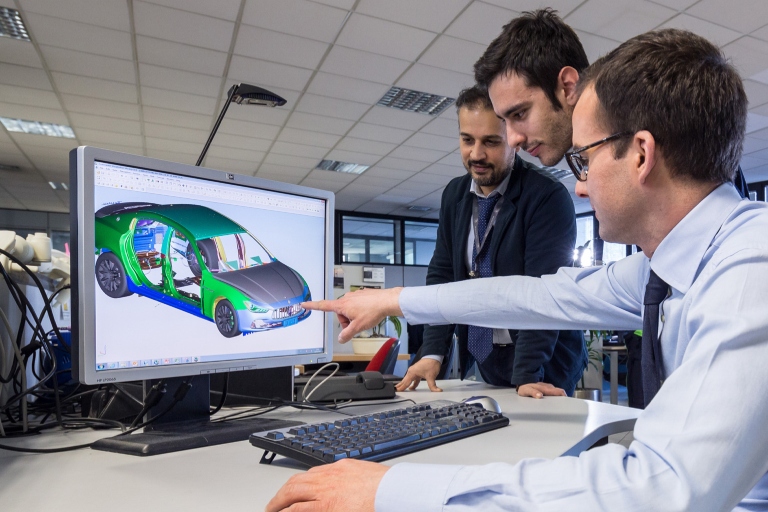
Beyond the basic definition, product design engineering represents a distinct discipline with its own methodologies and skill requirements. Where traditional industrial design might focus on form and user experience, and mechanical engineering on technical systems, product design engineers specialize in making designs both desirable and feasible.
They’re translators between big ideas and practical reality. They consider aesthetics, functionality, performance, and cost while making sure every design choice aligns with the customer’s needs, safety standards, and manufacturing capabilities. Unlike roles focused solely on appearance, product design engineering ensures a product is viable to produce, durable in the real world, and delivers the intended user experience.
This unique position in the development process enables these engineers to prevent the all-too common disconnect between beautiful concepts and what can actually be built at scale at target price points.
The product engineering process: Turning concepts into reality
Every successful product follows a journey from “what if?” to “it’s here.” While the steps can vary across industries, most teams move through these core stages. Each one is shaped by the contributions of diverse engineering disciplines.
The engineering process is never purely linear. It loops back whenever new insights emerge. The best teams treat it as a collaborative cycle not a rigid checklist.
1. Ideation & concept development
It all starts with defining the problem and envisioning potential solutions. CAD designers might sketch initial forms and run quick 3D models, electrical engineers may start mapping circuit needs, and software architects consider system architecture. At this stage, ideas are cheap, but the right questions are priceless:
- Can this be built with available technology?
- How will it integrate with existing systems?
- What’s the expected lifecycle?
2. Product requirements and specifications
Once a concept sticks, product planners and managers capture functional and performance requirements. Configuration engineers define how product variations will be managed. Manufacturing engineers weigh in on process feasibility, tooling needs, and cost targets. A good requirements phase balances ambition with realism toset the foundation for design work without creating roadblocks later.
3. Detailed design
This is where the heavy CAD work begins. Mechanical engineers create assemblies and parts, optimizing for strength, weight, and manufacturability. Electrical engineers design PCB layouts and wiring harnesses. Network designers define connectivity requirements. Software developers start building core code modules. Decisions made here ripple across the product’s entire lifecycle, so collaboration is essential to prevent costly redesigns.
4. Prototyping and testing
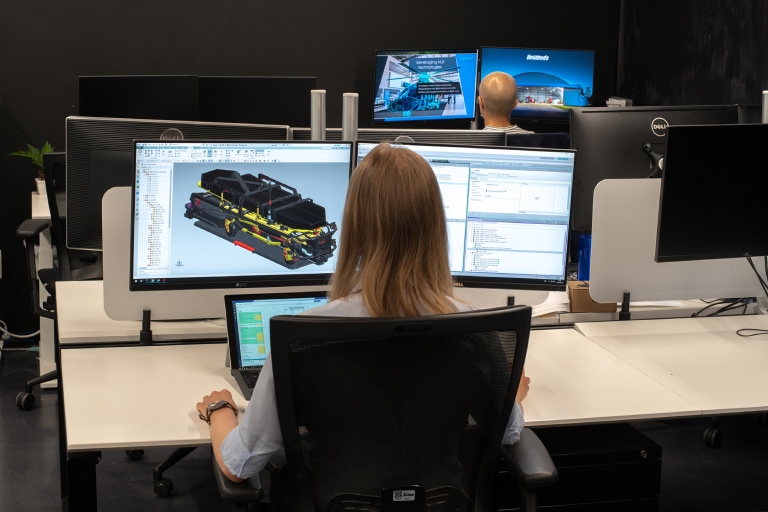
Physical prototypes and digital twins bring the design to life. Digital prototyping allows teams to simulate performance under different scenarios before committing to physical builds. Manufacturing engineers evaluate assembly processes. Mechanical engineers stress-test components. Software teams integrate and validate system behavior. This phase is where many hidden issues surface, and where iteration saves time and money.
5. Product optimization and validation
Feedback from testing drives refinements, tightening tolerances, improving thermal management, reducing material waste, or enhancing user experience. For configuration engineers, this is also when variant strategies are finalized. Every change here aims to balance performance, cost, and manufacturability without introducing new risks.
6. Production ramp-up
The final step moves designs into full-scale manufacturing. Manufacturing engineers finalize assembly lines. Quality teams monitor for consistency. Product managers prepare for launch. By now, hundreds of decisions from every discipline have converged into a product ready for the market.
Digital tools & prototyping: Speed meets precision
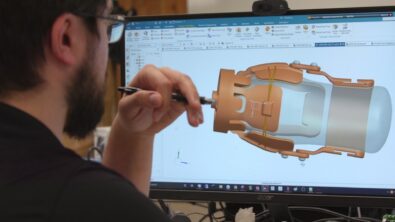
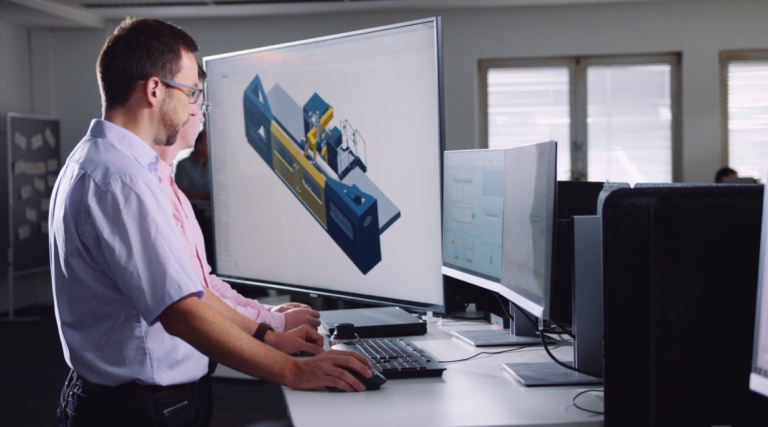
Modern product engineering teams rarely rely on physical prototypes alone. Digital prototyping lets CAD models evolve into full simulations, predicting behavior before metal is cut or circuits are soldered. A digital twin, a real-time virtual counterpart, takes this further by mirroring a product’s performance in operation, allowing for predictive maintenance, continuous optimization, and even remote testing.
For electrical engineers, that means verifying circuit stability under load before boards are fabricated. For mechanical engineers, it’s seeing how a design responds to extreme forces without waiting for a crash test. For manufacturing engineers, it’s testing assembly sequences virtually to spot bottlenecks.
These digital assets, both the static CAD models used in early design and the dynamic digital twins that simulate real-world performance, become even more powerful when integrated with cloud-based collaboration platforms. While CAD models represent the product’s physical properties and design intent, digital twins add layers of operational data and real-world behavior simulation. When connected through collaborative platforms, the entire product lifecycle becomes visible and accessible.
Now, an engineer can modify a component in the CAD model and immediately see how that change affects performance predictions in the digital twin simulation. Advanced visualization tools extend these digital representations beyond engineering teams, allowing stakeholders from marketing, manufacturing, and executive leadership to explore virtual prototypes and provide informed feedback earlier in the process. When everyone can interact with the same digital representation, communication barriers dissolve and alignment happens naturally.
Perhaps most importantly, this digital continuity from concept to production is collapsing development timelines that once stretched for years into months or even weeks. Companies can now explore more design iterations, conduct more thorough virtual testing, and still bring products to market faster than ever—all while maintaining engineering excellence and reducing physical prototype costs.
Designing for sustainability
Sustainable product engineering isn’t just a trend; it’s reshaping how leading companies compete and win.
Engineering teams face complex decisions at every stage of the product lifecycle. How materials are selected, components are designed, and systems are optimized all present opportunities to simultaneously improve environmental impact and business performance. The key is approaching these decisions with sustainability as a core design parameter rather than an afterthought.
Forward-thinking designers are discovering that sustainability-driven innovation leads to breakthrough solutions across industries: materials that perform better while using fewer resources, product architectures that enable longer useful lives, and manufacturing approaches that reduce waste while improving quality. These innovations emerge when teams are empowered to question conventional approaches and apply cutting-edge tools to reimagine what’s possible.
This approach is exemplified by Belgian-based company, CEE. Their engineering team used Simcenter for structural analysis and FLOEFD for flow simulation to develop a revolutionary coffee roaster that consumes up to three times less energy than conventional systems. By reimagining the fundamental process, shifting from batch roasting to a continuous conduction-based system designed specifically for renewable energy, they achieved both environmental and performance breakthroughs.
The result wasn’t just a more sustainable product but a compelling business opportunity. Their technology became the foundation for “Ray & Jules,” an award-winning coffee brand marketed as “the sunny kind of coffee.” This case demonstrates how sustainable engineering creates tangible business advantages: operational cost savings from reduced energy consumption, brand differentiation through environmental credentials, and new market opportunities that wouldn’t exist with conventional approaches.
When sustainability requirements drive product design engineering innovation rather than constrain it, the outcome is superior products that deliver measurable competitive advantage.
Innovation through AI & data
AI is also reshaping product design engineering. Modern engineering platforms leverage machine learning to transcend human cognitive limitations, turning computational power into creative partnership. The most sophisticated generative design algorithms now explore design spaces humans could never fully investigate, simultaneously optimizing for conflicting requirements like structural integrity, thermal performance, weight reduction, and manufacturing constraints.
These AI capabilities create breakthrough possibilities across the engineering spectrum. Structural engineers can discover non-intuitive geometries that reduce material usage while maintaining or improving performance. Thermal engineers can rapidly identify cooling solutions that would be impossible to derive through traditional methods. Manufacturing engineers can predict and prevent quality issues before they occur by analyzing patterns invisible to human observation.
The integration of AI with Industrial Internet of Things (IIoT) data creates particularly powerful feedback loops. Real-world performance data flows back into development environments, enabling AI to identify patterns that inform next-generation designs. This continuous learning cycle accelerates evolution across product categories, from consumer electronics that adapt to usage patterns to industrial equipment that predicts maintenance needs before failures occur.
Siemens: Accelerating innovation with generative AI
Siemens is leading the charge in combining engineering expertise with AI-driven speed. Their generative AI capabilities, integrated with digital twin technology, enable teams to design, simulate, and optimize products in a unified environment. Mechanical engineers can test dozens of iterations in hours. Electrical engineers can validate complex systems without extensive physical prototyping. Manufacturing engineers can optimize production lines before they’re even built.
The result? Faster development cycles, higher-quality products, and reduced costswithout compromising innovation.
What distinguishes the Siemens approach is how it preserves human expertise while amplifying capabilities. The AI doesn’t replace engineering judgment. It elevates it by handling computational complexity and pattern recognition at unprecedented scale, allowing engineers to focus on innovation strategy and critical decision-making.
This human-AI partnership delivers measurable business outcomes: development cycles compressed from months to weeks, material costs reduced through intelligent optimization, and entirely new product capabilities unlocked through design approaches that wouldn’t be feasible with conventional methods.
Engineering the future
The convergence of advanced simulation tools, sustainability-driven design, and AI-powered design engineering is creating unprecedented opportunities for innovation. Today’s product engineers are no longer just technical specialists, but also strategic innovators equipped to solve the most pressing challenges across industries.
What makes this moment in product engineering particularly powerful is how these capabilities build upon and amplify each other. Digital twins don’t just simulate product performance; they provide the data foundation that AI needs to generate insights. Sustainability isn’t just about reducing environmental impact; it drives innovations that create new business models, as shown by CEE’s revolutionary coffee roaster. AI doesn’t just automate routine tasks; it unlocks design possibilities beyond human imagination.
For organizations committed to innovation, the path forward requires embracing this integrated approach. The most successful companies aren’t treating these technologies as separate initiatives but as interconnected elements of a comprehensive product development strategy. When digital twins inform sustainability decisions, which then become optimization targets for AI systems, the result is a virtuous cycle of continuous improvement and breakthrough innovation.
The engineers leading this transformation are developing a unique blend of technical depth, systems thinking, and creative problem-solving. They understand that in a world of increasing complexity, the ability to navigate across disciplines—from mechanical to electrical to software—while keeping sight of the bigger picture is what separates game-changing products from incremental improvements.
As we look ahead, the organizations that will define the next era of innovation won’t be those with the most resources, but those that most effectively combine human creativity with technological capability. They’ll create environments where engineers can focus their expertise on the challenges that matter most while leveraging digital tools, sustainability principles, and AI to amplify their impact.
The future of product design engineering isn’t about technology replacing human ingenuity. It’s about technology expanding what human ingenuity can achieve.
In this future, the question isn’t whether we can build something, but what we should build to create the greatest positive impact for customers, businesses, and our shared world. By leveraging Siemens’ holistic and integrated product development solutions, today’s engineering teams can meet ever-evolving demands with creativity and confidence.
FAQs about product design engineering
What is design engineering?
Design engineering is about transforming imaginative ideas into viable products. It involves defining how a product should function, selecting suitable materials, sketching or modeling it in CAD, and ensuring it can be manufactured reliably at scale. In practice, it’s an elegant blend of creativity, technical know-how, and practical judgment, ensuring each product not only looks and feels great but also works efficiently in the real world.
How does mechanical design engineering relate to product development?
Mechanical design engineering is the backbone of product realization. It takes broader concepts (like user needs or electronic functionality) and makes them tangible, by specifying structures, clearances, tolerances, and materials. Mechanical engineers ensure the product is durable, cost-effective, and manufacturable. They also lead prototyping and refinement such as testing virtual models or physical versions for strength, fit, and ergonomics, and iterating until everything performs reliably.
How does electro design engineering relate to product development?
Electro design engineering brings essential functionality to life like power delivery, signal routing, component integration, and meeting electrical safety standards. These engineers craft schematics and layouts that must work seamlessly with mechanical structures and software. Early integration of electrical considerations prevents clashes in space, thermal management headaches, or EMI risks. In essence, they’re the bridge between “this needs power” and “this works confidently and safely”.
How can AI technology be used to generate design engineering concepts?
AI is emerging as a creative ally in design. By feeding constraints like weight limits, strength thresholds, and material choices into AI-driven tools, engineers receive multiple optimized design alternatives automatically. These AI-generated concepts offer fresh directions that might not surface through manual iteration alone. It’s like expanding your team with a colleague who’s brilliant at suggesting thoughtful, engineering-backed ideas.
How can product design engineering technology speed up product development?
Modern tools, from smart CAD platforms to simulation suites, are all about accelerating iteration. CAD now offers built-in guidance that helps ensure designs are clean and robust from the start. Simulation tools let teams virtually test designs under real-world conditions before any prototype is built, saving costly trial runs. When requirements, revisions, and documentation are managed via digital threads, handoffs happen faster and with fewer mistakes, keeping projects on schedule and efficient.
How do integrated design engineering solutions support design for manufacturability?
Integrated design engineering solutions unify design, manufacturing, and support details into one shared framework. When design engineers define parts, manufacturing needs like tooling, assembly sequencing, and quality checks are already factored in. This upfront alignment reduces surprises—and rework—later on. The outcome? A cohesive, efficient handoff that delivers designs that look good, function well, and can be produced consistently and affordably.
What role does concurrent engineering play in product engineering processes?
Concurrent engineering encourages parallel progress across disciplines—design, electrical layout, manufacturing planning, testing, and beyond—rather than waiting for one phase to complete before starting the next. This collaborative rhythm accelerates time-to-market, improves quality, and reveals potential problems early. Clear communication and integrated workflows empower teams to iterate more intelligently together—and deliver higher-quality products faster.
How can advanced product development solutions from Siemens speed up product design engineering?
While I won’t name specific tools, Siemens is known for embedding intelligent automation throughout design. Their solutions streamline design concept generation, simulation, and version control. By moving smoothly from ideation to simulation to manufacturing planning, they minimize iteration cycles and help teams deliver with greater confidence and efficiency. In many ways, the technology acts as a thoughtful partner—anticipating issues, suggesting alternatives, and keeping projects moving ahead of schedule.