Circular thinking in semiconductors: How logistics drives sustainable transformation

The semiconductor industry is at the heart of global innovation – powering everything from mobility and energy systems to consumer electronics. Yet behind the technological progress lies an urgent environmental challenge. Between 2015 and 2023, energy consumption in semiconductor manufacturing more than doubled and Scope 3 emissions increased by 647%, with total emissions projected to reach 277 million metric tonnes of CO₂e by 2030.

To ensure future resilience and compliance with growing ESG expectations, semiconductor companies must rethink how resources flow through their value chains. Circular economy principles – supported by advanced digital logistics – are emerging as a key pathway toward sustainable, efficient and transparent operations.
Download the infographic “The key role of logistics and the circular economy in the semiconductor industry“ and discover how circular transformation is reshaping the semiconductor industry.
Circularity starts at product design
Sustainability begins long before the first chip is produced. By integrating circular design approaches early in the innovation process, organizations can plan for product reuse, refurbishment and recycling. This includes making informed sourcing decisions that balance cost, risk and CO₂ emissions while exploring recycled materials as viable alternatives.
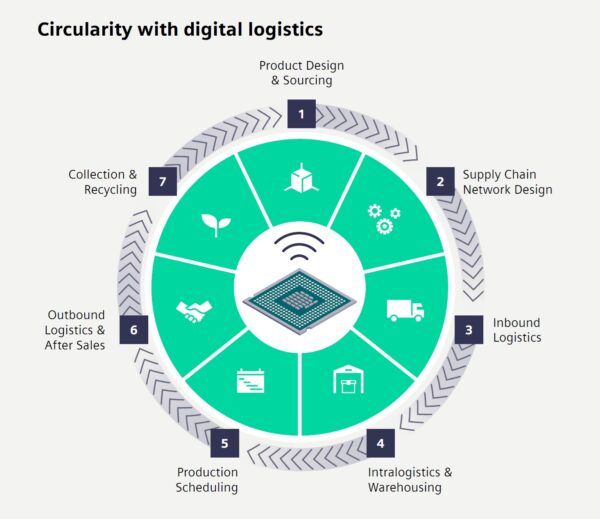
The infographic “The key role of logistics and the circular economy in the semiconductor industry” highlights how digitalization enables such strategies – from design and sourcing through production and logistics, all the way to end-of-life collection and recycling.
Digital logistics as the enabler of circular value chains
Circularity does not stop at the factory gate. As products move through their lifecycle, logistics becomes the critical link connecting all stages of the circular economy.
Digital logistics platforms provide end-to-end visibility, allowing companies to track recyclable materials, simulate transport routes and optimize capacity utilization. Cloud-based collaboration ensures that all partners – from suppliers to recyclers – work from a shared, real-time view of data.
Simulation tools and digital twins help organizations test how network changes, material flows or return processes affect both cost efficiency and carbon performance before implementation. This digital backbone enables semiconductor manufacturers to transform linear supply chains into dynamic, regenerative ecosystems.
Unlocking hidden value through circularity
Circular business models are no longer just an environmental initiative – they are a strategic growth driver. In 2022, global circular economy transactions generated $339 billion in revenue, a figure projected to reach $713 billion by 2026 – a 110% increase in just four years.
For the semiconductor industry, adopting circular practices means not only reducing emissions but also mitigating supply risks, ensuring regulatory compliance and strengthening brand reputation. With logistics and digitalization at its core, circularity becomes a source of resilience and competitiveness.

From supply chain to ecosystem
The path toward circularity requires collaboration across the value network. As the infographic illustrates, digital platforms and intelligent logistics solutions enable organizations to:
- Optimize resource efficiency in production and warehousing
- Reduce transport emissions through better route planning and mode selection
- Leverage reverse logistics for repair, reuse and recycling
- Integrate product lifecycle data to ensure transparency and traceability
Together, these measures transform traditional supply chains into circular ecosystems – systems designed not only to deliver, but to regenerate.
Take the next step toward circular results
To explore how your organization can make logistics the centerpiece of its circular transformation, download the full infographic: “The key role of logistics and the circular economy in the semiconductor industry“
And discover more insights in Siemens Digital Industries Software’s white paper,
“The Circular Economy – How Digital Technology Is Transforming the Supply Chain into an Ecosystem“, which explains how digitalization is enabling industries worldwide to turn sustainability into value.