Mixed-Signal Verification: Symphony Customer Success Stories across the Siemens EDA and Solido Custom IC Forums

Three countries. Multiple customer presentations and posters. One clear takeaway: Siemens’ Symphony, part of Solido Simulation Suite, is solving the industry’s toughest mixed-signal verification challenges.
It’s been fantastic to see, in person, how customers are leveraging Solido Custom IC (CIC) technologies to solve their evolving verification challenges at our Siemens EDA Forums and CIC Forums worldwide. There’s something special about meeting with customers face-to-face, and our global forums over the past few months have demonstrated the breadth of applications where Symphony is making an impact.
I was particularly impressed by the innovative ways customers are using Symphony mixed-signal technology to accurately verify design functionality, connectivity, and performance across analog/digital (A/D) interfaces and tackling complex verification challenges in a variety of IC applications.
Read on to discover these customer stories!
Toppan (Japan) – 50% Faster CMOS Image Sensor Verification
First stop on this tour: Japan! At the Siemens EDA Forum, Toppan, a leading provider of integrated solutions in the fields of printing, communications, security and packaging, demonstrated how Symphony transformed their verification workflow for a complex CMOS image sensor IC. The design integrated a microcontroller with multiple analog blocks such as LDO, PLL, and temperature sensors, creating significant verification challenges at the full chip level.
Toppan highlighted Symphony’s critical advantage: flexibility in supporting non-Siemens digital solvers. With Symphony, Toppan reduced their mixed-signal verification time by more than 50% without compromising accuracy.

EKEPOWER (Taiwan) – Versatile Solutions for Multiple IC Types
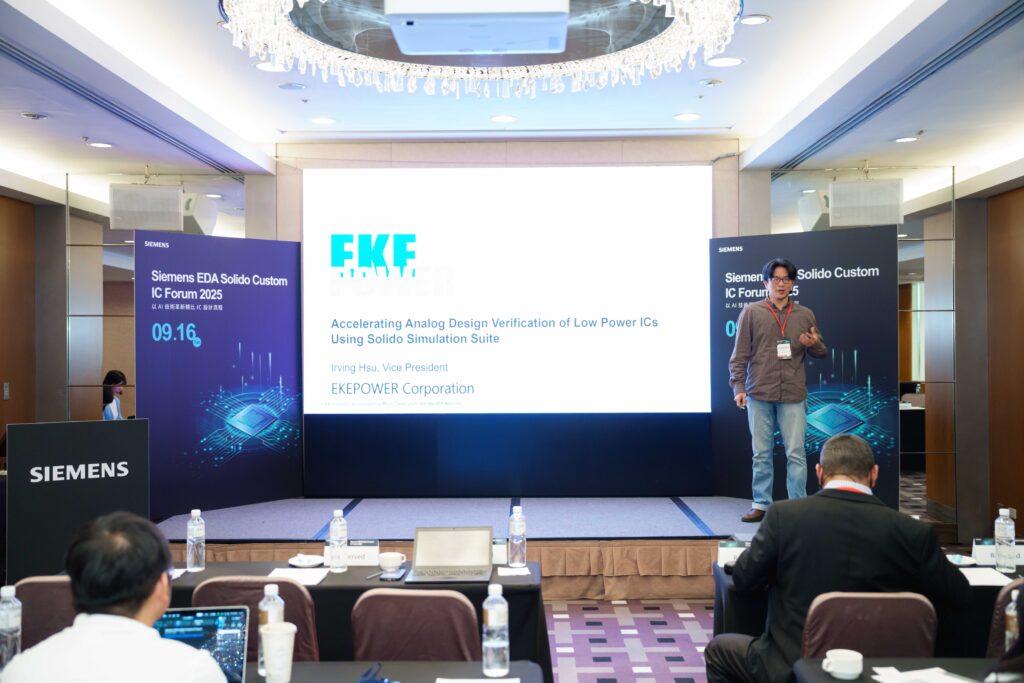
Next up was the Solido Custom IC Taiwan Forum where EKEPOWER, an innovator in printing applications, detailed how the versatile Solido Simulation Suite resolved their challenges for three different kinds of low power ICs: RFID IC, Graphic Driver IC and Timing Generator IC.
They successfully utilized Symphony’s Boundary Elements (BE) to simulate the complex interaction between mixed-signal circuits with high accuracy, including RF Front End (RFFE), Sensor Readout and Verilog-modelled Digital Baseband components.
Analogport (India) – Streamlining High-Speed Interface Verification
The Solido Custom IC Forum in India was attended by hundreds of experts working in the custom IC domain. Although there were many presentations showcasing how our customers are benefiting from the advanced solutions we offer, the mixed-signal sessions made their own mark.
Analogport Pvt Ltd, specialists in high-speed interface IP for multiple protocols such as PCIe, USB and SATA, demonstrated how Symphony Pro’s Boundary Elements provide seamless, automated, and configurable translation between analog and digital domains, simplifying analog mixed-signal (AMS) integration. They also leveraged Symphony’s selective data dumping capability to optimize AMS verification by improving efficiency, speed, and scalability while ensuring focused debugging. Analogport was particularly appreciative of the timely support they received from the Solido Custom IC team, which reinforces our customer-first mindset.

Microchip (India) – Innovative Applications Beyond Traditional Simulation
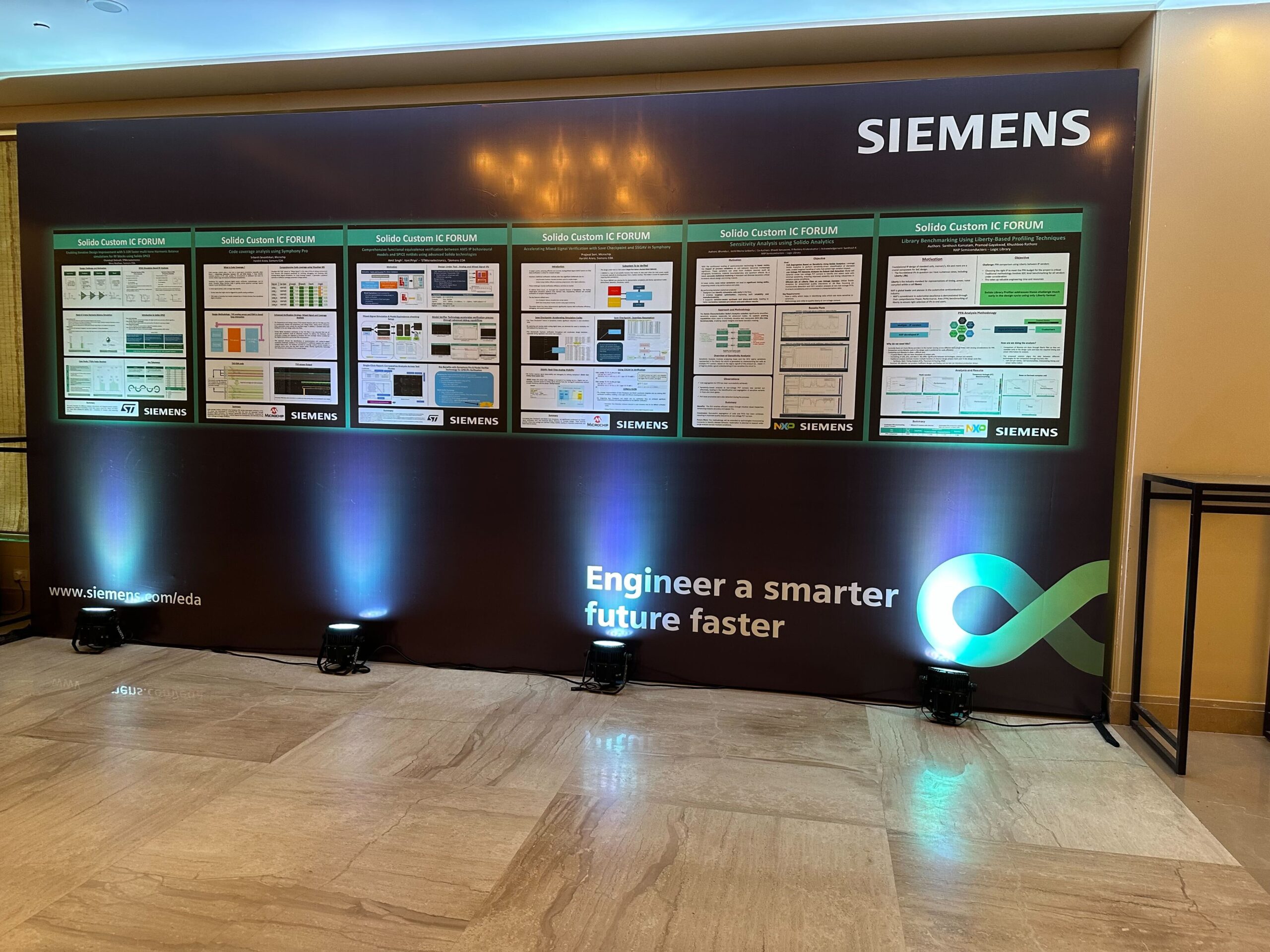
Microchip, a leader in providing ICs for industrial, automotive, consumer, aerospace, defense, communications, and computing markets, presented two insightful case studies through poster sessions.
The first poster focused on mixed-signal code coverage analysis conducted using Symphony Pro, which was instrumental in uncovering RTL bugs that were not detectable through standalone digital verification. Microchip leveraged the intuitive and flexible mixed-signal Visualizer GUI to display a graphical overview of different coverage parameters for their temperature and voltage sensor (TVS block), exposing corner cases they had missed in the initial iterations. This approach significantly bolstered verification robustness by identifying critical test coverage gaps, enabling targeted test development and ultimately drove higher coverage and design confidence. Their case study revealed an innovative application, which extends well beyond conventional mixed-signal simulation approaches, demonstrating unprecedented ways to maximize the technology’s capabilities
The second poster from Microchip demonstrated two powerful features from Symphony: Symphony Get Analog Value (SGAV) and Save Checkpoint Restore, which significantly accelerated overall mixed-signal verification time and enhanced debug efficiency for complex designs with long runtimes.
Microchip deployed these features for a single-port battery-backed SRAM (BBRAM), a distinct circuit from the previous example, highlighting Symphony’s versatility for mixed-signal verification. The SGAV and save checkpoint restore features provided critical time savings and real-time analog visibility, leading to improved productivity and faster time-to-market. Their success story underscores Symphony’s core value: enabling customers to achieve significant cost efficiencies through reduced design iterations while accelerating market delivery with uncompromised quality standards.
A Trusted Solution for Complex Challenges in Mixed-Signal Verification
The forums provided valuable perspectives on how customers are maximizing our technology’s potential and why Symphony continues to set the standard for mixed-signal verification, delivering the performance and accuracy that today’s complex designs demand. We’re proud to support engineers worldwide as they push the boundaries of what’s possible in their designs. If you would like to learn more about how Symphony can solve your next mixed-signal verification challenge, click here.
To learn more about Solido Custom IC solutions, click here.