What are engineering student competitions?

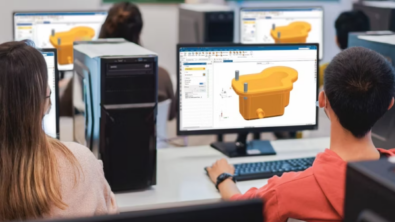
Engineering student competitions are hands-on, team-based challenges that allow students to apply engineering principles to real-world problems. Instead of focusing on grades or predefined solutions, these competitions emphasize problem definition, design decisions, testing and performance under authentic constraints.
Students can now register for the FREE Expedite – Skills for Competitions microcredential from Siemens. Earn key skills needed to enter your first competition with confidence, learn how to translate your experiences into compelling resume highlights and demonstrate your workforce readiness.
Engineering competitions explained
At their core, engineering student competitions are about learning by doing. Students work together to design, build, simulate and validate solutions while balancing technical requirements, time limits, budgets and rules. This makes competition experience a powerful complement to traditional engineering programs.
What defines an engineering student competition?
Engineering student competitions are typically organized around a specific challenge or objective, such as designing a vehicle, building a robotic system, optimizing a manufacturing process or solving a sustainability problem. Teams are given a formal rule set that defines goals, constraints and evaluation criteria.
A large part of what sets competitions apart from coursework is the higher level of responsibility and ownership. Students are entirely responsible for decisions, trade-offs and outcomes. For many students, it’s the first time they must navigate complex challenges without more experienced professionals or professors directly guiding them through the process. Success depends not only on technical skills but also on how well teams collaborate and communicate.
How are engineering student competitions structured?
While formats vary, most engineering student competitions follow a similar structure.
Teams begin by seeking to understand the problem statement and requirements. From there, they move into concept development, system design and planning. This is followed by implementation, testing and iteration. The process concludes with a competition event, where teams demonstrate their performance and present their design approach to the judges.
This structure closely mirrors professional engineering workflows, enabling students to gain experience with the ambiguity of unbound challenges, as well as the rigors of iteration and working within real-world constraints.
What engineering student competitions are not
Engineering student competitions are not simply extracurricular activities or academic exercises. They are neither limited to top-performing students nor do they require prior experience in competitions.
Instead, competitions are learning environments designed to help students grow. Many teams welcome beginners, providing mentorship and allowing students to start with small responsibilities before taking on more advanced roles.
Why do engineering student competitions exist?
Engineering student competitions exist to bridge the gap between theory and practice. They provide students with a space to apply what they have learned in class, experiment safely and understand how engineering decisions impact real-world outcomes.
For many students, competitions also provide context for coursework and help clarify career interests by exposing them to different engineering roles and disciplines.
Who are engineering student competitions for?
Engineering student competitions are open to students at all stages of their academic journey. First-year students can explore engineering in a practical setting, while advanced students can deepen technical expertise and develop leadership skills.
Competitions are also valuable for students who want hands-on experience, enjoy teamwork and are curious about how engineering works outside the classroom.
What are the benefits of participating in engineering student competitions?
Student engineering competitions offer benefits that extend well beyond the competition itself.
How do competitions support career development?
- Build a portfolio with concrete project examples for interviews and your engineering student resume
- Gain experience that differentiates you from candidates
- Connect classroom theory to industry applications
- Develop references and professional recommendations
What skills do students develop through competitions?
- Project management: timelines, budgets and resources
- Cross-functional collaboration and teamwork
- Technical communication and presentation skills
- Engineering decision-making under constraints
- How to leverage engineering software (learn how to get started with free Siemens software for students)
Learn seven essential skills for mechanical engineering careers and seven in-demand skills for electrical engineering careers.
How do competitions expand professional networks?
- Build relationships with peers who share similar interests
- Meet industry sponsors, mentors and judges
- Access alumni networks from competition organizations
What personal growth comes from competition participation?
- Build confidence through hands-on problem-solving
- Develop resilience by learning from failures
- Gain clarity on career interests and engineering disciplines
Learn more about why engineering student competitions are worth it and the benefits of these competitions.
How should students prepare for engineering student competitions?
Preparation varies based on competition type and experience level, but certain foundational steps apply across most competitions.
How do you find competition opportunities?
- Ask your university’s engineering department or relevant student organizations
- Attend information sessions hosted by existing teams
- Talk to upperclass students or faculty advisors
What should you understand about requirements?
- Read the rule set to understand objectives and constraints
- Identify required deliverables (e.g., reports, presentations and demonstrations)
- Understand the timeline from registration to competition day
- Review judging criteria
How do you get started with a team?
- Attend recruitment events early in the academic year
- Express interest even without prior experience
- Start with smaller responsibilities to learn workflows
- Commit to consistent participation
What are some examples of engineering competitions for students?
Engineering competitions fall into five main categories based on format and focus area.
Design-build competitions
Teams design, fabricate and test physical systems like race cars, solar cars, off-road vehicles or structural components over an academic year. These competitions are great for comprehensive, long-term project experience.
Robotics and autonomous systems competitions
Teams build and program robots for specific tasks, emphasizing mechatronics, controls and software. These are typically a year-round commitment with 15-50 student teams.
Hackathons and software challenges
Short, 24- to 72-hour events where small teams (2-5 students) develop software solutions. These competitions are a lower time commitment and focus on rapid prototyping.
Case competitions and innovation challenges
Teams solve real-world problems from industry sponsors through reports and presentations. The duration may range from weekends to several weeks.
Research and technical paper competitions
Individual or small teams conduct original research presented through papers or presentations. These competitions are typically best for students interested in graduate studies.
Siemens and Sony are challenging students worldwide to make a product or process more sustainable with Immersive Engineering. Register now for the 2026 Immersive Design Challenge before the deadline of January 31.