Learn how Florida International University is leading the way in additive manufacturing, biotechnology and more with academic-industrial partnerships

Florida International University’s (FIU) College of Engineering and Computing has emerged as a powerhouse for cutting-edge research and industry collaboration.
As a Carnegie R1 University, FIU has reported over $1 billion in research expenditures in the last five years, with $306 million in 2023-2024.
FIU ranks among the top 20 U.S. patent-producing public universities and, under interim Dean Inés Triay, is advancing groundbreaking research across disciplines with a focus on artificial intelligence, cybersecurity, advanced materials and manufacturing, robotics, next generation electronics and biomedical technologies.
To gain insight into FIU’s success in research, innovation and academic-industrial partnerships, we spoke with Dean Triay, who holds a PhD in chemistry from the University of Miami and has extensive experience in national security. Before joining FIU, she served as the 7th Assistant Secretary for Environmental Management at the Department of Energy. Dean Triay was appointed to this role by President Obama in May 2009, where she led the largest nuclear waste cleanup effort in the world. At FIU, Dean Triay has served as the Executive Director for the Applied Research Center for twelve years in addition to her current role as interim dean.
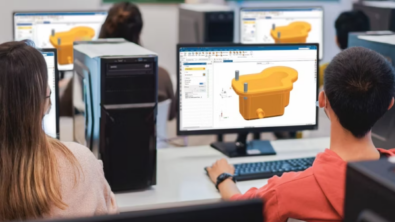
FIU uses Siemens’ software for a variety of research and educational purposes. To secure Siemens’ software for your institution, apply for an academic partner grant today.
Identifying and solving the most pressing research challenges facing industry
For Dean Triay, successful academic-industrial partnerships begin with shared objectives, exemplified by FIU’s AI-enabled microgrid project developed with a major energy company. This initiative enhances energy distribution and supports efficiency goals, highlighting how FIU serves as a valuable research arm. As Dean Triay stated, “We have an AI-enabled microgrid right here at our engineering center,” adding that, “This company routinely utilizes our research.”
Additionally, FIU’s patented inventions demonstrate the university’s commitment to addressing pressing challenges in areas like biotechnology, additive manufacturing and more. Innovations include a novel security protocol to protect videos from quantum hacking, an algorithm that differentiates healthy heart sounds from those of a developing disease and AI-powered visualization for Alzheimer’s diagnosis and prognosis.
Meanwhile, more than 25 researchers at the Cold Spray and Rapid Deposition (ColRAD) Laboratory are focused on advanced studies in 3D printing technologies that aid U.S. defense forces in enhancing the durability of materials for next-generation vehicles and munitions.
Beyond military applications, Cold Spray 3D printing is solving significant challenges in robotics, aerospace and environmental resistance, including the development of antibacterial coatings for biomedical use and strategies for preventing corrosion in coastal communities.
Balancing academic imperatives with industrial priorities
Academic-industrial partnerships often face significant challenges, particularly when it comes to balancing timelines and priorities.
“The biggest obstacle that we have when we’re trying to establish a partnership with private industry is the difference in timing,” said Dean Triay. “Private industry wants a product as soon as possible because obviously they have to make a profit.”
Meanwhile, universities have broader educational goals. “We have responsibilities to give them an education that allows them to get any number of jobs in different industries or in academia themselves,” she explained.
FIU strives to address this gap by serving as a solution center for industrial organizations. They accomplish this through strategic project selection and by allowing students to complete dissertations or capstone projects that directly address industry challenges.
For example, FIU has collaborated with a significant aerospace manufacturer to connect students to internships and commercial projects, which enriches their learning experience.
“We actually want to become solution centers for the private industry,” Dean Triay stated, noting that FIU has built an innovation complex specifically to facilitate these partnerships.
Adapting engineering education for the needs of today’s students
With industrial organizations facing an unprecedented rate of technological change and market shifts, the need for adaptable educational paradigms has never been greater. Toward that effort, FIU has integrated AI into their curricula.
“We have gone through a revamping of our entire curriculum in the College of Engineering and Computing to ensure that when our engineers and computer scientists graduate, they are indeed AI-ready,” Dean Triay explained.
Dean Triay also sees tremendous potential in microcredentials.
“Microcredentialing is one of the most effective ways of enabling continuing education as well as allowing students to pursue areas that they may not have chosen as their major field of study,” she noted. This approach allows students to be nimble and expand their horizons while pursuing their primary field of study. FIU’s growing portfolio of microcredentials supports this goal, offering students flexible pathways to deepen expertise, explore interdisciplinary interests and enhance career readiness.
Through cutting-edge research, rigorous academic-industrial collaboration and forward-thinking curriculum development, FIU continues to set the standard for building day-one ready engineers.
To learn more about how microcredentials can support inclusive, dynamic and learner-centered undergraduate engineering programs, download our ebook on the topic.