Building practical engineering skills through the FAME Design Challenge

Tuomas Rahkola and Teemu Kivelä won the 2026 FAME Additive Manufacturing Design Challenge with a bracket concept developed through research, modelling and simulation. Additive manufacturing and auxetic structures were new subjects for the team. Working on a problem supplied by Patria gave them an opportunity to build that knowledge and apply it using Siemens software.

Teemu Kivelä and Tuomas Rahkola receive their awards at Alihankinta in Tampere.
The competition was organised by the Finnish Additive Manufacturing Ecosystem (FAME) in collaboration with Patria and supported by Siemens, LUT University and our partner MAIT Nordics. Run by DIMECC (the innovation accelerator for digitalizing industry in Finland), FAME connects companies and research organisations working to advance industrial additive manufacturing in Finland.
Patria asked students to design a mechanical fuse: a structural component that remains rigid under lower loads, then deforms in a controlled way when a specified impulse threshold is reached. The aim was to absorb energy and reduce the impulse transmitted through the bracket, while meeting manufacturing and design-space constraints.
The winning concept uses two tubes with repeating, inward-angled honeycomb patterns. The team describes these as auxetic tubular re-entrant honeycomb structures, designed to absorb impact energy through controlled plastic deformation. The complete bracket was intended to be light, durable and easy to install.
Before starting the design, Tuomas and Teemu studied literature on additive manufacturing and auxetic structures. Translating that research into a cylindrical model was challenging. They had to project the cutout pattern onto a curved surface while keeping the design adjustable.
“We wanted the model to be parametric so that the density of the honeycomb pattern as well as other parameters could easily be changed.”
Tuomas Rahkola and Teemu Kivelä

An early sketch of the bracket concept.
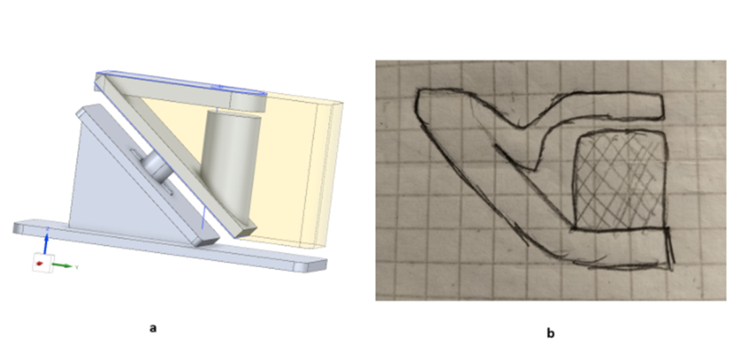
The second concept, shown as a CAD model and a hand-drawn sketch.
The team used Siemens Designcentern NX tools for modelling and Designcentern Solid Edge Simulation, using the Simcenter Nastran solver for finite element analysis (FEA). These simulations helped them examine the proposed structure under loading and informed successive design changes.
“These were essentially the applications that allowed us to create and test the design, turning our ideas into reality.”
Tuomas Rahkola and Teemu Kivelä
Progress came through trial and error and repeated design-and-simulation cycles. They also explored topology optimisation, but found the geometry of the auxetic tubes difficult to handle in that workflow.


Finite element simulations of an early tubular concept and the third bracket version.
The images show how the work developed from an initial idea into a complete bracket proposal that fits within the specified design space.


The third bracket version and its placement within the specified design space.
For the manufacturing route, the team selected wire arc additive manufacturing (WAAM). This process builds metal parts layer by layer using wire melted by an electric arc. Preparing the proposal also meant learning about materials suitable for the process.
Feedback from Patria’s engineers helped the students understand where their design could be improved. As the team explains:
“We also received feedback on our design from Patria’s engineers, which deepened our understanding of the flaws and development opportunities of our design.”
Tuomas Rahkola and Teemu Kivelä
FAME reported that the evaluators particularly appreciated the solution’s manufacturability and potential for further development. The team was recognised at Alihankinta, the Subcontracting Fair in Tampere.
For Tuomas and Teemu, the experience extended beyond the technical work. They valued working as a team, following a design process shaped by requirements, researching unfamiliar topics and building connections in a field that could become part of their future careers.
“Innovation happens when we connect the right worlds: industry challenges, engineering talent and digital technology. The FAME Design Challenge is a great example of that connection in action. Congratulations to the winners!”
Hannu Mäkinen, Product Engineering Domain Owner, MAIT Nordics
For our Future Workforce Program, this is a practical example of how software access and real-world applications can support each other. The students used engineering tools to explore their ideas, considered manufacturing requirements and discussed their work with industry engineers. Their experience shows the learning that can take place as students investigate a problem and refine a proposed solution.
Congratulations to Tuomas and Teemu, and thank you to FAME, Patria, LUT University and MAIT Nordics for supporting this challenge.