Smarter FMEDA, Safer Designs: The Questa One Verification IQ Compliance Advisor Story

FMEDA Challenges in Modern Semiconductor and Automotive Projects
Ever wondered why creating an FMEDA, a fundamental requirement for functional safety compliance, often feels far more challenging than expected? While the objective sounds straightforward, verification engineers know the reality is anything but simple. As modern SoCs continue to grow in complexity, integrating hundreds of IPs, accommodating constantly evolving safety requirements, managing thousands of potential failure modes, and implementing increasingly sophisticated safety mechanisms, FMEDA development can quickly turn into a daunting and resource-intensive effort. What starts as a safety analysis can soon become a struggle to maintain accuracy, traceability, and consistency across a rapidly changing design landscape. So, what are the biggest obstacles that make FMEDA creation and maintenance such a challenge? Let’s explore the key pain points engineers face and why traditional approaches are finding it difficult to keep pace with today’s complex semiconductor designs.
The Hidden Risks of Missing End-to-End Traceability Across the Functional Safety Lifecycle
Without end-to-end traceability, engineers must manually maintain links between requirements, FMEDA analyses, safety metrics, and verification activities across multiple tools. This makes it difficult to verify coverage, assess the impact of changes, and maintain audit readiness. As projects grow in complexity, the lack of integrated traceability increases engineering effort, reduces visibility, and raises the risk of compliance gaps and inconsistent safety analyses.
Challenges of Managing FMEDAs with Spreadsheets
While Excel is widely used for FMEDA creation and maintenance, spreadsheet-based workflows can become difficult to manage as projects grow in complexity. Manual data entry, formula updates, and cross-sheet dependencies increase the risk of errors that can impact safety metrics and diagnostic coverage calculations. In addition, the lack of built-in traceability, version control, and collaboration features makes change management, audit preparation, and supplier FMEDA integration more challenging, resulting in increased effort and reduced productivity.
The Risks of FMEDA Tools Without Version Management
FMEDA evolves throughout the product lifecycle as requirements change, safety mechanisms are updated, and suppliers release new IP FMEDAs. Without effective version management, engineers can struggle to track revisions, compare changes, and identify the latest approved analysis. This increases the risk of using outdated FMEDAs, leading to inaccurate safety metrics, inconsistent assumptions, and potential audit and compliance issues.
Limited What-If Analysis Capabilities
Without What-If Analysis, engineers must manually modify FMEDA data and recalculate safety metrics for every design change. This makes it difficult to quickly evaluate alternative safety architectures, compare design options, or optimize safety mechanisms early in development. As a result, decision-making slows down, engineering effort increases, and opportunities to improve safety and reduce costs may be missed.
Backup and Recovery Concerns
Without backup and recovery capabilities, valuable FMEDA data can be lost due to file corruption, accidental changes, or system failures. Restoring previous analyses and approved baselines becomes difficult, leading to rework, project delays, and reduced confidence in the accuracy of safety data.
How VIQ Compliance Advisor Helps
The following are some of the key high-level features of the tool.
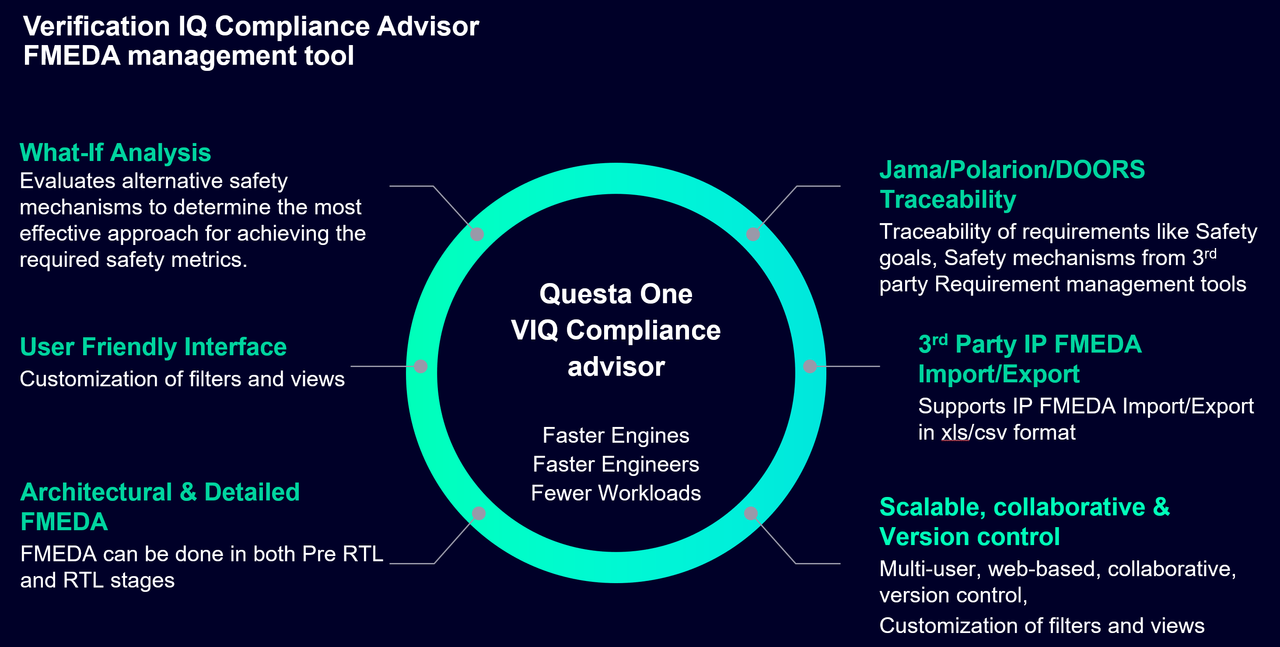
The following sections showcase a few of the tool’s features and how they help users achieve their goals.
Providing End-to-End Traceability Across the Functional Safety Lifecycle
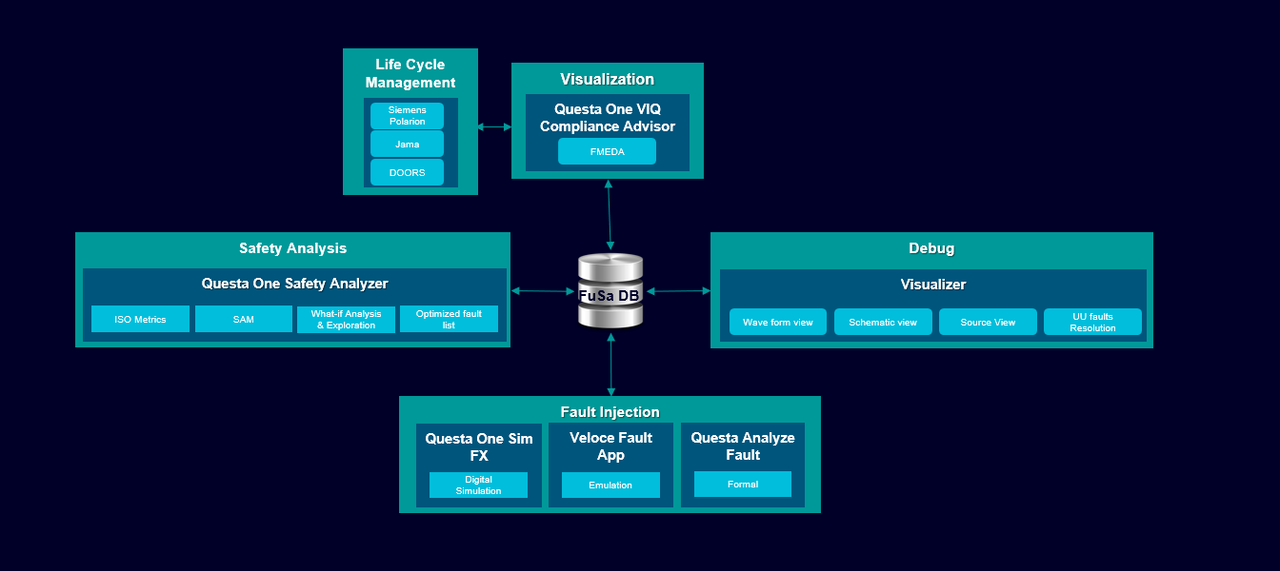
VIQ Compliance Advisor provides end-to-end traceability across the functional safety lifecycle, creating a seamless connection between requirements, FMEDA analyses, and downstream safety verification activities. Users can establish and maintain traceability from requirements managed in tools such as Jama, Polarion and DOORS directly into FMEDA records, ensuring comprehensive coverage and impact analysis. The traceability extends beyond FMEDA to Siemens structural safety analysis engines for accurate safety metric calculations, as well as fault simulation, emulation, and formal verification solutions used to execute fault campaigns and validate safety mechanisms. By linking these activities within a connected workflow, VIQ Compliance Advisor helps organizations maintain consistency, improve visibility, strengthen compliance evidence, and accelerate functional safety verification from requirements through implementation and validation.
To learn more, please download our full paper on this topic: Accelerated Assurance with Questa One Functional Safety
Modernizing FMEDA Without Disrupting Existing Workflows
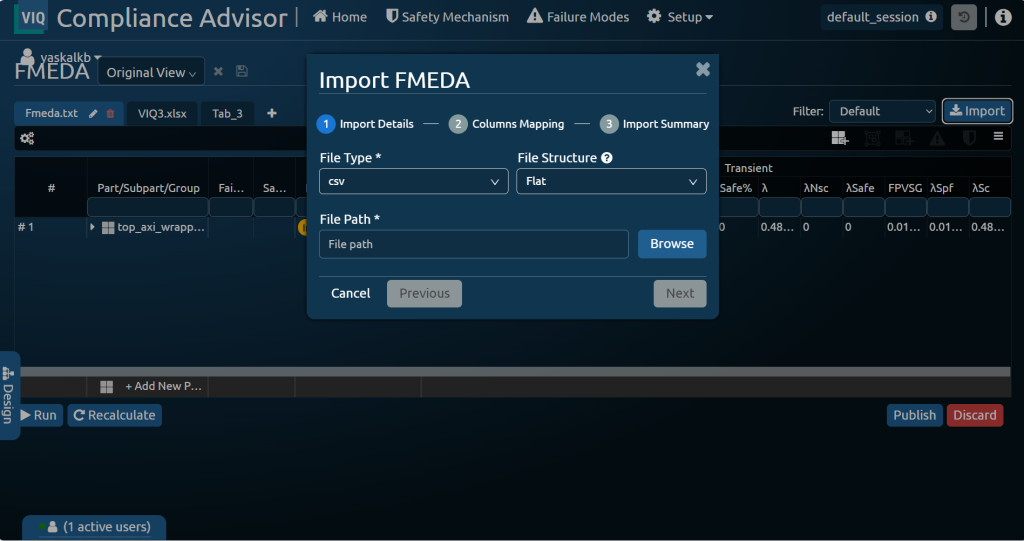
VIQ Compliance Advisor helps organizations modernize existing FMEDA workflows without forcing teams to abandon their historical spreadsheet-based processes. By supporting the import of FMEDA data from Excel and CSV files, the platform enables companies to leverage years of existing safety analysis investments while transitioning to a more scalable and connected digital engineering environment. This reduces migration risk, minimizes disruption to established workflows, and allows engineering teams to adopt modern FMEDA management practices at their own pace.
Instead of manually re-entering information, users can import supplier FMEDAs directly into the platform, automatically map FMEDA structures, consolidate multiple IP FMEDAs into a unified analysis, preserve valuable supplier information, and synchronize updates more efficiently. This significantly reduces the effort required to create SoC-level FMEDAs while minimizing manual data entry and associated errors.
VIQ Compliance Advisor provides built-in version management capabilities that allow organizations to maintain complete control over FMEDA evolution
With this feature users can track every FMEDA revision, review historical changes, Maintain complete audit trails. Version management enables organizations to maintain consistency and compliance throughout the product lifecycle.
VIQ Compliance Advisor also offers several powerful features, including FMEDA export in XLS/CSV formats, creation of Architectural (Pre-RTL) and Detailed (RTL) FMEDAs, What-If Analysis capabilities, data backup functionality & Fault simulation results view providing users with greater flexibility, efficiency, and control throughout the FMEDA lifecycle.
Driving Functional Safety Excellence with VIQ Compliance Advisor
VIQ Compliance Advisor, a TÜV SÜD-certified solution, simplifies FMEDA creation by replacing manual, error-prone processes with intelligent automation, seamless traceability, automated third-party IP FMEDA integration, and robust version management. It enables engineering teams to reduce effort, improve accuracy, maintain compliance, and focus on delivering safer products. With VIQ Compliance Advisor, FMEDA becomes a connected, scalable, and intelligent part of the functional safety lifecycle.
The journey doesn’t stop here. We’re building next-generation AI/ML capabilities to make FMEDA smarter, faster, and more insightful. Stay tuned for what’s next.
To learn more, please visit: