How Productive Machines and Siemens NX CAM Are Advancing CNC Machining Together
Siemens and Productive Machines bring physics-based AI into NX CAM to optimize feed rates and spindle speeds, helping reduce chatter and shop-floor trial and error.
Even the most carefully programmed toolpath can run into chatter, tool breakage or dimensional errors once it meets the realities of cutting forces, tool deflection and machine limits on the shop floor.
You program the operation. Run the machine. Check the part. Something is off. So you go back to CAM, change the cutting conditions, post-process the operation to generate a new NC program, and run another trial.
Then you do it again.
For precision machine shops, that cycle adds up fast. Every trial uses machine time, operator time, material and cutting tools. And while you’re adjusting the operation, the machine isn’t making production parts.
Optimizing cutting conditions in CAM first can reduce the adjustments needed on the machine.
Siemens and Productive Machines are addressing this with SenseNC. SenseNC uses physics-based AI to optimize cutting conditions inside NX CAM, so programmers can address potential cutting problems before the program reaches the machine. Here’s how it works, and what it has meant for one aerospace manufacturer.
SenseNC: Built into the NX CAM workflow
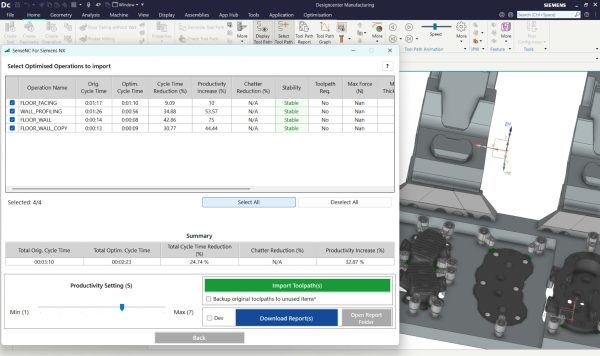
SenseNC adds optimization of feed rates and spindle speeds to the machining operations you create in Siemens CAM software.
It analyzes the operation and identifies where feed rate or spindle speed can be adjusted. The programmer can review the optimized operation in NX CAM, post-process it and send the NC program to the machine as usual.
“When talking to manufacturers, we heard that any new tool should live inside the Siemens NX CAM environment, not add another disconnected system.”
Dr Erdem Ozturk, Founder & CEO, Productive Machines
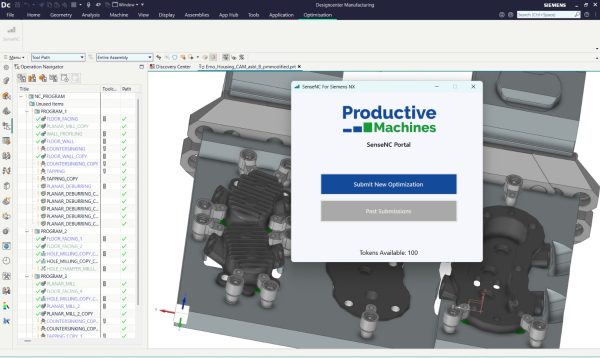
SenseNC addresses both needs.The difference is when those adjustments are made. Instead of finding out during a machine trial that a feed rate is too aggressive or an operation is prone to chatter, the programmer can address those issues while the operation is still in CAM.
Program in NX CAM → Optimize with SenseNC → Review → Post-process → Machine
SenseNC is easy to use and does not depend on a programmer’s individual skill level. It fits into the existing workflow rather than replacing it.
The machine still runs the operation as usual. More of the cutting-condition work is done before the first cut.
How SenseNC helps optimize cutting conditions
Not every part of a toolpath puts the same demands on the tool. The feed rate that works well in one section may be too slow or too aggressive in another. And when chatter becomes a problem, changing the feed rate may not be enough. Spindle speed matters too.
SenseNC addresses these two parts of the cutting process with SenseNC Feeds and SenseNC Finesse.
SenseNC Feeds: Adjusting feed rate along the toolpath
As the tool moves through the cut, the amount of material being removed and the cutting load can change. SenseNC Feeds responds to those changes by adjusting the feed rate along the toolpath.
It looks at cutting loads, tool stresses and the machine’s torque and power limits to determine where the feed rate can increase and where it needs to come down.
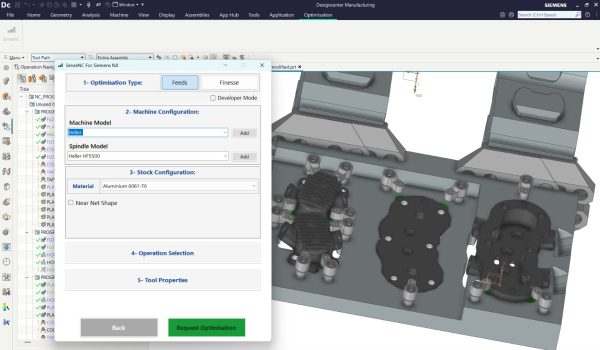
SenseNC Feeds
Adjusts the feed rate as cutting conditions change. Increases it where conditions allow and reduces it when cutting loads rise.
The operation does not have to run at one fixed feed rate from start to finish.
SenseNC Finesse: Finding stable spindle speeds
When chatter or vibration limits an operation, the spindle speed may need to change.
SenseNC Finesse uses the measured dynamic response of the tool and holder to identify spindle speeds that are less likely to produce chatter. A 40-second tap test measures that response before machining.
SenseNC Finesse
Uses a 40-second tap test to find more stable spindle speeds based on the tool and holder’s dynamic response.
SenseNC then considers spindle speed and feed rate together to help find cutting conditions that are both productive and more stable.
“Deploying SenseNC typically saves between $40,000 to $140,000 per machine tool per year by cutting cycle times by roughly 20% and reducing tooling costs by about 11%.”
Dr Erdem Ozturk, Founder & CEO, Productive Machines
1,000+ hours saved for a leading aerospace manufacturer
Aerospace manufacturing involves complex geometries, tight tolerances and demanding machining requirements. Optimizing cutting strategies is essential to achieve the required part quality while improving machining efficiency and process reliability.
For a leading aerospace manufacturer producing aircraft engine and structural parts, SenseNC was deployed on-premises within NX CAM to optimize machining operations and evaluate the results on real production parts.
The team used SenseNC to optimize machining operations for four parts. Two of those parts went into production, followed by the other two.
The first aluminum casting provided a clear example of the cycle-time impact.
LEADING AEROSPACE MANUFACTURER RESULTS
CUT 53 MINUTES FROM EVERY PART
4 hours 51 minutes → 3 hours 57 minutes
~19% reduction in cycle time
with SenseNC in NX CAM
For the two parts that went into production, the accumulated cycle-time savings resulted in more than 1,000 hours of machine capacity saved over six months.
The result came from improving the cutting conditions used to machine the parts, rather than adding new machine tools.
What the results mean on the shop floor
The value of optimizing cutting conditions goes beyond reducing the cycle time of one operation.
If fewer machine trials are needed to find workable conditions, more of that machine time can go toward making production parts.
That can mean:
- Reduce lead times by spending less time running iterations on the machine
- Lower machining costs by using more effective feed rates and spindle speeds
- Increase production capacity by getting more out of the available machine time
- Improve part quality by addressing cutting problems during CAM programming, before they reach the shop floor
With SenseNC in NX CAM, programmers can work through feed rate, spindle speed and cutting stability before using the machine to find out what works.
Put SenseNC to work in NX CAM
The power of NX CAM is already well-known in the industry, with its reputation solidified by the part manufacturing community on peer review sites like G2, which has rated NX CAM as the #1 computer-aided manufacturing software. The results at the leading aerospace manufacturer show what is possible when cutting conditions are optimized before the program reaches the machine.
If demand is pressing on your capacity, or chatter and trial machining are slowing you down, SenseNC can help you optimize feed rates and spindle speeds in NX CAM before you send the program to the machine.
SenseNC Feeds is available on the Siemens Xcelerator Marketplace for NX CAM users, with an interface designed for CAM programmers to use as part of their existing workflow.
Explore SenseNC Feeds on the Siemens Xcelerator Marketplace, or reach out to me, Dr. Erdem Ozturk on LinkedIn to discuss how SenseNC can fit into your machining workflow.
Learn more to explore how this exciting Siemens NX CAM integrated capability with SenseNC can help you improve the performance of your machining process and become more globally competitive.