Bridging the IT/OT gap for industrial AI: How Siemens and HighByte put industrial data to work

See how Siemens and HighByte connect factory-floor data with enterprise IT to help manufacturers scale governed industrial AI initiatives.
Key highlights
- Siemens and HighByte have established a technology partnership that pairs local data contextualization on Siemens Industrial Edge with governed AI execution in Siemens Intelligence Center X
- The industrial AI bottleneck has shifted from connectivity to context, requiring raw factory telemetry to be combined with structured business records before enterprise models and agents can use it
- Industrial DataOps solves IT/OT gap locally, harmonizing machine signals with maintenance and production data inside the plant network so only clean, modeled data reaches enterprise clouds
- Real-world implementations deliver measurable asset ROI, demonstrated by Vivix extending the operating life of a $120 million glass furnace by two years while scaling toward 50 production AI agents
To build AI models, agents and applications at scale within a governed environment, industrial organizations need industrial data. More specifically, they must bridge the age-old gap between IT data (like ERP transactions) and OT data (like real-time telemetry and historical time series data).
Today, that IT/OT divide is one of the biggest bottlenecks preventing industrial AI from moving from pilot to production.
The IT/OT gap: Moving from connectivity to context
The IT/OT gap persists because these systems and data sets are typically owned and used by separate teams who enjoy their own autonomy and don’t want to be overly dependent on each other.
IT data, such as production orders, goods movements and maintenance work orders, is structured and fairly easy for data scientists, AI engineers and application developers to understand. OT data, such as telemetry from PLCs and sensors, is raw and difficult to interpret.
Picture a stream of measurements taken from a machine without any indication of:
- The parameter or unit of measure
- What product it was running
- Which operational state it was in
This is typically what is missing from OT data and is the context needed to make it usable by IT personas and other business stakeholders.
For years, the industry treated this as a connectivity challenge, focused on accessing assets and navigating proprietary protocols. Today, connectivity has largely been solved, but context persists as a critical bottleneck.
Industrial DataOps: Solving context at the source
To make industrial data usable across an enterprise, organizations cannot rely on one-off custom code; it creates an environment susceptible to breakdowns when scaling across multiple lines and sites.
Solving the context problem requires a systematic approach:
- Contextualize at the source: Merging raw telemetry with transactional, historical and file data locally inside the plant network, and before the data leaves the factory floor.
- Move only what matters: Rather than dumping uncontextualized sensor floods into cloud storage, curate and stream meaningful, modeled data into enterprise repositories (like Snowflake on AWS).
- Power governed intelligence: Feed that clean, contextualized stream directly into the enterprise systems that build AI models, orchestrate autonomous agents and empower frontline operators and engineers.
Siemens and HighByte: A pre-integrated foundation
To turn that architecture into a practical reality, Siemens has partnered with HighByte. HighByte is a pioneer in Industrial DataOps, bridging the IT/OT divide and complementing Siemens’ data ecosystem.
- HighByte doesn’t store industrial data; it processes it through pipelines. Deployed directly on Siemens Industrial Edge, HighByte ingests data from both IT and OT sources, harmonizing it and using IT data to contextualize the OT data so it becomes immediately usable for downstream applications.
- Siemens Intelligence Center X provides the agentic enterprise layer. It takes the clean, contextualized data from HighByte and enterprise repositories, applying domain models, AI capabilities and low-code operational apps (via Mendix) to orchestrate and govern real-time industrial workflows.
Together, they eliminate months of custom integration code and upkeep so teams can focus directly on business outcomes.
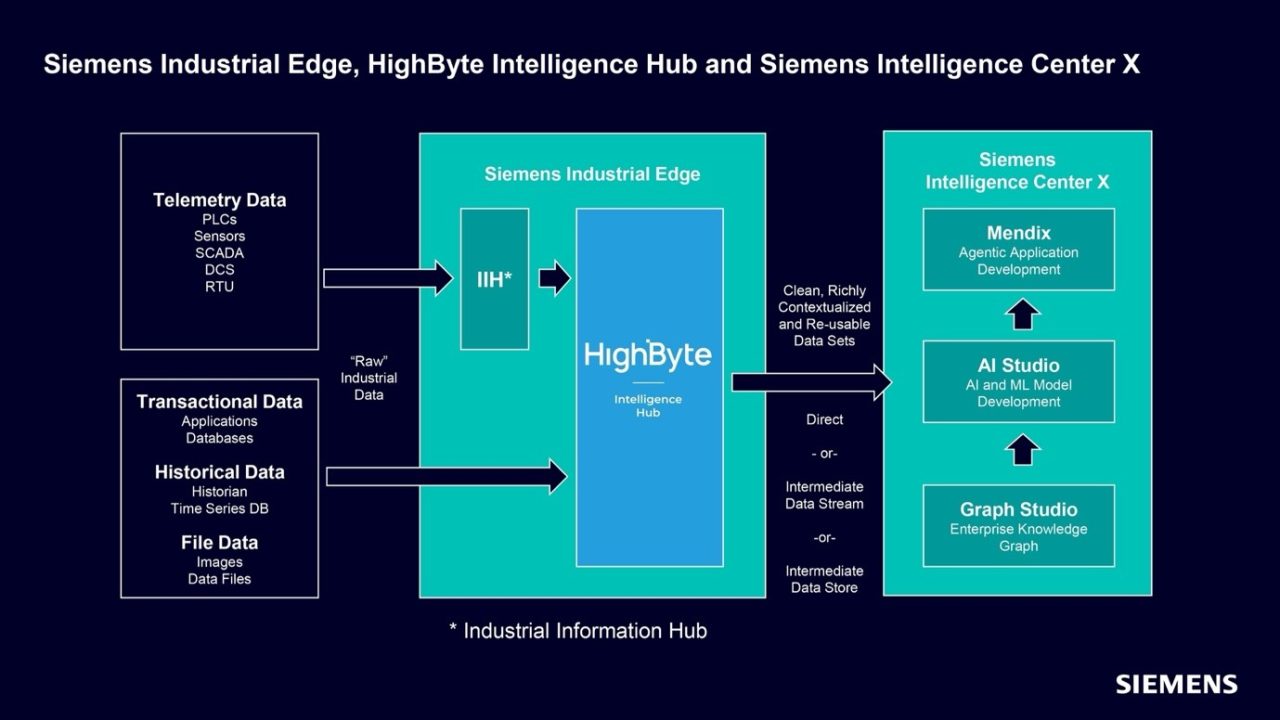
The Siemens-HighByte partnership includes the ability to deploy HighByte on Industrial Edge (also via the Industrial Edge Marketplace). In this scenario, Industrial Information Hub can be used to process and distribute telemetry data, whereas HighByte can contextualize it with the help of transactional, historical and file data.
Real-world proof: Extending a $120M asset at Vivix
This architecture is already delivering measurable results on the factory floor. Vivix Vidros Planos, one of the most modern producers of flat glass in South America, embarked on a journey to transform what was essentially an SAP- and Excel-based operation into an agentic enterprise.
Today, Vivix uses HighByte to harmonize and contextualize plant data and feed it into Snowflake on AWS, alongside Siemens Intelligence Center X. The impact has been unprecedented:
- Extended furnace lifetime: Vivix increased the operating life of their $120 million glass furnace at the heart of their operation from 18 years to 20 years. They accomplished this by combining Statistical Process Control (SPC) with predictive maintenance machine learning models, surfacing real-time insights to operators in a conversational interface.
- Scaling AI agents: Vivix has 10 operational AI agents running in production across manufacturing, quality and maintenance, with plans to expand to 50 by the end of the year.
Start pragmatically: Working backwards from value
Building a governed data and context foundation takes thought, but you don’t have to do it all at once. The most successful transformations start pragmatically by working backwards from a high-impact, real-world use case like the Vivix furnace.
Ready to turn your plant-floor data into agentic business value?
Contact our team to schedule an introductory discovery call. Let’s discuss your current data challenges and see how combining HighByte with Siemens Intelligence Center X creates the context layer needed for reliable industrial AI.
Frequently Asked Questions
For a single pilot, yes, but for a multi-plant enterprise, it creates technical debt.
Scripting a connection between one machine and one database is relatively simple. The challenge begins when you try to maintain, secure and update hundreds of custom scripts across different plants as firmware changes and engineers change roles. Industrial DataOps replaces fragile, point-to-point code with a standardized, visual data pipeline that IT and OT teams can govern centrally.
No, it works alongside them.
Tools like Siemens IIH and traditional IoT platforms excel at connecting to physical hardware and moving raw measurements around the plant floor. HighByte takes over where connectivity ends: it ingests those raw measurements and joins them with work orders from your ERP, maintenance logs and batch records. HighByte can take data directly from IIH, add that business context and send the modeled result downstream.
No, the entire architecture is built around open standards.
Siemens and HighByte actively design for vendor-neutral interoperability, including emerging frameworks like the Smart Manufacturing Institute’s (CESMII) Industrial Information Interoperability eXchange (i3X). HighByte uses open protocols to establish a Unified Namespace (UNS), meaning your plant data remains accessible to any third-party cloud, analytics platform or application.
