Logiicdev Joins Factory-One: Exploring Deterministic Edge AI for the Next Generation of Robotics
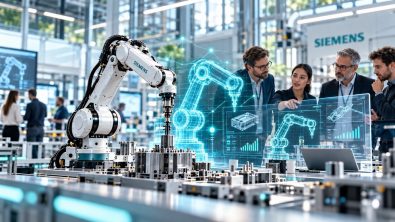
Factory-One brings another emerging technology into the mission – exploring whether deterministic, low-power AI compute can help robots perceive, decide and respond more effectively in the physical world.
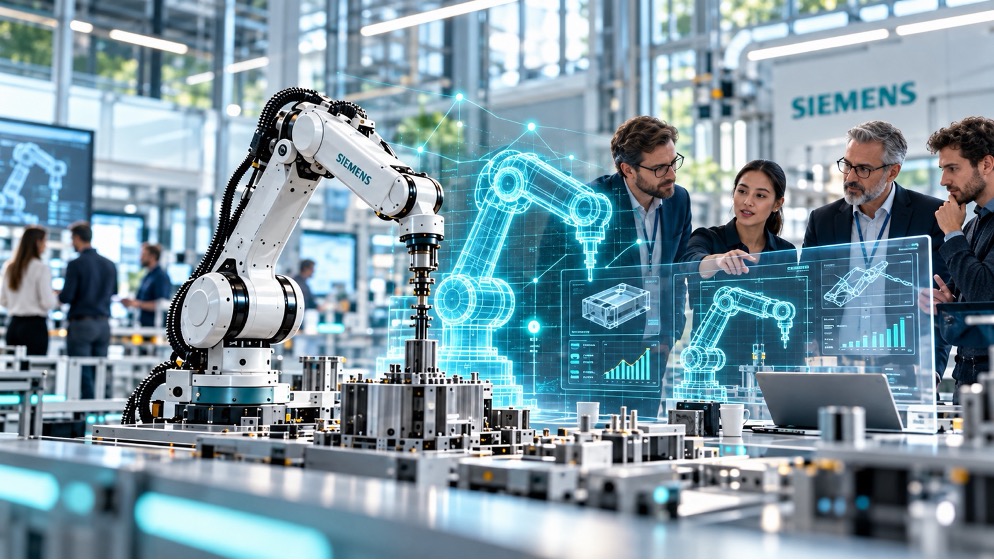
Robotics is moving quickly.
AI is giving machines increasingly sophisticated abilities to perceive their surroundings, understand what is happening and decide what to do next.
But moving AI from a data centre into a robot creates a very different engineering challenge.
A robot operating in a factory cannot simply be intelligent. It needs to respond quickly and predictably. It may need to combine information from cameras, LiDAR and other sensors while operating within tight power, thermal and safety constraints.
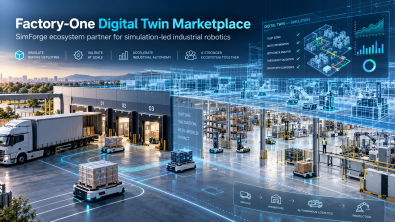
These are exactly the kinds of problems that Factory-One, our Siemens Cre8Ventures Mission-Led robotics campaign, is intended to explore.
And that is why we are pleased to welcome Logiicdev into the Factory-One ecosystem.
From promising technology to a real industrial mission
Factory-One starts with a simple idea:
Bring us a robot – but more importantly, bring us a problem.
Rather than asking robotics companies to understand which semiconductor, sensor, AI, photonics or quantum technology they might need, Cre8Ventures brings technology companies together around a specific customer challenge.
We can then ask a much more useful question:
Can this combination of technologies enable something that the robot cannot easily do today?
Logiicdev gives us another capability to explore against that question.
The company is developing Mantrum, a deterministic AI hardware accelerator designed for real-time multi-sensor fusion and Physical AI applications including robotics, industrial automation and autonomous systems.
Its proposition is particularly interesting for Factory-One because it targets two very practical constraints facing physical AI: processing latency and power and thermal load. Logiicdev proposes addressing these through deterministic execution and low-power multi-sensor fusion.
Why this matters for Factory-One
Imagine a robot working in a changing manufacturing environment.
It may need to see an object using a camera, understand its position using depth or LiDAR information, combine that with other sensor data and decide how to react.
All of this needs to happen quickly.
And unlike many cloud AI applications, the same inputs should produce predictable behaviour – particularly as we move towards industrial and potentially safety-critical applications.
This is where we believe Logiicdev presents an interesting technology hypothesis for Factory-One.
Could deterministic edge AI allow future robots to combine multiple sensors and make decisions locally, with lower latency, lower power consumption and greater predictability?
We don’t yet know the answer.
That is the point.
Factory-One is not about selecting technologies from presentations. It is about creating a structured environment in which emerging technologies can be tested against real industrial problems.
BUILD -> PROVE -> SCALE
The collaboration provides a potential path from technology exploration towards industrial validation.
Logiicdev proposes initially validating its Mantrum AI IP using FPGA platforms and real-world LiDAR, vision and multi-sensor datasets. Its longer-term proposition extends towards integration with motion-control and industrial communications technologies and potentially a dedicated system-on-chip.
Within Factory-One, however, the starting point is deliberately simpler.
Start with the mission.
Identify a robotics problem worth solving.
Build a representative digital implementation.
Measure whether the technology materially improves the things that matter – performance, latency, power, predictability, safety or cost.
And only then decide whether there is something worth scaling.
That is how we want the Cre8Ventures Mission-Led Platform to work.
A marketplace around the robot
Logiicdev is also an example of the broader idea behind Factory-One.
The next generation of robotics is unlikely to emerge from one technology company working alone.
It will require combinations of technologies across:
Semiconductors -> Sensors -> AI -> Connectivity -> Control -> Digital Twins -> Industrial Automation
Our role with Cre8Ventures is increasingly to bring those capabilities together around problems that customers actually want solved.
Siemens technologies can provide the engineering and digital environment in which those ideas can be built and evaluated.
Our growing Cre8Ventures Marketplace brings emerging capabilities into that environment.
And robotics companies and industrial customers provide something even more important:
the mission and the route to market.
Welcome to Factory-One
We are therefore delighted to welcome Logiicdev to the Factory-One campaign.
The next step is not to predict where its technology might eventually be used.
It is to find the right industrial robotics challenge, put the technology to work and generate the evidence.
Mission -> Build -> Prove -> Scale -> Sell.
That is collaborative venturing.
And that is what Factory-One is being built to do.